European
Southern
Observatory

The Messenger
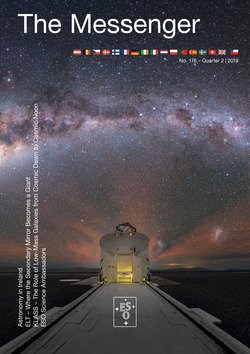
The Messenger is ESO’s journal for science and technology. It serves as a link between ESO and its broad astronomical community by providing information about scientific, technical, and other developments. It also delivers relevant news about astronomy and astrophysics to a broader public, including policy-makers, government officials, journalists, teachers, and amateur astronomers, as well as to interested scientists from other fields.

The Messenger is published twice per year and is available for free download as a PDF here and via the digital publishing platform Scribd.

Subscribe
If you wish to receive the new issue directly into your inbox, sign up here:
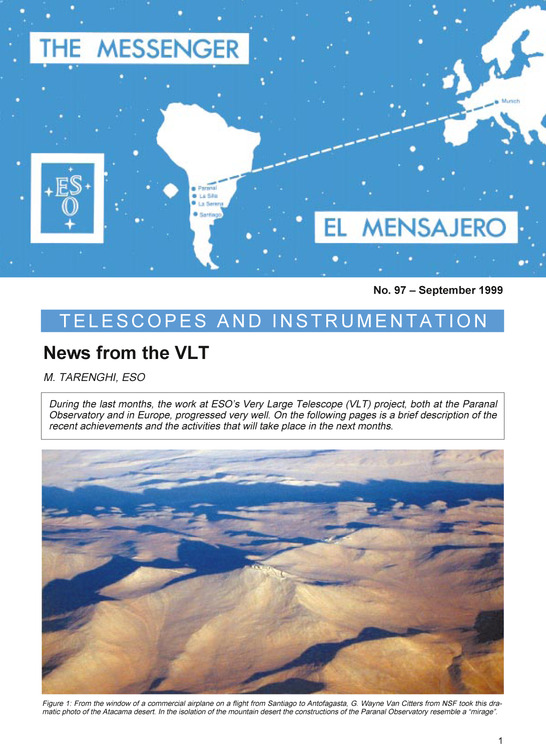
Issue 97
Messenger Issue 97

The Messenger Issue 97

Read the full PDF

Past Issues
Messenger Issue 195
2025Issue 195
Messenger Issue 194
2025Issue 194
Messenger Issue 193
2024Issue 193
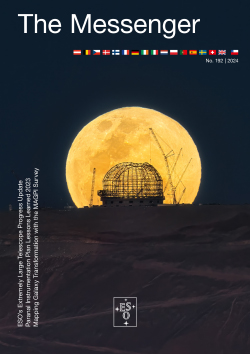
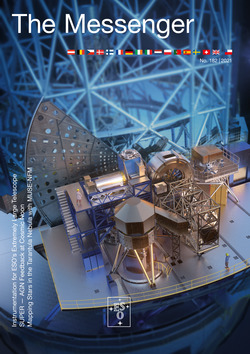
Messenger Issue 192
2024Issue 192
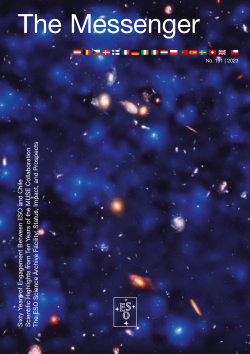
Messenger Issue 191
2023Issue 191
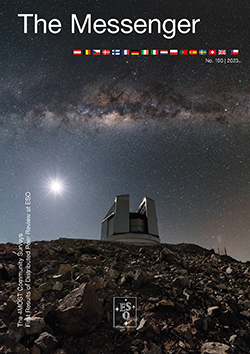
Messenger Issue 190
2023Issue 190
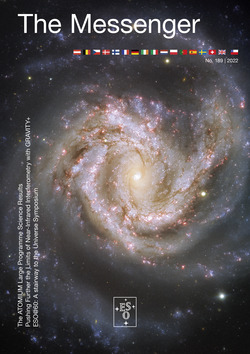
Messenger Issue 189
2022Issue 189
Messenger Issue 188
2022Issue 188
Messenger Issue 187
2022Issue 187
Messenger Issue 186
2022Issue 186
Messenger Issue 185
2021Issue 185
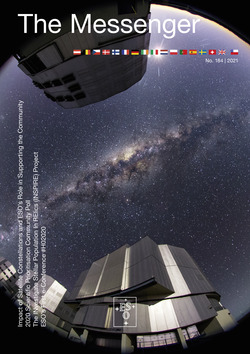
Messenger Issue 184
2021Issue 184
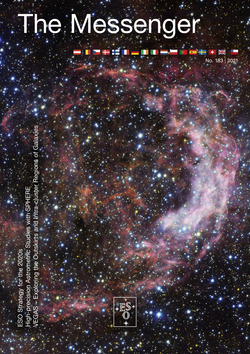
Messenger Issue 183
2021Issue 183
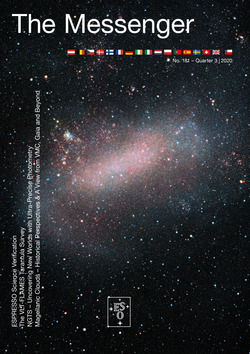
Messenger Issue 182
2021Issue 182
Messenger Issue 181
2020Issue 181
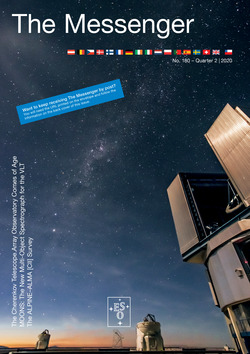
Messenger Issue 180
2020Issue 180
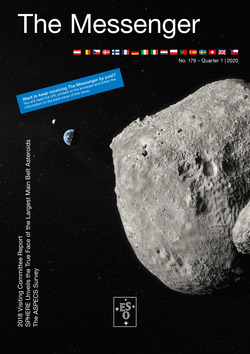
Messenger Issue 179
2020Issue 179
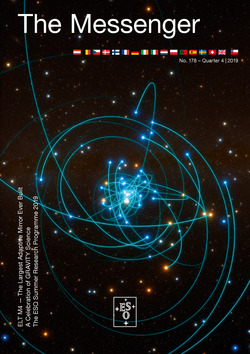
Messenger Issue 178
2019Issue 178
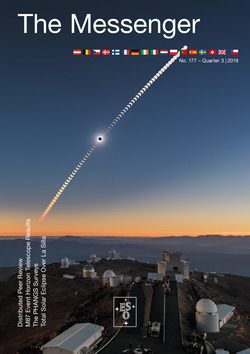
Messenger Issue 177
2019Issue 177
Messenger Issue 176
2019Issue 176
Table of Content No. 97 | 1999
Telescopes and Instrumentation
Tarenghi, M.
News from the VLT.
More...
ADS BibCode: 1999Msngr..97....1T
Authors:
Tarenghi, M.
Abstract:
During the last months, the work at ESO’s Very Large Telescope (VLT) project, both at the Paranal Observatory and in Europe, progressed very well. On the following pages is a brief description of the recent achievements and the activities that will take place in the next months.

Ettlinger, E., Giordano, P. et al.
Performance of the VLT mirror coating unit.
More...
ADS BibCode: 1999Msngr..97....4E
Authors:
Ettlinger, E.; Giordano, P.; Schneermann, M.
Abstract:
Three sputtered aluminium film on the 8-metre-class mirrors produced in the VLT Coating Unit is very uniform along the whole radius (standard deviation 4.16%). The reflectance in the ultraviolet, visible and infrared regions is near to that which ideally can be expected.

Sarazin, M., Navarrete, J.
Climate variability and ground-based astronomy: The VLT site flights against La Niña.
More...
ADS BibCode: 1999Msngr..97....8S
Authors:
Sarazin, M.; Navarrete, J.
Abstract:
Hopes were raised two years ago to be soon able to forecast observing conditions and thus efficiently adapt the scheduling of the observing blocks accordingly. In this brave new world, however, not everything is perfect: as if the task of building a detailed knowledge of the sites was not hard enough, climatic events such as the El Niño - La Niña Oscillation can turn decade long databases into poorly representative samples. A reanalysis of the long-term meteorological database pointed out an ever-in-creasing frequency of occurrence of bads seeing associated to a formerly quasi-inexistent NE wind direction.

Castillo F., C., Serrano G., L.
Analysis of the Anomalous Atmospheric Circulation in Northern Chile During 1998
More...
ADS BibCode: 1999Msngr..97...10C
Authors:
Castillo F., C.; Serrano G., L.

Ferrari, M., Derie, F.
Variable curvature mirrors
More...
ADS BibCode: 1999Msngr..97...11F
Authors:
Ferrari, M.; Derie, F.
Abstract:
Since the very beginning of the VLTI project, it has been foreseen that observations with this unique interferometer should not be limited to on-axis objects and the possibility to have a “wide” field of view (2 arcsec) was planned. It turned out that the “wide” field of view goal could not be achieved without a precise pupil management.

Derie, F., Brunetto, E. et al.
The VLTI test siderostats are ready for first light
More...
ADS BibCode: 1999Msngr..97...12D
Authors:
Derie, F.; Brunetto, E.; Ferrari, M.
Abstract:
To allow the technical commissioning of the VLT in its early phases, without the VLT Unit Telescopes or the Auxiliary Telescopes, two test siderostats have been developed to simulate the main functions and interfaces of these telescopes.

Christou, J. C., Bonnacini, D. et al.
Myopic deconvolution of Adaptive Optics Images
More...
ADS BibCode: 1999Msngr..97...14C
Authors:
Christou, J. C.; Bonnacini, D.; Ageorges, N.; Marchis, F.
Abstract:
Adaptive Optics produces diffractionlimited images, always leaving a residual uncorrected image and sometime PSF artifacts due, e.g., to the deformable mirror. Post-processing is in some cases necessary to complete the correction and fully restore the image. The results of applying a multi-frame iterative deconvolution algorithm to simulated and actual Adaptive Optics data are presented, showing examples of the application and demonstrating the usefulness of the technique in Adaptive Optics image post-processing. The advantage of the algorithm is that the frame-to-frame variability of the PSF is beneficial to its convergence, and the partial knowledge of the calibrated PSF during the observations is fully exploited for the convergence. The analysis considers the aspects of morphology, astrometry, photometry and the effect of noise in the images. Point sources and extended objects are considered.

ESO
Latest News: “First Light” for VLT High-Resolution Spectrograph UVES
More...
ADS BibCode: 1999Msngr..97...22.
Authors:
ESO
Abstract:
A major new astronomical instrument for the ESO Very Large Telescope at Paranal (Chile), the UVES high-resolution spectrograph, made its first observations of astronomical objects on September 27, 1999. The astronomers are delighted with the quality of the spectra obtained at this moment of “First Light”. Although much fine-tuning still has to be done, this early success promises well for new and exciting science projects with this large European research facility.

Lamy, H., Hutsemekers, D.
Erratum : A procedure for deriving accurate linear polarimetric measurements
More...
ADS BibCode: 1999Msngr..97...23L
Authors:
Lamy, H.; Hutsemekers, D.
Abstract:
Erratum

Sterzik, M., Weilenmann, U.
3.6-m Telescope Control System Upgrade Completed
More...
ADS BibCode: 1999Msngr..97...25S
Authors:
Sterzik, M.; Weilenmann, U.
Abstract:
New highlights can be reported from the 3.6-m upgrade project: the full VLTcompliant Telescope Control System (TCS) has been finally tested and commissioned during recent technical-time periods. On August 9th it has been successfully put into routine operation. Let us briefly recall the milestones passed. The "heart" of the telescope, the servo control system for the axis, was completely modified. The telescope control is now based on so-called “Local Control Units” (LCUs), an identical hardware platform to that used at the VLT. It substitutes the over 20 years old TCS running on HP1000 computers. In contrast to the VLT and NTT, the 3.6-m is an equatorial mounted telescope, and the entire control SW had to be modified and adapted for controlling the alpha and delta axis. With the broad usage of standardised architectures and software concepts at the 3.6-m, which were originally designed and developed for the VLT, we intend to gain operational stability, quality, and maintainability. However, it also requires to replace proven components like the old, incremental encoders with optical strip encoders which are required to read the telescope position. The new encoders are supposed to deliver a five times higher resolution, but once we tested the performance of them in practice, we encountered an unexpected problem: in extreme telescope positions, implying several tens of tons of weight on the axis, the tight tolerances (±100 mm) required for reliable readings of the position were exceeded, thus loosing control over the telescope. Through careful adjustment of the heads we were able to restrict the “dead zone” to a very small region in the Northwest. In September, a dynamical mount for the reading heads will be installed, which is expected to completely solve this problem.

The La Silla News Page
Hainaut, O.
News from the NTT: O. Hainaut and the NTT Team
More...
ADS BibCode: 1999Msngr..97...24H
Authors:
Hainaut, O.
Abstract:
The editors of the La Silla News Page would like to welcome readers of the fourteenth edition of a page devoted to reporting on technical updates and observational achievements at La Silla. We would like this page to inform the astronomical community of changes made to telescopes, instruments, operations, and of instrumental performances that cannot be reported conveniently elsewhere. Contributions and inquiries to this page from the community are most welcome.

Reports from Observers
Courbin, F., Magain, P. et al.
Deconvolving spectra of lensing galaxies, QSO hosts, and more ...
More...
ADS BibCode: 1999Msngr..97...26C
Authors:
Courbin, F.; Magain, P.; Sohy, S.; Lidman, C.; Meylan, G.
Abstract:
High spatial resolution undoubtedly plays a key role in most major advances in observational astrophysics. In this context, considerable effort has been devoted to the development of numerical methods aimed at improving the spatial resolution of astronomical images. However, the most commonly used techniques (e.g., Richardson 1972, Lucy 1974, Skilling & Bryan 1984) tend to produce the so-called “deconvolution artefacts” (oscillations in the vicinity of high spatial frequency structures) which alter the photometric and astrometric properties of the original data. Recently, Magain, Courbin & Sohy (1998ab; hereafter MCS) proposed and implemented a new deconvolution algorithm which overcomes such drawbacks. Its success is mainly the consequence of a deliberate choice to achieve an improved resolution rather than an infinite one, hence avoiding retrieving spatial frequencies forbidden by the sampling theorem.

Leisy, P., Francois, P. et al.
Emission-line-object survey in the LMC with the WFI: new faint planetary nebulae
More...
ADS BibCode: 1999Msngr..97...29L
Authors:
Leisy, P.; Francois, P.; Fouqué, P.
Abstract:
The authors' goal is a large survey (10 square degrees in total) of two regions in the SMC and the LMC, to identify new fainter emission-line objects (as PNe, H II regions, Be stars, symbiotic stars, young stars, etc.). They concentrate their efforts mostly on PNe and H II regions. The new candidates allow to derive accurately the full PNe luminosity function in the Magellanic Clouds (MCs), which is still poorly known for faint objects.

Announcements
ESO
Personnel Movements
More...
ADS BibCode: 1999Msngr..97...31.
Authors:
ESO

ESO
List of Scientific Preprints
More...
ADS BibCode: 1999Msngr..97R..32.
Authors:
ESO

Our use of Cookies

We use cookies that are essential for accessing our websites and using our services. We also use cookies to analyse, measure and improve our websites’ performance, to enable content sharing via social media and to display media content hosted on third-party platforms.

You can manage your cookie preferences and find out more by visiting 'Cookie Settings and Policy'.

ESO Cookies Policy


The European Organisation for Astronomical Research in the Southern Hemisphere (ESO) is the pre-eminent intergovernmental science and technology organisation in astronomy. It carries out an ambitious programme focused on the design, construction and operation of powerful ground-based observing facilities for astronomy.

This Cookies Policy is intended to provide clarity by outlining the cookies used on the ESO public websites, their functions, the options you have for controlling them, and the ways you can contact us for additional details.

What are cookies?

Cookies are small pieces of data stored on your device by websites you visit. They serve various purposes, such as remembering login credentials and preferences and enhance your browsing experience.

Categories of cookies we use

Essential cookies (always active): These cookies are strictly necessary for the proper functioning of our website. Without these cookies, the website cannot operate correctly, and certain services, such as logging in or accessing secure areas, may not be available; because they are essential for the website’s operation, they cannot be disabled.

Cookie ID/Name
Description/Purpose
Provider (1st party or 3rd party)
Browser session cookie or Stored cookie?
Duration
csrftoken
XSRF protection token. We use this cookie to protect against cross-site request forgery attacks.
1st party
Stored
1 year
user_privacy
Your privacy choices. We use this cookie to save your privacy preferences.
1st party
Stored
6 months
_grecaptcha
We use reCAPTCHA to protect our forms against spam and abuse. reCAPTCHA sets a necessary cookie when executed for the purpose of providing its risk analysis. We use www.recaptcha.net instead of www.google.com in order to avoid unnecessary cookies from Google.
3rd party
Stored
6 months

Analytics cookies: These cookies collect information about how visitors interact with our website, such as which pages are visited most often and how users navigate the site. This data helps us improve website performance, optimize content, and enhance the user experience; these cookies are only placed if you provide your consent. We use the following analytics cookies.

Matomo Cookies:

This website uses Matomo (formerly Piwik), an open source software which enables the statistical analysis of website visits. Matomo uses cookies (text files) which are saved on your computer and which allow us to analyze how you use our website. The website user information generated by the cookies will only be saved on the servers of our IT Department. We use this information to analyze www.eso.org visits and to prepare reports on website activities. These data will not be disclosed to third parties.

On behalf of ESO, Matomo will use this information for the purpose of evaluating your use of the website, compiling reports on website activity and providing other services relating to website activity and internet usage.

ON | OFF

Matomo cookies settings:

Cookie ID/Name
Description/Purpose
Provider (1st party or 3rd party)
Browser session cookie or Stored cookie?
Duration
Settings
_pk_id
Stores a unique visitor ID.
1st party
Stored
13 months
_pk_ses
Session cookie temporarily stores data for the visit.
1st party
Stored
30 minutes
_pk_ref
Stores attribution information (the referrer that brought the visitor to the website).
1st party
Stored
6 months
_pk_testcookie
Temporary cookie to check if a visitor’s browser supports cookies (set in Internet Explorer only).
1st party
Stored
Temporary cookie that expires almost immediately after being set.

Additional Third-party cookies on ESO websites: some of our pages display content from external providers, e.g. YouTube.

Such third-party services are outside of ESO control and may, at any time, change their terms of service, use of cookies, etc.

YouTube: Some videos on the ESO website are embedded from ESO’s official YouTube channel. We have enabled YouTube’s privacy-enhanced mode, meaning that no cookies are set unless the user actively clicks on the video to play it. Additionally, in this mode, YouTube does not store any personally identifiable cookie data for embedded video playbacks. For more details, please refer to YouTube’s embedding videos information page.

Cookies can also be classified based on the following elements.

Regarding the domain, there are:

As for their duration, cookies can be:

How to manage cookies

Cookie settings: You can modify your cookie choices for the ESO webpages at any time by clicking on the link Cookie settings at the bottom of any page.

In your browser: If you wish to delete cookies or instruct your browser to delete or block cookies by default, please visit the help pages of your browser:

Please be aware that if you delete or decline cookies, certain functionalities of our website may be not be available and your browsing experience may be affected.

You can set most browsers to prevent any cookies being placed on your device, but you may then have to manually adjust some preferences every time you visit a site/page. And some services and functionalities may not work properly at all (e.g. profile logging-in, shop check out).

Updates to the ESO Cookies Policy

The ESO Cookies Policy may be subject to future updates, which will be made available on this page.

Additional information

For any queries related to cookies, please contact: pdprATesoDOTorg.

As ESO public webpages are managed by our Department of Communication, your questions will be dealt with the support of the said Department.