European
Southern
Observatory

The Messenger
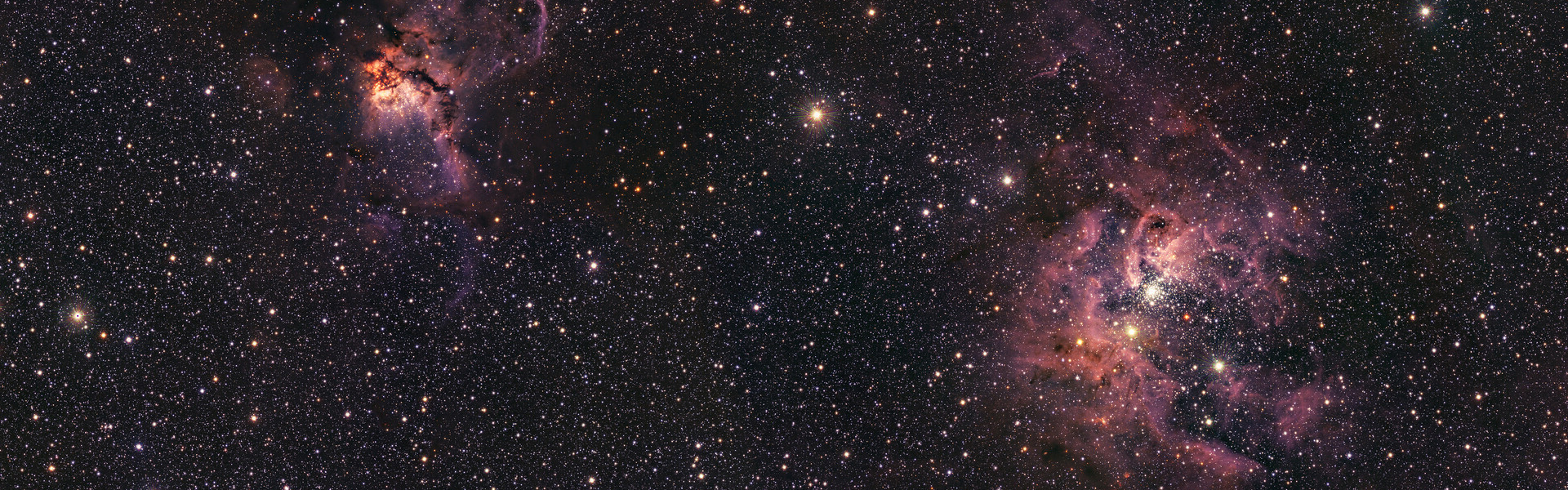
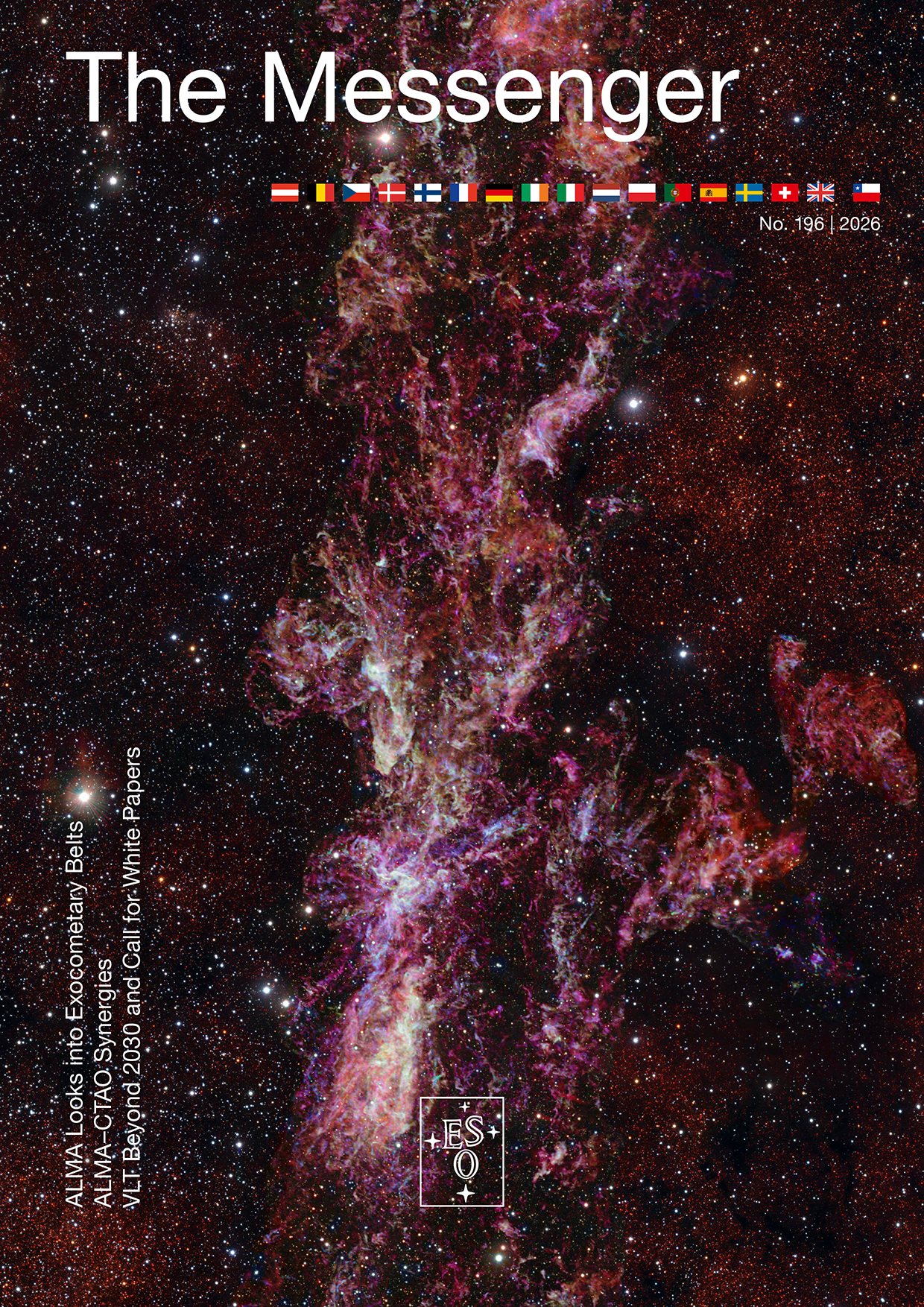
The Messenger is ESO’s journal for science and technology. It serves as a link between ESO and its broad astronomical community by providing information about scientific, technical, and other developments. It also delivers relevant news about astronomy and astrophysics to a broader public, including policy-makers, government officials, journalists, teachers, and amateur astronomers, as well as to interested scientists from other fields.

The Messenger is published twice per year and is available for free download as a PDF here and via the digital publishing platform Scribd.
Subscribe
If you wish to receive the new issue directly into your inbox, sign up here:
Latest Issue
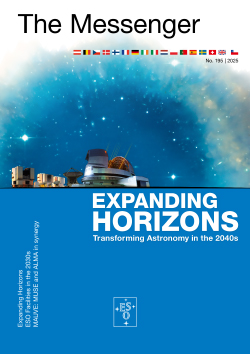
Messenger Issue 195

The Messenger Issue 195

Highlights include:

  • Brinchmann, J., Barcons, X. et al.: Expanding Horizons: Transforming Astronomy in the 2040s
  • Brinchmann, J., Leibundgut, B. et al.: ESO Facilities in the 2030s
  • Catinella, B., Cortese, L. et al.: Multiphase Astrophysics to Unveil the Virgo Environment (MAUVE)

Read the full PDF

Past Issues
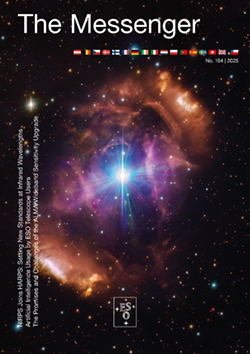
Messenger Issue 194
2025Issue 194
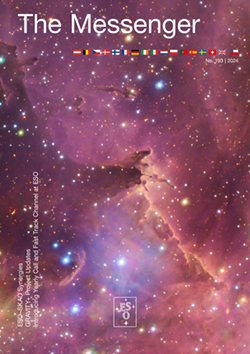
Messenger Issue 193
2024Issue 193
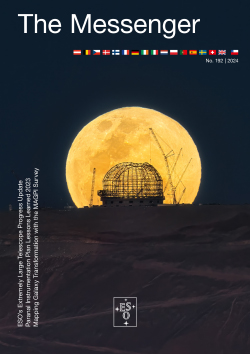
Messenger Issue 192
2024Issue 192
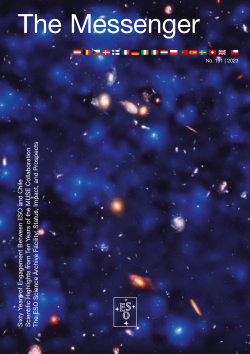
Messenger Issue 191
2023Issue 191
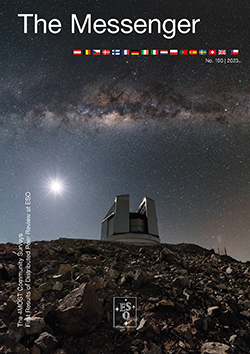
Messenger Issue 190
2023Issue 190
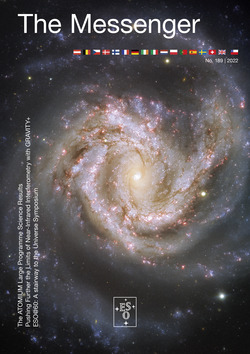
Messenger Issue 189
2022Issue 189
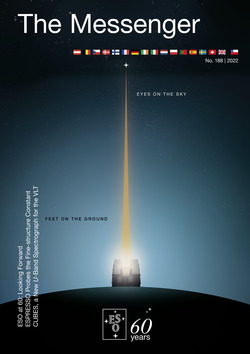
Messenger Issue 188
2022Issue 188
Messenger Issue 187
2022Issue 187
Messenger Issue 186
2022Issue 186
Messenger Issue 185
2021Issue 185
Messenger Issue 184
2021Issue 184
Messenger Issue 183
2021Issue 183
Messenger Issue 182
2021Issue 182
Messenger Issue 181
2020Issue 181
Messenger Issue 180
2020Issue 180
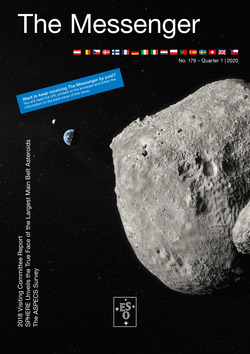
Messenger Issue 179
2020Issue 179
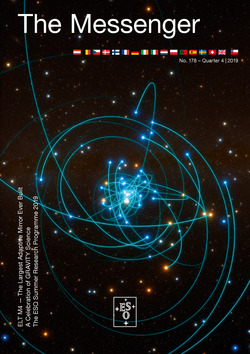
Messenger Issue 178
2019Issue 178
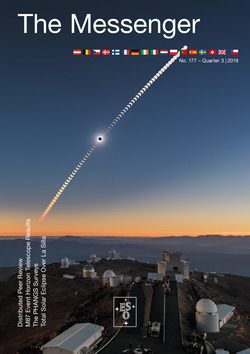
Messenger Issue 177
2019Issue 177
Messenger Issue 176
2019Issue 176
Table of Content No. 195 | 2025
The Organisation
Brinchmann, J., Barcons, X. et al.
Expanding Horizons: Transforming Astronomy in the 2040s
More...
ADS BibCode: 2025Msngr.195....5B
Authors:
Brinchmann, J., Barcons, X., Lyubenova, M., Leibundgut, B., Callanan, P., Krauss, S.
Abstract:
The Expanding Horizons process will help ESO define its next major undertaking after the Extremely Large Telescope. It is an open and inclusive process, in which the whole ESO community is invited to participate. The goal of Expanding Horizons is to trigger dialogue about the key scientific challenges that will face astronomy, and disruptive technologies required to address them, in the 2040s. This process is divided into four stages: (a) searching for transformational scientific questions, (b) the call for concepts for facilities to address these questions, (c) the assessment of the submitted proposals, and (d) a final decision by the ESO Council. Programmatic work will only start after this decision has been adopted, including study and early design phases and resourcing of the newly created Programme. The design, construction and operation of the new facility, or of the significantly upgraded existing facility, will be owned by ESO, either alone or in partnership with other organisations.

Brinchmann, J., Leibundgut, B. et al.
ESO Facilities in the 2030s
More...
ADS BibCode: 2025Msngr.195....7B
Authors:
Brinchmann, J., Leibundgut, B., Andreani, P., Díaz Trigo, M., Mérand, A., Péroux, C., Vernet, J.
Abstract:
An overview of the ESO facilities that will be offered at the beginning of the next decade is presented. We describe the existing and expected capabilities and put them into context with other facilities either under construction or in development for the next decade.

Astronomical Science
Catinella, B., Cortese, L. et al.
Multiphase Astrophysics to Unveil the Virgo Environment (MAUVE)
More...
ADS BibCode: 2025Msngr.195...15C
Authors:
Catinella, B., Cortese, L., Sun, J., Brown, T., Emsellem, E., Fraser-McKelvie, A., Watts, A., Attwater, A., Battisti, A., Boselli, A., Choi, W., Chung, A., da Cunha, E., Davis, T., Ellison, S., Jáchym, P., Jimenez-Donaire, M., Kolcu, T., Lee, B., McGregor, J., Roberts, I., Schinnerer, E., Spekkens, K., Thater, S., Thilker, D., van de Sande, J., Villanueva, V., Williams, T., Zabel, N.
Abstract:
The Multiphase Astrophysics to Unveil the Virgo Environment (MAUVE) project is a multi-facility programme exploring how dense environments transform galaxies. Combining a VLT/MUSE P110 Large Programme and ALMA observations of 40 late- type Virgo Cluster galaxies, MAUVE resolves star formation, kinematics, and chemical enrichment within their molecular gas discs. A key goal is to track the evolution of cold gas that survives in the inner regions of satellites after entering the cluster, and how it evolves across different infall stages. With its high spatial resolution — probing down to the physical scales of giant molecular cloud complexes — and multiphase synergy, MAUVE aims to offer a time-resolved view of environmental quenching and set a new benchmark for cluster galaxy studies.

Spavone, M., Buttitta, C. et al.
Arp@VST: Legacy Survey of the Arp Peculiar Galaxies with the VST
More...
ADS BibCode: 2025Msngr.195...19S
Authors:
Spavone, M., Buttitta, C., Calvi, R., Loni, A., and the VST Team
Abstract:
Arp@VST is a public observing programme, conducted at the VLT Survey Telescope (VST) hosted at ESO’s Paranal Observatory. It aims to revisit the Arp catalogue by creating a public survey. The Atlas of Peculiar Galaxies was produced by Halton Arp in 1966 and contains 338 galaxies with distorted morphologies and/or interacting systems. Given the excellent capabilities of the VST to map the galaxies’ structure down to low surface brightness levels, for this project we will acquire deep, multi-band (g, r, i, Hα) images for all the Arp galaxies visible from Paranal Observatory (Declination < +10 deg). Being a public survey, the reduced data will be released via the ESO Science Archive as soon as they are processed.

Berg, T., D’Odorico, V. et al.
From the Intergalactic to the Interstellar Scales – EQUALS: a High-resolution Legacy Survey of Gas in the Distant Universe Using ESPRESSO
More...
ADS BibCode: 2025Msngr.195...23B
Authors:
Berg, T., D’Odorico, V., Boera, E., Calderone, G., Cuellar, R., Cupani, G., Cristiani, S., Di Stefano, S., Grazian, A., Guarneri, F., Iršič, V., Lopez, S., Milaković, D., Noterdaeme, P., Pasquini, L., Viel, M., Welsh, L.
Abstract:
Understanding how the Universe evolved from diffuse primordial gas into the rich cosmic web we observe today is one of the great challenges of modern astrophysics. Quasar absorption lines — the imprints left by intervening gas on the light from distant quasars — provide key diagnostics of many aspects of this investigation, ranging from fundamental physics to cosmology and galaxy formation. The unprecedented combination of extremely precise wavelength calibration, high spectral resolution and high sensitivity of the Echelle SPectrograph for Rocky Exoplanet and Stable Spectroscopic Observations (ESPRESSO) has finally enabled observations that will further constrain both state-of-the-art cosmological simulations of galaxy evolution and theoretical stellar nucleosynthetic yields. In this article, we present the ESPRESSO Quasar Absorption Line Survey (EQUALS), an ESO Large Programme, designed to tackle several outstanding questions from constraining the properties of dark matter at the smallest scales probed by the Lyman-alpha forest to determining the temperature of the intergalactic medium at z ~ 4 and precisely quantifying the chemical contributions of stellar populations in the early Universe. EQUALS will provide a legacy sample of deep spectra to showcase ESPRESSO capabilities to the quasar absorption line community whilst providing epoch measurements for the key science goals of upcoming spectroscopic instrumentation on the next generations of telescopes.

Astronomical News
Stoehr, F., Farago, A. et al.
Morphological Image Similarity Search on the ALMA Science Archive Query Interface Using Deep Unsupervised Contrastive Representation Learning
More...
ADS BibCode: 2025Msngr.195...29S
Authors:
Stoehr, F., Farago, A., Curiban, S., Manning, A., Garcia, J., Hsieh, P., Lipnicky, A., Plunkett, A.
Abstract:
With the exponential growth of astronomical data over time, finding the needles in the haystack is becoming increasingly difficult. The next frontier for science archives is to enable searches not only on observational metadata, but also on the content of the observations themselves. As a step in this direction, we have implemented morphological image similarity search into the ALMA Science Archive (ASA). To achieve this we use self-supervised contrastive affine- transformation-independent representation learning of source morphologies with a deep neural network. For a given image on the ASA web interface, astronomers are presented with a summary view of the morphologically most similar images. Each time an astronomer selects an additional image from that view, the display is instantly updated to show the images most similar to the combination of the selected images. Each selection thus refines the similarity display according to the scientific needs of the astronomer. This is the first time image similarity search has been offered in an astronomical science archive.

Rodler, F., Rojas Lilayú, A. et al.
Report on the ESO workshop "La Silla Observing School 2025"
More...
ADS BibCode: 2025Msngr.195...32R
Authors:
Rodler, F., Rojas Lilayú, A., Jímenez Gallardo, A., Marsset, M., Petr-Gotzens, M., De Rosa, R.
Abstract:
During the two weeks between 10 and 21 February 2025, the Office for Science at ESO in Vitacura and the La Silla Observatory were the hosts of the fifth La Silla Observing School. A group of 20 students consisting of mostly PhD but also some advanced MSc students from different parts of the world were guided by five tutors. The students prepared and carried out sophisticated observations at the La Silla Observatory, reduced and analysed the data, and finally presented their results to the scientific community at ESO Vitacura. In addition to learning about the observing techniques and instruments that were used during the school, the students also attended several talks focusing on soft skills, what makes a good scientific presentation, and career choices. Given the high demand from the astronomical community for such educational programmes, ESO now offers the La Silla Observing School on a yearly basis, so the next school is foreseen for February 2026.

Rain, M.
Report on the ESO workshop "Astronomy for All: Advancing Diversity, Equity and Inclusion within the Chilean Astronomical Community"
More...
ADS BibCode: 2025Msngr.195...36R
Authors:
Rain, M.
Abstract:
The Astronomy for All mini-workshop was organised in hybrid mode with the aim of promoting three of ESO’s most important core values — equity, diversity, and inclusion (EDI) — not only within the Chilean Institutions, but also within different observing facilities based in Chile. The meeting was organised as a joint effort by ESO, the Atacama Large Millimeter/submillimeter Array (ALMA), the Chilean Astronomical Society (SOCHIAS) and the U.S. National Radio Astronomy Observatory/Associated Universities Inc.

De Simone, M., de la Villarmois, E. et al.
Report on the ESO workshop "Towards New Frontiers: the Astrochemical Journey from Young Stellar Nurseries to Exoplanets"
More...
ADS BibCode: 2025Msngr.195...38S
Authors:
De Simone, M., de la Villarmois, E., Bianchi, E., Nazari, P., Redaelli, E.
Abstract:
Understanding the chemical composition of young prestellar and protostellar systems is key to unveiling the origin of planetary systems. In recent years, high-sensitivity observations at different wavelengths have revealed unexpected molecular complexity in cold cores, discs, and forming planetary systems. This workshop brought together about 90 researchers working on interstellar chemistry, protostellar evolution, disc chemistry and exoplanetary atmospheres to discuss the chemical evolution from clouds to planets. Key goals included identifying robust molecular tracers, understanding chemical inheritance, and bridging observations with laboratory and theoretical work. Particular focus was given to the synergy between the planet formation communities and those studying planetary atmospheres, highlighting the need for a shared language and cross-disciplinary collaboration. The programme featured invited reviews, contributed talks and poster sessions, along with breakout discussions and open question sessions that encouraged interactive and inclusive exchanges. These discussions emphasised the importance of combining chemical models with advanced observations from current and future facilities such as the Atacama Large Millimeter/submillimeter Array (ALMA), the ALMA Wideband Sensitivity Upgrade, the James Webb Space Telescope (JWST), the Square Kilometre Array Observatory, the Next Generation Very Large Array, and ESO’s Extremely Large Telescope. The workshop successfully set the stage for future collaborations, paving the way toward a unified understanding of the chemical processes that shape planetary systems.

Campbell-White, J., Manara, C.
Report on the ESO workshop "The Role of Accretion and Ejection Variability in the Evolution of Young Stars and their Disks (RAVEYSO)"
More...
ADS BibCode: 2025Msngr.195...41C
Authors:
Campbell-White, J., Manara, C.
Abstract:
The workshop The Role of Accretion and Ejection Variability in the Evolution of Young Stars and their Disks (RAVEYSO) was held at the ESO headquarters in Garching, Germany, from 19 to 22 May 2025. This international event brought together experts in the field of young stellar objects to discuss the latest advances in understanding the variability of the accretion and ejection processes and their implications for protoplanetary discs, and thus for star and planet formation.

López, S., Tejos, N. et al.
Report on the ESO workshop "Resolving the Circumgalactic Medium and its Impact on Galaxy Evolution"
More...
ADS BibCode: 2025Msngr.195...43L
Authors:
López, S., Tejos, N., Ledoux, C.
Abstract:
The diffuse, multiphase gas surrounding galaxies, known as the circumgalactic medium (CGM), has emerged as a key player in regulating gas accretion, star formation and feedback processes. Recent advances in observational techniques, including absorption-line studies and high-resolution emission mapping using deep integral field spectroscopy, have enabled the CGM to be probed with unprecedented detail across cosmic time. The first international conference in Chile dedicated to the CGM was held in the scenic rural town of Santa Cruz, in the Colchagua Valley. Hosted under the clear southern skies and surrounded by vineyards, the workshop brought together around 80 researchers from 12 countries, uniting observers and theorists to explore the rapidly advancing understanding of the CGM and its pivotal role in galaxy evolution.

Csörnyei, G., Schöller, M. et al.
Report on the ESO workshop "SOXS Day"
More...
ADS BibCode: 2025Msngr.195...46C
Authors:
Csörnyei, G., Schöller, M., Peroux, C.
Abstract:
A workshop was held at ESO Headquarters in Garching to introduce the newly installed and currently commissioned Son Of X-Shooter (SOXS) spectrograph. SOXS will be a new instrument on ESO's New Technology Telescope dedicated primarily to transient astrophysics, with the aim of spectroscopically following up on the events discovered by current and new all-sky surveys. The main objectives of the workshop were to present the instrument to the community, showcase its operational model, observational sequence, and guaranteed-time observation (GTO) areas. In addition to highlighting SOXS’s technical capabilities and scientific prospects, the workshop also addressed operational policies in preparation for when SOXS will be offered to the community.

Saviane, I., Infante, L. et al.
The first La Silla – Las Campanas day
More...
ADS BibCode: 2025Msngr.195...48S
Authors:
Saviane, I., Infante, L., Di Mille, F.
Abstract:
In the third week of June 2025 the first joint workshop between the La Silla and Las Campanas observatories was organised. Staff working in all principal areas took part, and over the two days we reviewed our shared mission alongside key differences in funding, operational models and data management. Presentations were offered by key people covering various aspects of operations, infrastructure and development plans, including upcoming instruments. The workshop aimed to foster collaboration and identify challenges for long-term sustainability, with specific areas of common interest such as safety, communications and light pollution.

Brinchmann, J.
Report on the European Astronomical Society Symposium "European Astronomy: Science Vision beyond 2040"
More...
ADS BibCode: 2025Msngr.195...51B
Authors:
Brinchmann, J.
Abstract:
ESO is currently undertaking the Expanding Horizons process to identify the next ESO Programme, and key to this is to understand what science questions will be important for the astronomical community in the 2040s. To stimulate the community to think about these issues, a symposium was organised at the European Astronomical Society’s (EAS) Annual Meeting in Cork, Ireland in June 2025. The structure of this symposium was developed in collaboration with the EAS Council with the goal of providing a broad view of various topics in astronomy and to incorporate the reports of the main international astronomy organisations and bodies into the plenary part of the symposium.

Prudil, Z., Baratella, M. et al.
Fellows at ESO
More...
ADS BibCode: 2025Msngr.195...52E
Authors:
Prudil, Z., Baratella, M., Fraser-McKelvie, A.

Our use of Cookies

We use cookies that are essential for accessing our websites and using our services. We also use cookies to analyse, measure and improve our websites’ performance, to enable content sharing via social media and to display media content hosted on third-party platforms.

You can manage your cookie preferences and find out more by visiting 'Cookie Settings and Policy'.

ESO Cookies Policy


The European Organisation for Astronomical Research in the Southern Hemisphere (ESO) is the pre-eminent intergovernmental science and technology organisation in astronomy. It carries out an ambitious programme focused on the design, construction and operation of powerful ground-based observing facilities for astronomy.

This Cookies Policy is intended to provide clarity by outlining the cookies used on the ESO public websites, their functions, the options you have for controlling them, and the ways you can contact us for additional details.

What are cookies?

Cookies are small pieces of data stored on your device by websites you visit. They serve various purposes, such as remembering login credentials and preferences and enhance your browsing experience.

Categories of cookies we use

Essential cookies (always active): These cookies are strictly necessary for the proper functioning of our website. Without these cookies, the website cannot operate correctly, and certain services, such as logging in or accessing secure areas, may not be available; because they are essential for the website’s operation, they cannot be disabled.

Cookie ID/Name
Description/Purpose
Provider (1st party or 3rd party)
Browser session cookie or Stored cookie?
Duration
csrftoken
XSRF protection token. We use this cookie to protect against cross-site request forgery attacks.
1st party
Stored
1 year
user_privacy
Your privacy choices. We use this cookie to save your privacy preferences.
1st party
Stored
6 months
_grecaptcha
We use reCAPTCHA to protect our forms against spam and abuse. reCAPTCHA sets a necessary cookie when executed for the purpose of providing its risk analysis. We use www.recaptcha.net instead of www.google.com in order to avoid unnecessary cookies from Google.
3rd party
Stored
6 months

Analytics cookies: These cookies collect information about how visitors interact with our website, such as which pages are visited most often and how users navigate the site. This data helps us improve website performance, optimize content, and enhance the user experience; these cookies are only placed if you provide your consent. We use the following analytics cookies.

Matomo Cookies:

This website uses Matomo (formerly Piwik), an open source software which enables the statistical analysis of website visits. Matomo uses cookies (text files) which are saved on your computer and which allow us to analyze how you use our website. The website user information generated by the cookies will only be saved on the servers of our IT Department. We use this information to analyze www.eso.org visits and to prepare reports on website activities. These data will not be disclosed to third parties.

On behalf of ESO, Matomo will use this information for the purpose of evaluating your use of the website, compiling reports on website activity and providing other services relating to website activity and internet usage.

ON | OFF

Matomo cookies settings:

Cookie ID/Name
Description/Purpose
Provider (1st party or 3rd party)
Browser session cookie or Stored cookie?
Duration
Settings
_pk_id
Stores a unique visitor ID.
1st party
Stored
13 months
_pk_ses
Session cookie temporarily stores data for the visit.
1st party
Stored
30 minutes
_pk_ref
Stores attribution information (the referrer that brought the visitor to the website).
1st party
Stored
6 months
_pk_testcookie
Temporary cookie to check if a visitor’s browser supports cookies (set in Internet Explorer only).
1st party
Stored
Temporary cookie that expires almost immediately after being set.

Additional Third-party cookies on ESO websites: some of our pages display content from external providers, e.g. YouTube.

Such third-party services are outside of ESO control and may, at any time, change their terms of service, use of cookies, etc.

YouTube: Some videos on the ESO website are embedded from ESO’s official YouTube channel. We have enabled YouTube’s privacy-enhanced mode, meaning that no cookies are set unless the user actively clicks on the video to play it. Additionally, in this mode, YouTube does not store any personally identifiable cookie data for embedded video playbacks. For more details, please refer to YouTube’s embedding videos information page.

Cookies can also be classified based on the following elements.

Regarding the domain, there are:

As for their duration, cookies can be:

How to manage cookies

Cookie settings: You can modify your cookie choices for the ESO webpages at any time by clicking on the link Cookie settings at the bottom of any page.

In your browser: If you wish to delete cookies or instruct your browser to delete or block cookies by default, please visit the help pages of your browser:

Please be aware that if you delete or decline cookies, certain functionalities of our website may be not be available and your browsing experience may be affected.

You can set most browsers to prevent any cookies being placed on your device, but you may then have to manually adjust some preferences every time you visit a site/page. And some services and functionalities may not work properly at all (e.g. profile logging-in, shop check out).

Updates to the ESO Cookies Policy

The ESO Cookies Policy may be subject to future updates, which will be made available on this page.

Additional information

For any queries related to cookies, please contact: pdprATesoDOTorg.

As ESO public webpages are managed by our Department of Communication, your questions will be dealt with the support of the said Department.