European
Southern
Observatory

The Messenger
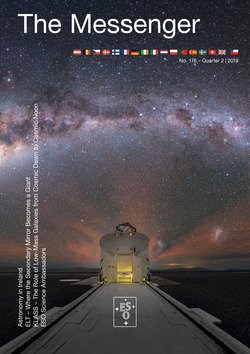
The Messenger is ESO’s journal for science and technology. It serves as a link between ESO and its broad astronomical community by providing information about scientific, technical, and other developments. It also delivers relevant news about astronomy and astrophysics to a broader public, including policy-makers, government officials, journalists, teachers, and amateur astronomers, as well as to interested scientists from other fields.

The Messenger is published twice per year and is available for free download as a PDF here and via the digital publishing platform Scribd.

Subscribe
If you wish to receive the new issue directly into your inbox, sign up here:
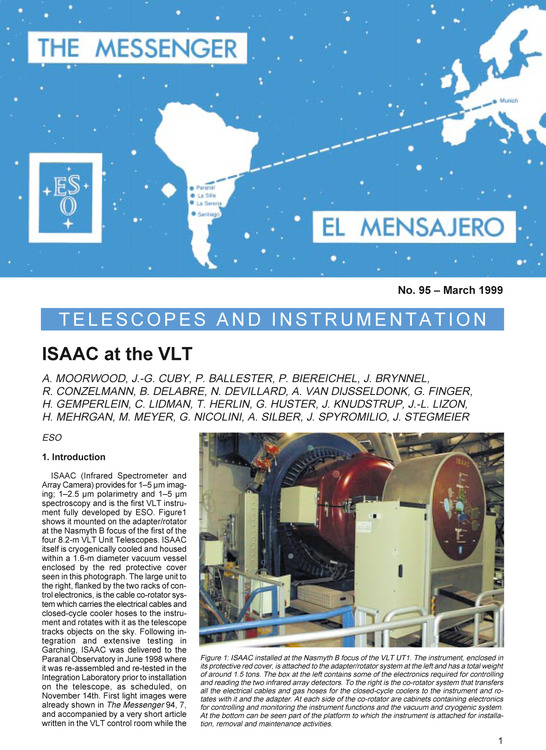
Issue 95
Messenger Issue 95

The Messenger Issue 95

Read the full PDF

Past Issues
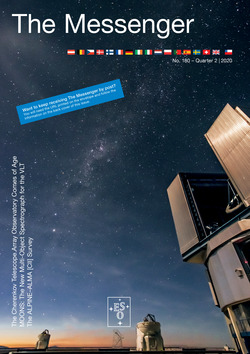
Messenger Issue 195
2025Issue 195
Messenger Issue 194
2025Issue 194
Messenger Issue 193
2024Issue 193
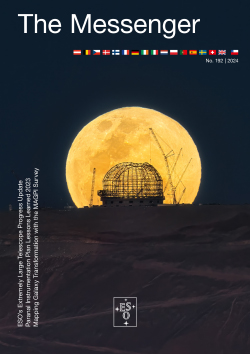
Messenger Issue 192
2024Issue 192
Messenger Issue 191
2023Issue 191
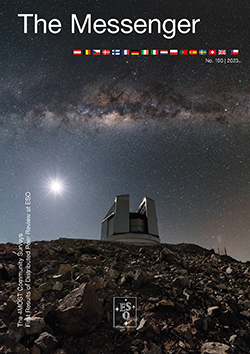
Messenger Issue 190
2023Issue 190
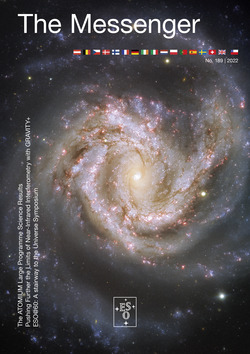
Messenger Issue 189
2022Issue 189
Messenger Issue 188
2022Issue 188
Messenger Issue 187
2022Issue 187
Messenger Issue 186
2022Issue 186
Messenger Issue 185
2021Issue 185
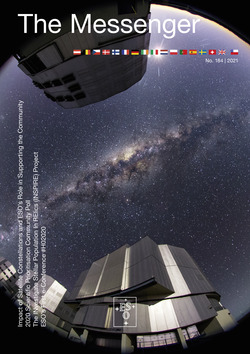
Messenger Issue 184
2021Issue 184
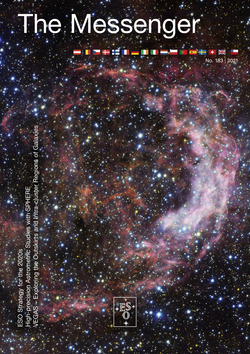
Messenger Issue 183
2021Issue 183
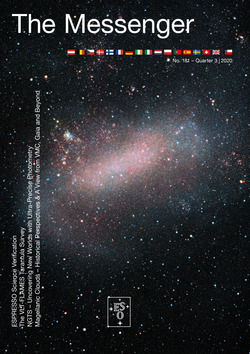
Messenger Issue 182
2021Issue 182
Messenger Issue 181
2020Issue 181
Messenger Issue 180
2020Issue 180
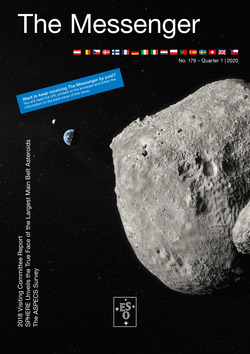
Messenger Issue 179
2020Issue 179
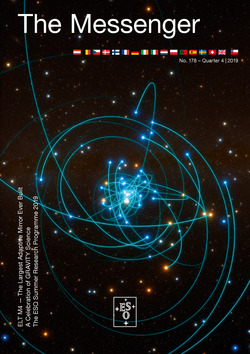
Messenger Issue 178
2019Issue 178
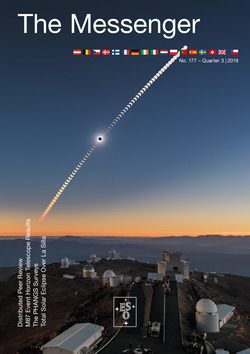
Messenger Issue 177
2019Issue 177
Messenger Issue 176
2019Issue 176
Table of Content No. 95 | 1999
Telescopes and Instrumentation
Moorwood, A., Cuby, J.-G. et al.
ISAAC at the VLT.
More...
ADS BibCode: 1999Msngr..95....1M
Authors:
Moorwood, A.; Cuby, J.-G.; Ballester, P.; Biereichel, P.; Brynnel, J.; Conzelmann, R.; Delabre, B.; Devillard, N.; van Dijsseldonk, A.; Finger, G.; Gemperlein, H.; Lidman, C.; Herlin, T.; Huster, G.; Knudstrup, J.; Lizon, J.-L.; Mehrgan, H.; Meyer, M.; Nicolini, G.; Silber, A.; Spyromilio, J.; Stegmeier, J.
Abstract:
ISAAC (Infrared Spectrometer and Array Camera) provides for 1 - 5 μm imaging, 1 - 2.5 μm polarimetry and 1 - 5 μm spectroscopy and is the first VLT instrument fully developed by ESO. The authors briefly recall its design and development, report on its performance during the commissioning tests and present some spectra of relatively faint objects which illustrate further the new scientific capabilities now offered by this instrument.

Devillard, N., Jung, Y. et al.
ISAAC pipeline data reduction.
More...
ADS BibCode: 1999Msngr..95....5D
Authors:
Devillard, N.; Jung, Y.; Cuby, J.-G.
Abstract:
The ISAAC pipeline, just as the pipeline for any other VLT instrument, is built to provide reduced data on site in order to assess their quality as soon as possible. Another version of the same software will also be running in Garching for quality control, trend analysis, and service-observing data-reduction purposes. All instrument pipelines share the same generic structure, taking care of data handling, i.e. transfers and reduction recipe triggering.

Kaufer, A., Stahl, O. et al.
Commissioning FEROS, the new high-resolution spectrograph at La-Silla.
More...
ADS BibCode: 1999Msngr..95....8K
Authors:
Kaufer, A.; Stahl, O.; Tubbesing, S.; Nørregaard, P.; Avila, G.; Francois, P.; Pasquini, L.; Pizzella, A.
Abstract:
On November 30, 1998, the second commissioning phase of the new Fiberfed Extended Range Optical Spectrograph (FEROS) was completed at the ESO 1.52-m telescope at La Silla. The instrument had been installed by a small team from the Heidelberg, Copenhagen and La Silla observatories starting in mid-September – just two years after the contract signature between the FEROS consortium and ESO. FEROS saw its first stellar light at the end of the installation phase on October 6th. An overview of the design and of the expected capabilities of the FEROS instrument has been presented in a previous paper [Kaufer et al., 1997, The Messenger 89, 1]; a more detailed description of the opto-mechanical design is found in [Kaufer & Pasquini, 1998, Proc, SPIE Vol. 3355, p. 844]. In the present article, the major technical results from the two commissioning phases which followed the first light event are reported.

Ageorges, N., Hubin, N.
Monitoring of the atmospheric sodium above La Silla.
More...
ADS BibCode: 1999Msngr..95...12A
Authors:
Ageorges, N.; Hubin, N.
Abstract:
This work corresponds to preparatory work for the laser guide star adaptive optics system planed for the VLT at Paranal. In this framework ESO and the National University of Ireland, Galway, are collaborating within the Training and Mobility of Researcher programme on “Laser guide star for 8 m class telescopes”, funded by the European Commission.

Baade, D., Meisenheimer, K. et al.
The Wide Field Imager at the 2.2-m MPG/ESO telescope: first views with a 67-million-facette eye.
More...
ADS BibCode: 1999Msngr..95...15B
Authors:
Baade, D.; Meisenheimer, K.; Iwert, O.; Alonso, J.; Augusteijn, T.; Beletic, J.; Bellemann, H.; Benesch, W.; Böhm, A.; Böhnhardt, H.; Brewer, J.; Deiries, S.; Delabre, B.; Donaldson, R.; Dupuy, C.; Franke, P.; Gerdes, R.; Gilliotte, A.; Grimm, B.; Haddad, N.; Hess, G.; Ihle, G.; Klein, R.; Lenzen, R.; Lizon, J.-L.; Mancini, D.; Münch, N.; Pizarro, A.; Prado, P.; Rahmer, G.; Reyes, J.; Richardson, F.; Robledo, E.; Sanchez, F.; Silber, A.; Sinclaire, P.; Wackermann, R.; Zaggia, S.
Abstract:
The basic capabilities of the Wide Field Imager (WFI) were described in a previous Messenger article (No. 93, p. 13; see also Table 1) which also includes a brief account of the contributions by the three participating institutes, namely ESO (Garching and La Silla), the Max-Planck- Institut für Astronomie in Heidelberg, and the Osservatorio Astronomico di Capodimonte in Napoli. Table 1 summarises the most important characteristics. A first fairly complete version of the user manual is now offered via the WFI home page on the Web (URL: http://www.ls.eso.org/ lasilla/Telescopes/2p2T/E2p2M/WFI/WFI. html). The same page also provides access to some examples of pictures obtained with the instrument. An exposure time calculator is available under the URL: http://www.eso.org/observing/etc/

Lidman, C.
New SOFI Grisms – NTT and IR Teams
More...
ADS BibCode: 1999Msngr..95...17L
Authors:
Lidman, C.
Abstract:
A new grism, with a resolving power of one to two thousand, was installed and tested over the new year. To cover most of the 0.8 micron to 2.5 micron range, the grism is used in orders 3 to 8 and with the broad-band filters (Z, J, H and Ks) as order-sorting filters. The details are listed in the following table. The resolution is listed for the 0.6 arcsecond slit.

Hainaut, O.R.
News from the NTT
More...
ADS BibCode: 1999Msngr..95...17H
Authors:
Hainaut, O.R.
Abstract:
The last three months have again been very quiet, with a total technical down time of 1.7%. As the telescope behaved very well, we had enough time to continue improving the system to make it even more reliable and user-friendly. To mention just a few of these improvements that are visible for the observer:

Brewer, J., Hainaut, O. et al.
The La Silla News Page
More...
ADS BibCode: 1999Msngr..95S..17B
Authors:
Brewer, J.; Hainaut, O.; Kürster, M.
Abstract:
The editors of the La Silla News Page would like to welcome readers of the thirteenth edition of a page devoted to reporting on technical updates and observational achievements at La Silla. We would like this page to inform the astronomical community of changes made to telescopes, instruments, operations, and of instrumental performances that cannot be reported conveniently elsewhere. Contributions and inquiries to this page from the community are most welcome.

Woudt, P. A., Silva, D.
The NTT service observing programme: on the efficiency of service observing.
More...
ADS BibCode: 1999Msngr..95...18W
Authors:
Woudt, P. A.; Silva, D.
Abstract:
A number of articles have recently appeared in the ESO Messenger reporting on the past experience of the NTT service observing programme in Periods 58, 59 and 60 (Silva and Quinn 1997, Silva 1998). In this paper, the third in this series, we report on the results of a statistical analysis of the efficiency of service observing during Period 60. We have compared service observing (SO) with the classical ‘Visitor’ Mode (VIS), and with the other main programme executed at the NTT during this period, the ESO Imaging Survey (EIS). To obtain an insight into the efficiency of service observing, we examined the Period 60 NTT observing logs in detail. We have only compared nighttime operations, and do not include pre-observing preparations into our analysis. The observations in Service Mode suffered significantly more from adverse weather conditions at La Silla than both the VIS and EIS observations. On average, the down time during Service Mode (both weather and technical down time) is more than double the down time during either the VIS and EIS Mode, 23.7% versus 10.9% and 10.4% respectively. Irrespective of these adverse weather conditions during Service Mode, it can be maintained that service observing is an efficient way of managing telescope time.

Sterzik, M.
A New Control Room for the 3.6-m Telescope
More...
ADS BibCode: 1999Msngr..95...18S
Authors:
Sterzik, M.
Abstract:
The 3.6-m telescope team started the year 1999 with the move of the control room. Our new control room is now located in the third floor of the telescope building, in a spacious room that has been freshly refurbished for this purpose. The general design is kept modern and functional, but a warm and friendly atmosphere in the room is generated by wooden panelling and wooden doors.

ESO
“First Light” of UT2
More...
ADS BibCode: 1999Msngr..95...24.
Authors:
ESO
Abstract:
Following the installation of the main mirror in its cell and a 20-hour working session to put the complex secondary mirror and its support in place, the UT2, now Kueyen, achieved (technical) first light in the morning of March 1, 1999, when an image was obtained of a bright star. It showed this telescope to be in good optical shape and further adjustments of the optical and mechanical systems are expected soon to result in some “astronomical” images.

Reports from Observers
Stecklum, B., Käufl, H.-U. et al.
The lunar occultation of CW Leo - a great finale for TIMMI.
More...
ADS BibCode: 1999Msngr..95...25S
Authors:
Stecklum, B.; Käufl, H.-U.; Richichi, A.
Abstract:
Although TIMMI (Käufl et al. 1992), ESO’s thermal infrared multi-mode instrument, had been decommissioned after Period 61, it got its very last chance on November 11th, 1998. The measurement was a special one, recording the lunar occultation of the well-known carbon star CW Leo1, and the present contribution summarises these observations.

Guzzo, L., Böhringer, H. et al.
The REFLEX cluster survey: observing strategy and first results on large-scale structure.
More...
ADS BibCode: 1999Msngr..95...27G
Authors:
Guzzo, L.; Böhringer, H.; Schuecker, P.; Collins, C. A.; Schindler, S.; Neumann, D. M.; de Grandi, S.; Cruddace, R.; Chincarini, G.; Edge, A. C.; Shaver, P. A.; Voges, W.
Abstract:
The authors discuss how after several years of work with the X-ray data from the RASS and with ESO telescopes, the REFLEX project has reached a stage where the first significant results on large-scale structure can be harvested. They hope to have at least given a hint of how the REFLEX survey is possibly the first X-ray selected cluster survey where the highest priority was given to the statistically homogeneous sampling over very large solid angles. This makes it an optimal sample for detecting and quantifying the spatial distribution of the most massive structures in the Universe, as can be appreciated from the high S/N superclusters out to at least z ≡ 0.1.

Fynbo, J. U., Thomsen, B. et al.
NTT service mode observations of the Lyman-limit absorber towards Q1205-30.
More...
ADS BibCode: 1999Msngr..95...32F
Authors:
Fynbo, J. U.; Thomsen, B.; Møller, P.
Abstract:
In order to examine whether zabs ≍ zem systems indeed are more active emitters (e.g. due to photoionisation by the QSO or induced star formation) the authors choose to study Q1205-30, since the spectrum of Q1205-30 published by Lanzetta et al. (1991) shows the presence of a strong LLS at the emission redshift of the QSO, which is zem = 3.036. In this paper the authors report on preliminary results of the analysis of the data obtained during NTT service observation in January, February and March 1998.

Other Astronomical News
Duerbeck, H. W., Osterbrock, D. E. et al.
Halfway from La Silla to Paranal - in 1909.
More...
ADS BibCode: 1999Msngr..95...34D
Authors:
Duerbeck, H. W.; Osterbrock, D. E.; Barrera S., L. H.; Leiva G., R.
Abstract:
This month - March 1999 - sees the 90th anniversary of the first expedition in northern Chile to search for a good site for an astronomical observatory: the Curtis expedition.

Nordström, B.
The Questionnaire Survey for “La Silla 2000+”
More...
ADS BibCode: 1999Msngr..95...38N
Authors:
Nordström, B.
Abstract:
First, I wish to thank the many colleagues who have spent time and effort on answering the “Questionnaire on the Future of the La Silla Facilities 1999–2006”. I am happy to report that we received 254 answers, about twice as many as four years ago, when a similar survey was initiated. This is a very gratifying response, which testifies to the great interest in the future of La Silla in the community and lends important support to the recommendations we will prepare.

Announcements
ESO
Catherine Cesarsky – ESO’s Next Director General
More...
ADS BibCode: 1999Msngr..95...38.
Authors:
ESO
Abstract:
The ESO Council has appointed Dr. Catherine Cesarsky as Director General for a five-year period, succeeding Professor Riccardo Giacconi, whose term ends this year. Dr. Cesarsky will take up her duties on September 1, 1999, at the ESO Headquarters in Garching (Germany).

ESO
List of Scientific Preprints (January–March 1999)
More...
ADS BibCode: 1999Msngr..95Q..39.
Authors:
ESO
Abstract:
1313. E. Brocato et al.: Predicted HST FOC and Broad Band Colours for Young and Intermediate Simple Stellar Populations. A&A.

ESO
Personnel Movements
More...
ADS BibCode: 1999Msngr..95R..39.
Authors:
ESO

ESO
ESO Studentship Programme
More...
ADS BibCode: 1999Msngr..95S..39.
Authors:
ESO
Abstract:
The European Southern Observatory research student programme aims at providing the opportunities and the facilities to enhance the post-graduate programmes of ESO member-state universities by bringing young scientists into close contact with the instruments, activities, and people at one of the world’s foremost observatories. For more information about ESO’s astronomical research activities please consult Research Projects and Activities (http://www.eso.org/projects/ or http://www.eso.org/science/).

ESO
Minor Planet Mariotti
More...
ADS BibCode: 1999Msngr..95R..40.
Authors:
ESO
Abstract:
“Named in memory of Jean-Marie Mariotti (1955–1998), French astronomer, most recently in Garching at the European Southern Observatory. He led the pioneering project to establish optical interferometry with the new Very Large Telescope as a breakthrough new astronomical instrument for the next century. His interest was in the area of high angular resolution, and he was involved in interferometric projects both on the ground (e.g., FLUOR and VLTI) and in space (DARWIN). He hoped with these techniques to find low-mass companions, and ultimately planets outside our solar system. He had an extraordinarily effective mix of technical expertise and scientific eagerness."

Our use of Cookies

We use cookies that are essential for accessing our websites and using our services. We also use cookies to analyse, measure and improve our websites’ performance, to enable content sharing via social media and to display media content hosted on third-party platforms.

You can manage your cookie preferences and find out more by visiting 'Cookie Settings and Policy'.

ESO Cookies Policy


The European Organisation for Astronomical Research in the Southern Hemisphere (ESO) is the pre-eminent intergovernmental science and technology organisation in astronomy. It carries out an ambitious programme focused on the design, construction and operation of powerful ground-based observing facilities for astronomy.

This Cookies Policy is intended to provide clarity by outlining the cookies used on the ESO public websites, their functions, the options you have for controlling them, and the ways you can contact us for additional details.

What are cookies?

Cookies are small pieces of data stored on your device by websites you visit. They serve various purposes, such as remembering login credentials and preferences and enhance your browsing experience.

Categories of cookies we use

Essential cookies (always active): These cookies are strictly necessary for the proper functioning of our website. Without these cookies, the website cannot operate correctly, and certain services, such as logging in or accessing secure areas, may not be available; because they are essential for the website’s operation, they cannot be disabled.

Cookie ID/Name
Description/Purpose
Provider (1st party or 3rd party)
Browser session cookie or Stored cookie?
Duration
csrftoken
XSRF protection token. We use this cookie to protect against cross-site request forgery attacks.
1st party
Stored
1 year
user_privacy
Your privacy choices. We use this cookie to save your privacy preferences.
1st party
Stored
6 months
_grecaptcha
We use reCAPTCHA to protect our forms against spam and abuse. reCAPTCHA sets a necessary cookie when executed for the purpose of providing its risk analysis. We use www.recaptcha.net instead of www.google.com in order to avoid unnecessary cookies from Google.
3rd party
Stored
6 months

Analytics cookies: These cookies collect information about how visitors interact with our website, such as which pages are visited most often and how users navigate the site. This data helps us improve website performance, optimize content, and enhance the user experience; these cookies are only placed if you provide your consent. We use the following analytics cookies.

Matomo Cookies:

This website uses Matomo (formerly Piwik), an open source software which enables the statistical analysis of website visits. Matomo uses cookies (text files) which are saved on your computer and which allow us to analyze how you use our website. The website user information generated by the cookies will only be saved on the servers of our IT Department. We use this information to analyze www.eso.org visits and to prepare reports on website activities. These data will not be disclosed to third parties.

On behalf of ESO, Matomo will use this information for the purpose of evaluating your use of the website, compiling reports on website activity and providing other services relating to website activity and internet usage.

ON | OFF

Matomo cookies settings:

Cookie ID/Name
Description/Purpose
Provider (1st party or 3rd party)
Browser session cookie or Stored cookie?
Duration
Settings
_pk_id
Stores a unique visitor ID.
1st party
Stored
13 months
_pk_ses
Session cookie temporarily stores data for the visit.
1st party
Stored
30 minutes
_pk_ref
Stores attribution information (the referrer that brought the visitor to the website).
1st party
Stored
6 months
_pk_testcookie
Temporary cookie to check if a visitor’s browser supports cookies (set in Internet Explorer only).
1st party
Stored
Temporary cookie that expires almost immediately after being set.

Additional Third-party cookies on ESO websites: some of our pages display content from external providers, e.g. YouTube.

Such third-party services are outside of ESO control and may, at any time, change their terms of service, use of cookies, etc.

YouTube: Some videos on the ESO website are embedded from ESO’s official YouTube channel. We have enabled YouTube’s privacy-enhanced mode, meaning that no cookies are set unless the user actively clicks on the video to play it. Additionally, in this mode, YouTube does not store any personally identifiable cookie data for embedded video playbacks. For more details, please refer to YouTube’s embedding videos information page.

Cookies can also be classified based on the following elements.

Regarding the domain, there are:

As for their duration, cookies can be:

How to manage cookies

Cookie settings: You can modify your cookie choices for the ESO webpages at any time by clicking on the link Cookie settings at the bottom of any page.

In your browser: If you wish to delete cookies or instruct your browser to delete or block cookies by default, please visit the help pages of your browser:

Please be aware that if you delete or decline cookies, certain functionalities of our website may be not be available and your browsing experience may be affected.

You can set most browsers to prevent any cookies being placed on your device, but you may then have to manually adjust some preferences every time you visit a site/page. And some services and functionalities may not work properly at all (e.g. profile logging-in, shop check out).

Updates to the ESO Cookies Policy

The ESO Cookies Policy may be subject to future updates, which will be made available on this page.

Additional information

For any queries related to cookies, please contact: pdprATesoDOTorg.

As ESO public webpages are managed by our Department of Communication, your questions will be dealt with the support of the said Department.