European
Southern
Observatory

The Messenger
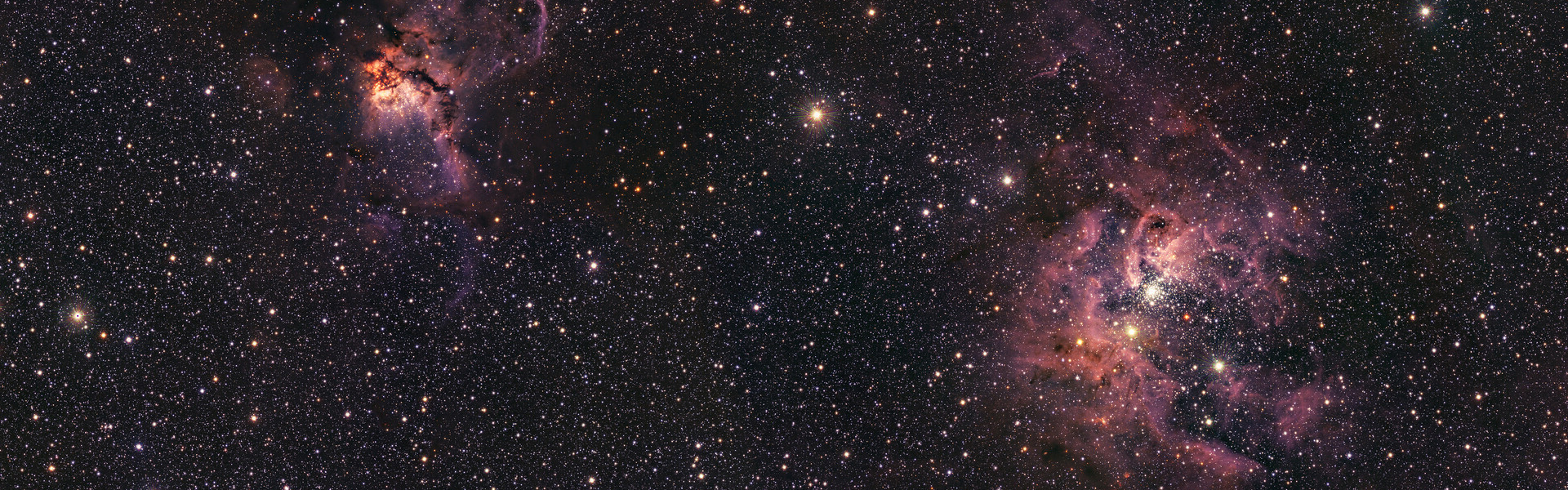
The Messenger is ESO’s journal for science and technology. It serves as a link between ESO and its broad astronomical community by providing information about scientific, technical, and other developments. It also delivers relevant news about astronomy and astrophysics to a broader public, including policy-makers, government officials, journalists, teachers, and amateur astronomers, as well as to interested scientists from other fields.

The Messenger is published twice per year and is available for free download as a PDF here and via the digital publishing platform Scribd.
Subscribe
If you wish to receive the new issue directly into your inbox, sign up here:
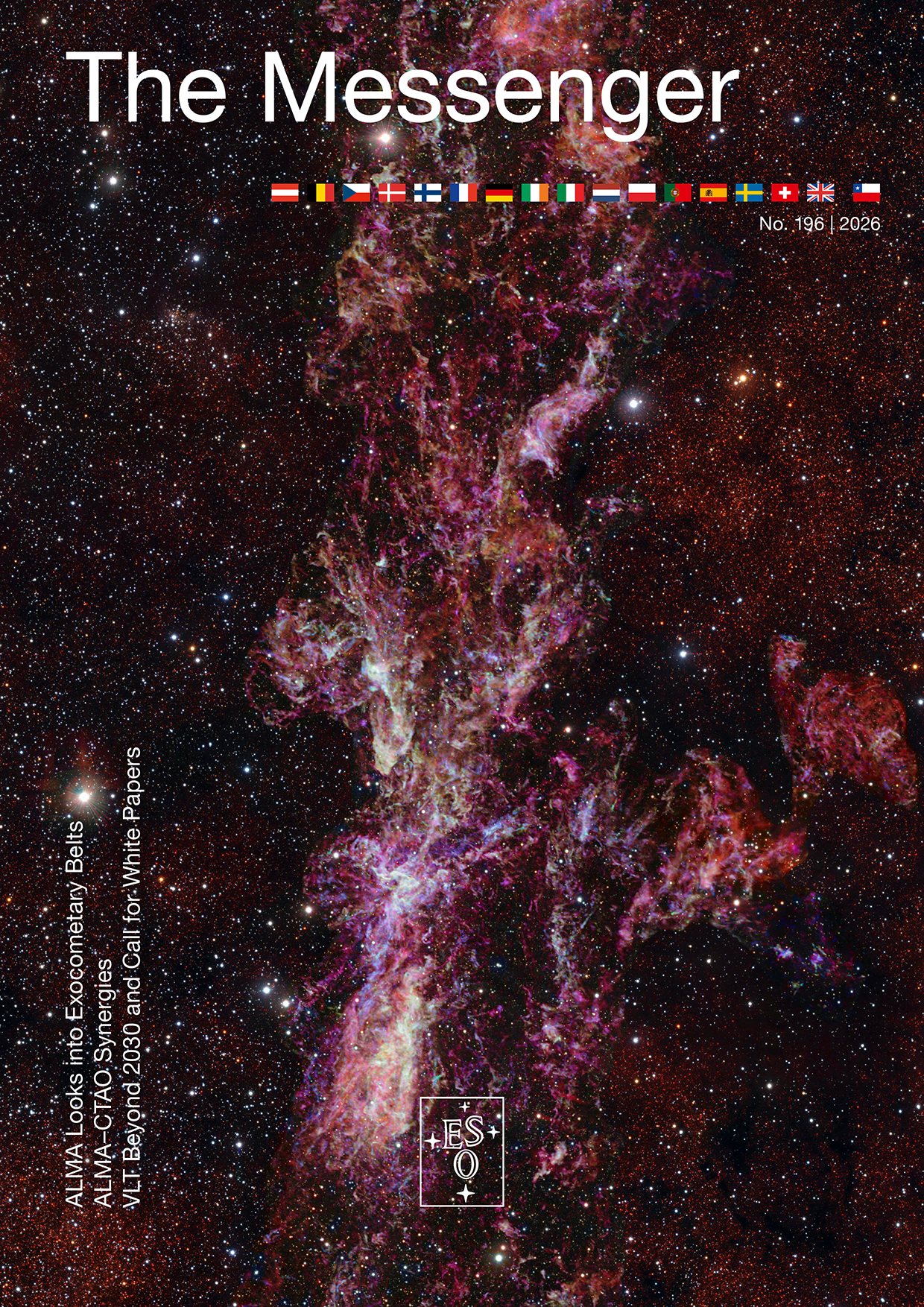
Issue 196
Messenger Issue 196

The Messenger Issue 196

Read the full PDF

Past Issues
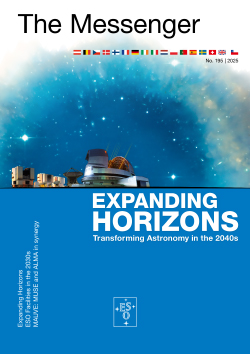
Messenger Issue 195
2025Issue 195
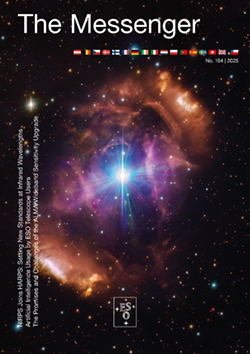
Messenger Issue 194
2025Issue 194
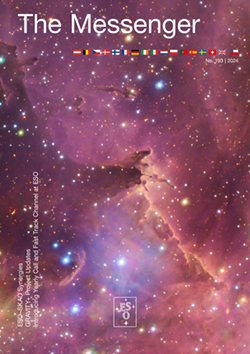
Messenger Issue 193
2024Issue 193
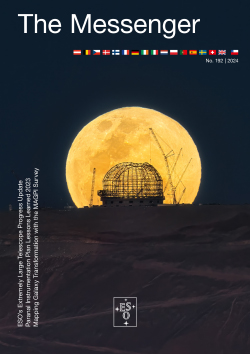
Messenger Issue 192
2024Issue 192
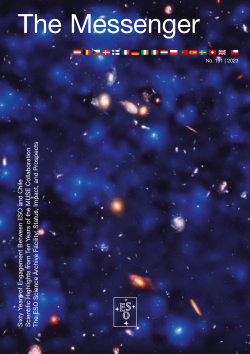
Messenger Issue 191
2023Issue 191
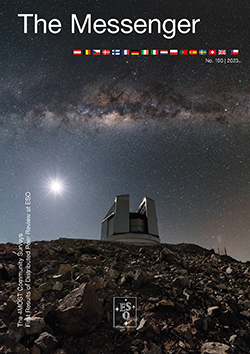
Messenger Issue 190
2023Issue 190
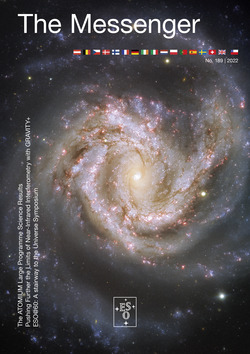
Messenger Issue 189
2022Issue 189
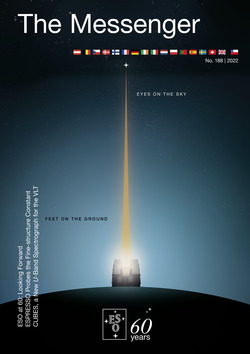
Messenger Issue 188
2022Issue 188
Messenger Issue 187
2022Issue 187
Messenger Issue 186
2022Issue 186
Messenger Issue 185
2021Issue 185
Messenger Issue 184
2021Issue 184
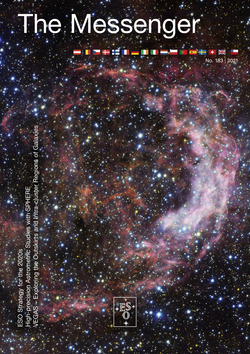
Messenger Issue 183
2021Issue 183
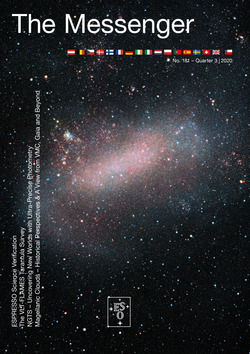
Messenger Issue 182
2021Issue 182
Messenger Issue 181
2020Issue 181
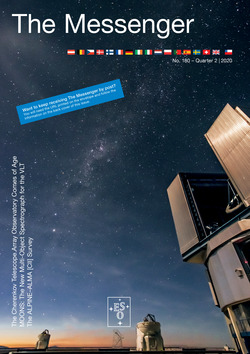
Messenger Issue 180
2020Issue 180
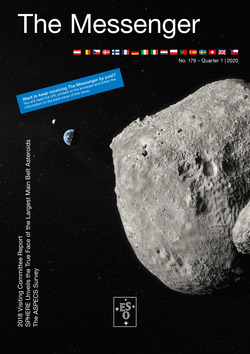
Messenger Issue 179
2020Issue 179
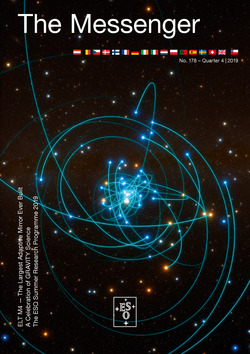
Messenger Issue 178
2019Issue 178
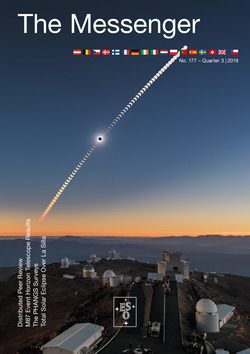
Messenger Issue 177
2019Issue 177
Table of Content No. 196 | 2026
Astronomical Science
Matrà, L.
Exocometary Belts Transformed by ALMA
More...
ADS BibCode: 2026Msngr.196....5M
Authors:
Matrà, L.
Abstract:
Exocometary belts are belts of planetesimals lying in the cold outer regions of planetary systems — analogues of our Solar System’s Edgeworth–Kuiper belt. Like extrasolar planets, these ice reservoirs are very common in extrasolar planetary systems. In the last 12 years, sensitive, spatially resolved observations enabled by the Atacama Large Millimeter/submillimeter Array (ALMA) have fundamentally transformed our understanding of these belts. ALMA has exposed their exocometary nature with detections of volatile gas linked to exocometary ice compositions and revealed a variety of radial and vertical (sub)structures often linked to ice/gas giants lurking below detectability at tens of au. These ALMA-enabled advances provide new insight into the composition, dynamics and diversity of exocometary belts, and their role in shaping outer planetary systems in the latest stages of planet formation and beyond.

Davies, R., Agapito, G. et al.
ERIS: A Snapshot of the Guaranteed Time Programmes
More...
ADS BibCode: 2026Msngr.196....9D
Authors:
Davies, R., Agapito, G., Agudo Berbel, A., Baruffolo, A., Bertola, E., Black, M., Bonaglia, M., Bourdarot, G., Briguglio, R., Cao, Y., Carbonaro, L., Cresci, G., Dallilar, Y., D’Amato, Q., Deysenroth, M., Di Antonio, I., Di Cianno, A., Di Rico, G., Doelman, D., Dolci, M., Eisenhauer, F., Esposito, S., Fantinel, D., Fedele, D., Ferruzzi, D., Feuchtgruber, H., Förster Schreiber, N., Genzel, R., Gillessen, S., Glauser, A., Grani, P., Hartl, M., Hayoz, J., Henry, D., Huber, H., Keller, C., Kenworthy, M., Kravchenko, K., Kuntschner, H., Lightfoot, J., Lunney, D., Lutz, D., Macintosh, M., Maio, F., Mannucci, F., Ott, T., Pearson, D., Puglisi, A., Quanz, S., Rabien, S., Rau, C., Riccardi, A., Salasnich, B., Schmid, H., Taro Shimizu, T., Snik, F., Sturm, E., Tacconi, L., Taylor, W., Übler, H., Valentini, A., Waring, C., Xompero, M., Zanchettin, M.
Abstract:
The Enhanced Resolution Imager and Spectrograph (ERIS) was conceived as a project to retain and enhance ESO’s fundamental capabilities for diffraction- limited imaging and spectroscopy at ESO’s Very Large Telescope. It significantly improves on the performance of two instruments that were being maintained beyond their operational lifetimes. The observational modes are integral field spectroscopy at 1–2.5 µm, imaging at 1–5 µm with several options for high-contrast imaging, and long-slit spectroscopy at 3–4 µm. ERIS has been in operation for the community since April 2023 and is very much in demand, regularly providing data quality that previously was only achieved in the best conditions. Here we highlight a snapshot of a few of the Guaranteed Time Observations projects, showing that the consortium is now engaged in an exciting science programme.

Shenar, T., Bodensteiner, J. et al.
Multiplicity of Massive Stars at Low Metallicity: Early Results from the BLOeM Campaign
More...
ADS BibCode: 2026Msngr.196...15S
Authors:
Shenar, T., Bodensteiner, J., Abdul-Masih, M., Backs, F., Berlanas, S., Bestenlehner, J., Bobrick, A., Bowman, D., Britavskiy, N., Crowther, P., Deshmukh, K., Fabry, M., Gieles, M., Gilkis, A., González-Torà, G., Gräfener, G., Gull, M., Götberg, Y., Hawcroft, C., Hénault-Brunet, V., Herrero, A., Holgado, G., Izzard, R., Janssens, S., Jin, H., Kalari, V., Katabi, Z., de Koter, A., Klencki, J., Kubátová, B., Kubát, J., Langer, N., Lechien, T., Lennon, D., Lefever, R., Ludwig, B., Mahy, L., Maíz Apellániz, J., Mandel, I., Mang Román, A., Maravelias, G., Marchant, P., Menon, A., Najarro, F., O’Grady, A., Oskinova, L., Ovadia, R., Patrick, L., Pauli, D., Pawlak, M., Bernini Peron, M., Picco, A., Ramachandran, V., Renzo, M., Rocha, D., Sana, H., Sander, A., Sayada, T., Schootemeijer, A., Schneider, F., Seeburger, R., Sen, K., Shahaf, S., Simón-Díaz, S., Stoop, M., Toonen, S., Tramper, F., Valli, R., Van Daele, P., van Loon, J., Son, L., Vigna-Gómez, A., Villaseñor, J., Vink, J., Wang, C., Xu, X.
Abstract:
Massive stars at low metallicity (Z) play a central role in shaping the high-redshift Universe, yet their multiplicity remains poorly constrained. The Binarity at Low Metallicity (BLOeM) campaign is a two-year survey of 929 stars in the Small Magellanic Cloud with the Fibre Large Array Multi Element Spectrograph (FLAMES) intrument at ESO’s Very Large Telescope, providing the first large-scale spectroscopic monitoring of massive stars at low Z (1/5 solar). Analysis of the initial nine epochs reveals high intrinsic binary fractions (> 70%) on the main sequence and a steep decline in evolved objects. Analysis of the full dataset will yield orbital solutions, identify black-hole companions and allow a derivation of the initial mass function for single and binary stars at low Z.

Arnaboldi, M., Brinchmann, J. et al.
The KMOS Spectroscopic Public Surveys
More...
ADS BibCode: 2026Msngr.196...20A
Authors:
Arnaboldi, M., Brinchmann, J., Leibundgut, B., Popesso, P., Haeussler, B., Corral-Santana, J., De Cia, A., Peroux, C., Patat, F., Rejkuba, M., Wittkowski, M., Delmotte, N., Barnes, A., Schmidtobreick, L., Gomez Camus, M., Nogueras-Lara, F.
Abstract:
We summarise the steps leading to the call, selection, approval and start of operations of the K-band Multi Object Spectrograph (KMOS) Spectroscopic Public Surveys. Following the ESO Scientific and Technical Committee’s recommendation, the process, which began in 2024, resulted in two KMOS public surveys, EMPOWER (extragalactic) and VVVX–GalCen (galactic). They began data acquisition in January 2026 and will collect data over the next three years. The survey management plans detailing the observing strategies, data reductions and data releases will be published on the ESO web pages.

Andreani, P., Díaz Trigo, M.
ALMA–CTAO Synergies
More...
ADS BibCode: 2026Msngr.196...23A
Authors:
Andreani, P., Díaz Trigo, M.
Abstract:
This article aims to raise awareness within the ESO astronomical community of the scientific opportunities offered by the upcoming Cherenkov Telescope Array Observatory (CTAO), highlighting cases where combining the millimetre/submillimetre capabilities of the Atacama Large Millimeter/submillimeter Array (ALMA) with the CTAO’s very-high-energy (~TeV) observations enables new avenues for discovery. Many astrophysical sources and environments exhibit emission processes detectable in both regimes; however, the synergies extend beyond shared emission mechanisms and include broader physical processes and observational connections linking millimetre/submillimetre and TeV energies.

Instrumentation
Ireland, M., Martinache, F. et al.
First Fringes for Asgard — Phase 1
More...
ADS BibCode: 2026Msngr.196...29I
Authors:
Ireland, M., Martinache, F., Kraus, S., Defrère, D., Taras, A., Courtney-Barrer, B., Haubois, X., Schuhler, N., Allouche, F., Bernard, J., Bourget, P., Cvetojevic, N., Garreau, G., Gil, J., Langford, C., Laugier, R., Ligi, R., McGuinness, G., Martinod, M., Morel, S., Pallanca, L., Paul, J., Pavez, M., Petrov, R., Robbe-Dubois, S., Robertson, G., Snaith, O., Tuthill, P.
Abstract:
Asgard is a suite of visitor instrument modules for the Very Large Telescope Interferometer designed to deliver high-contrast interferometric capability at infrared wavelengths through the phased installation of adaptive optics, fringe-tracking and spectroscopic and nulling instrumentation. Phase 1 was integrated and installed in mid-2025, followed by a commissioning campaign exploiting the Auxiliary Telescopes. First-light results demonstrate the robust acquisition and stabilisation of fringes across all six baselines in both K-band sub-filters, with Heimdallr tracking achieved down to mK ≈ 9.5. Early on-sky tests also validate the wavefront correction functionality provided by the Baldr instrument. With Phase 2/3 instruments (BIFROST and NOTT) now entering the integration phase, Asgard is on track to provide the community with next-generation interferometric capabilities for high-angular-resolution and high-contrast science.

Astronomical News
Callanan, P., Brinchmann, J. et al.
ESO Expanding Horizons White Papers Call: Current Status
More...
ADS BibCode: 2026Msngr.196...33C
Authors:
Callanan, P., Brinchmann, J., Lyubenova, M.
Abstract:
In July 2024 ESO launched the Expanding Horizons process to help the organisation define its next major undertaking after the Extremely Large Telescope. The first step of this process is to identify the major scientific questions that will drive the research of the astronomy community in the 2040s. A call for White Papers was issued to encourage discussion of Expanding Horizons as broadly as possible across the community, and to help the Senior Science Committee identify these key future astronomical questions. This article gives an overview of the submitted White Papers.

Péroux, C., Mérand, A. et al.
VLT Beyond 2030 and Call for White PapersReport on the ESO workshop
More...
ADS BibCode: 2026Msngr.196...35P
Authors:
Péroux, C., Mérand, A., Chruślińska, M.
Abstract:
The VLT Beyond 2030 conference gathered participants from the community and ESO experts to present and discuss science and technological ideas for the future of both the Very Large Telescope (VLT) and its interferometer (VLTI). An effort was made to pair participants with science and engineering backgrounds so as to optimise cross-field fertilisation and initiate ‘out-of-the-main- room’ discussions. The well-attended conference reflected the continued interest within our community in developing new projects for the VLT/I and the will to use this facility to answer key science questions that are likely to be crucial in the decades to come. This article presents a summary of the overall points of focus during the conference and also serves as the opening of the call for White Papers with a deadline of 15 January 2027. Proposers are encouraged to fast-forward to the years beyond 2030 to identify essential areas of research so that together we can shape a long-term roadmap for the VLT/I.

Fraser-McKelvie, A., Barnes, A. et al.
Galaxy Ecosystems Under the Microscope: Lessons from Highly-Resolved StudiesReport on the ESO workshop
More...
ADS BibCode: 2026Msngr.196...40F
Authors:
Fraser-McKelvie, A., Barnes, A., Congiu, E., de Sá-Freitas, C.
Abstract:
In the past decade, our approach to studying galaxies has undergone a remarkable transformation. By focusing on the most nearby systems, we can now probe the fundamental building blocks of galaxies — molecular clouds, H II regions and star clusters, along with fully resolved galaxy structures such as nuclear stellar discs, bars, and spiral arms — in unprecedented detail. The Galaxy Ecosystems Under the Microscope (GalRes25) workshop brought together over 110 participants from institutes in 18 countries at ESO Headquarters in Garching from 7 to 11 July 2025 to exchange the latest results from these highly resolved studies. Over the course of around 60 talks and 50 posters, participants explored how galaxies assemble their baryonic components, how star formation and feedback regulate their evolution, and how small-scale physics connects to global galactic properties. Sessions on gravitational lensing extended this discussion to the high-redshift Universe, setting the stage for future high-definition studies of galaxies both near and far with the Atacama Large Millimeter/submillimeter Array’s Wideband Sensitivity Upgrade, the Square Kilometre Array, ESO’s Extremely Large Telescope, and upcoming Very Large Telescope instruments such as BlueMUSE and the Multi-conjugate-adaptive-optics-Assisted Visible Imager and Spectrograph (MAVIS).

Hibon, P., Vera, E. et al.
AO4ELT8: First Edition of AO4ELT in ChileReport on the ESO workshop
More...
ADS BibCode: 2026Msngr.196...43H
Authors:
Hibon, P., Vera, E., Sivo, G.
Abstract:
Adaptive optics is one of the major challenges that the future extremely large telescopes face, and it’s essential to reach their scientific goals in terms of accuracy and sensitivity. It’s crucial for the entire scientific community working on the topic to gather and share ideas about the latest advances in this field. This is achieved through the Adaptive Optics for Extremely Large Telescopes (AO4ELT) conference, which has been held every two years since 2009. After the success of the seventh AO4ELT conference organised by the Optics Department of ONERA (the French aerospace lab) and the Marseille Astrophysics Laboratory, the Optoelectronics Laboratory (OPTOLAB) and Pontifical Catholic University of Valparaiso (PUCV) have joined the AO4ELT organisation to host the eighth conference in the series (AO4ELT8). The event was held in the city of Viña del Mar, Chile, between 27 and 31 October 2025.

Kiefer, L., Grothkopf, U. et al.
LISA 10 — Library and Information Services in AstronomyReport on the ESO workshop
More...
ADS BibCode: 2026Msngr.196...45K
Authors:
Kiefer, L., Grothkopf, U., Meakins, S., Eren, M.
Abstract:
The 10th LISA conference (LISA 10) took place at ESO Chile in early November 2025. The theme, Research Equity and Access in the Age of AI, highlighted the rapidly evolving landscape of scholarly communication in astronomy. Artificial intelligence, open access mandates, and expanding data archives are transforming scientific practice and information in an increasingly interdisciplinary research environment. Through presentations, posters, and discussions, LISA 10 explored how these developments are redefining the management of astronomy information work and the role of librarians.

Paladini, C.
Why Galaxies Care About AGB Stars V: 3D Winds In The Cosmic Matter CycleReport on the ESO workshop
More...
ADS BibCode: 2026Msngr.196...48P
Authors:
Paladini, C.
Abstract:
The fifth workshop in the Why Galaxies Care About AGB Stars series brought together researchers working on asymptotic giant branch (AGB) stars, stellar populations and galaxy evolution, with the aim of fostering collaboration and advancing our understanding of the role of AGB stars in the cosmic matter cycle. The workshop covered a broad range of topics, from stellar interiors and mass loss to circumstellar chemistry and the impact of AGB stars on unresolved stellar populations and galaxies across cosmic time. With recent breakthroughs in high-angular-resolution imaging, multi-wavelength observations and three-dimensional modelling, the meeting provided a timely overview of the current state of the field and a forum in which to discuss future prospects in the ESO’s Extremely Large Telescope era and beyond.

Chauvin, G.
ExoELT-2025 Community Workshop: Planetary Formation & Exoplanets in the ELT EraReport on the ESO workshop
More...
ADS BibCode: 2026Msngr.196...51C
Authors:
Chauvin, G.
Abstract:
The ExoELT-2025 community workshop, held at ESO’s headquarters in Garching, Germany, in November 2025, brought together more than 170 participants to review the scientific readiness of ESO’s Extremely Large Telescope (ELT) for studies of planet formation and exoplanets ahead of its first light by the end of this decade. The workshop presented the status and performance of the ELT and its instruments and discussed key science cases, ranging from planet-forming discs and protoplanets to exoplanet demographics and atmospheric characterisation. The unique capabilities of the ELT as regards spatial resolution, sensitivity and instrument versatility were highlighted, together with strong synergies with existing and future ground- and space-based facilities. The workshop fostered community coordination, promoted early-career researchers and identified priorities and challenges for maximisng the scientific return of the ELT.

Sedaghati, E., Boffin, H. et al.
La Silla Observing School 2026Report on the
More...
ADS BibCode: 2026Msngr.196...54S
Authors:
Sedaghati, E., Boffin, H., de Burgos Sierra, A., de Sá-Freitas, C., Pala, A., Pessi, T., Rain, M., Schmidtobreick, L.
Abstract:
The La Silla Observing School, currently being held annually, comprises lectures and observations aiming at teaching students and early-career researchers various aspects of observational astronomy. Additionally, for this year’s school, a group of public school teachers from communities near the ESO sites in Chile were also included with the aim of strengthening the bond between ESO and the local communities, as well as promoting astronomy to the younger generations. This year’s school took place during the first two weeks of February 2026, starting with talks and lectures at ESO’s Vitacura offices in Santiago, then continuing with four nights of observations at the observatory, using the ESO Faint Object Spectrograph and Camera 2 at the New Technology Telescope, the High Accuracy Radial velocity Planet Searcher and the Near Infra Red Planet Searcher at the 3.6-metre telescope and the PLATOSpec instrument at the 1.52-metre telescope, culminating in three final days in Vitacura where the various groups analysed the data obtained and presented the results of their projects.

Chruślińska, M., Lucertini, F.
Fellows at ESO
More...
ADS BibCode: 2026Msngr.196...59E
Authors:
Chruślińska, M., Lucertini, F.

Wild, W.
In memoriam Thijs de Graauw (1942–2026)
More...
ADS BibCode: 2026Msngr.196...61W
Authors:
Wild, W.
Abstract:
On 20 April Thijs de Graauw passed away in Santigo de Chile at the age of 84.

Our use of Cookies

We use cookies that are essential for accessing our websites and using our services. We also use cookies to analyse, measure and improve our websites’ performance, to enable content sharing via social media and to display media content hosted on third-party platforms.

You can manage your cookie preferences and find out more by visiting 'Cookie Settings and Policy'.

ESO Cookies Policy


The European Organisation for Astronomical Research in the Southern Hemisphere (ESO) is the pre-eminent intergovernmental science and technology organisation in astronomy. It carries out an ambitious programme focused on the design, construction and operation of powerful ground-based observing facilities for astronomy.

This Cookies Policy is intended to provide clarity by outlining the cookies used on the ESO public websites, their functions, the options you have for controlling them, and the ways you can contact us for additional details.

What are cookies?

Cookies are small pieces of data stored on your device by websites you visit. They serve various purposes, such as remembering login credentials and preferences and enhance your browsing experience.

Categories of cookies we use

Essential cookies (always active): These cookies are strictly necessary for the proper functioning of our website. Without these cookies, the website cannot operate correctly, and certain services, such as logging in or accessing secure areas, may not be available; because they are essential for the website’s operation, they cannot be disabled.

Cookie ID/Name
Description/Purpose
Provider (1st party or 3rd party)
Browser session cookie or Stored cookie?
Duration
csrftoken
XSRF protection token. We use this cookie to protect against cross-site request forgery attacks.
1st party
Stored
1 year
user_privacy
Your privacy choices. We use this cookie to save your privacy preferences.
1st party
Stored
6 months
_grecaptcha
We use reCAPTCHA to protect our forms against spam and abuse. reCAPTCHA sets a necessary cookie when executed for the purpose of providing its risk analysis. We use www.recaptcha.net instead of www.google.com in order to avoid unnecessary cookies from Google.
3rd party
Stored
6 months

Analytics cookies: These cookies collect information about how visitors interact with our website, such as which pages are visited most often and how users navigate the site. This data helps us improve website performance, optimize content, and enhance the user experience; these cookies are only placed if you provide your consent. We use the following analytics cookies.

Matomo Cookies:

This website uses Matomo (formerly Piwik), an open source software which enables the statistical analysis of website visits. Matomo uses cookies (text files) which are saved on your computer and which allow us to analyze how you use our website. The website user information generated by the cookies will only be saved on the servers of our IT Department. We use this information to analyze www.eso.org visits and to prepare reports on website activities. These data will not be disclosed to third parties.

On behalf of ESO, Matomo will use this information for the purpose of evaluating your use of the website, compiling reports on website activity and providing other services relating to website activity and internet usage.

ON | OFF

Matomo cookies settings:

Cookie ID/Name
Description/Purpose
Provider (1st party or 3rd party)
Browser session cookie or Stored cookie?
Duration
Settings
_pk_id
Stores a unique visitor ID.
1st party
Stored
13 months
_pk_ses
Session cookie temporarily stores data for the visit.
1st party
Stored
30 minutes
_pk_ref
Stores attribution information (the referrer that brought the visitor to the website).
1st party
Stored
6 months
_pk_testcookie
Temporary cookie to check if a visitor’s browser supports cookies (set in Internet Explorer only).
1st party
Stored
Temporary cookie that expires almost immediately after being set.

Additional Third-party cookies on ESO websites: some of our pages display content from external providers, e.g. YouTube.

Such third-party services are outside of ESO control and may, at any time, change their terms of service, use of cookies, etc.

YouTube: Some videos on the ESO website are embedded from ESO’s official YouTube channel. We have enabled YouTube’s privacy-enhanced mode, meaning that no cookies are set unless the user actively clicks on the video to play it. Additionally, in this mode, YouTube does not store any personally identifiable cookie data for embedded video playbacks. For more details, please refer to YouTube’s embedding videos information page.

Cookies can also be classified based on the following elements.

Regarding the domain, there are:

As for their duration, cookies can be:

How to manage cookies

Cookie settings: You can modify your cookie choices for the ESO webpages at any time by clicking on the link Cookie settings at the bottom of any page.

In your browser: If you wish to delete cookies or instruct your browser to delete or block cookies by default, please visit the help pages of your browser:

Please be aware that if you delete or decline cookies, certain functionalities of our website may be not be available and your browsing experience may be affected.

You can set most browsers to prevent any cookies being placed on your device, but you may then have to manually adjust some preferences every time you visit a site/page. And some services and functionalities may not work properly at all (e.g. profile logging-in, shop check out).

Updates to the ESO Cookies Policy

The ESO Cookies Policy may be subject to future updates, which will be made available on this page.

Additional information

For any queries related to cookies, please contact: pdprATesoDOTorg.

As ESO public webpages are managed by our Department of Communication, your questions will be dealt with the support of the said Department.