European
Southern
Observatory

The Messenger
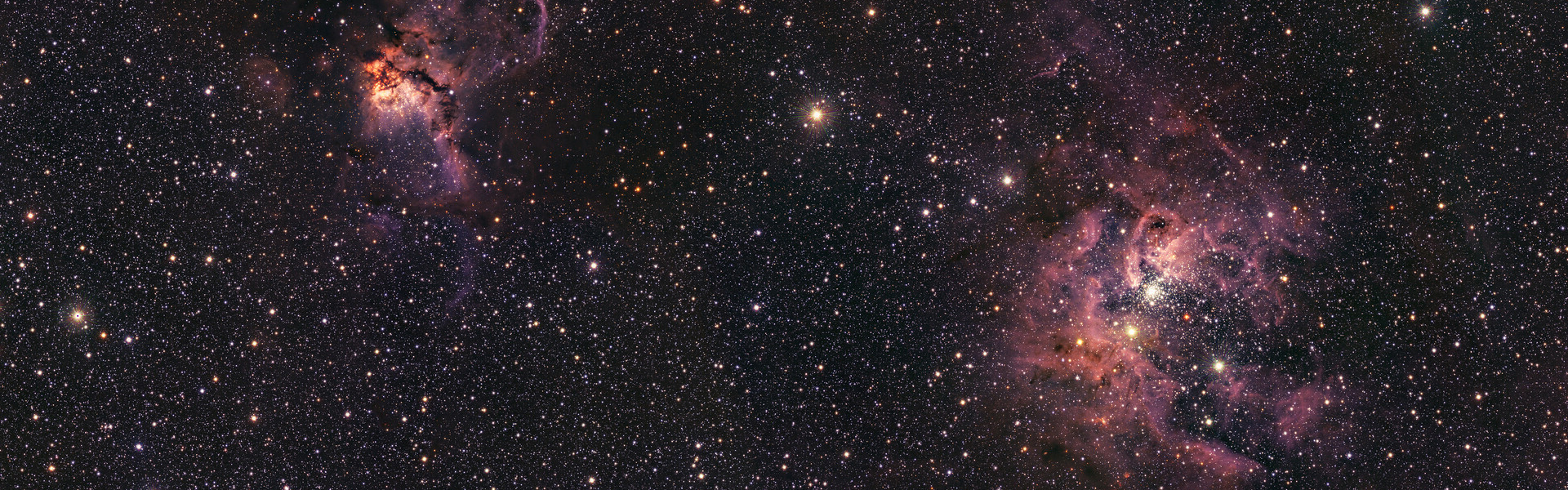
The Messenger is ESO’s journal for science and technology. It serves as a link between ESO and its broad astronomical community by providing information about scientific, technical, and other developments. It also delivers relevant news about astronomy and astrophysics to a broader public, including policy-makers, government officials, journalists, teachers, and amateur astronomers, as well as to interested scientists from other fields.

The Messenger is published twice per year and is available for free download as a PDF here and via the digital publishing platform Scribd.
Subscribe
If you wish to receive the new issue directly into your inbox, sign up here:
Issue 191
Messenger Issue 191

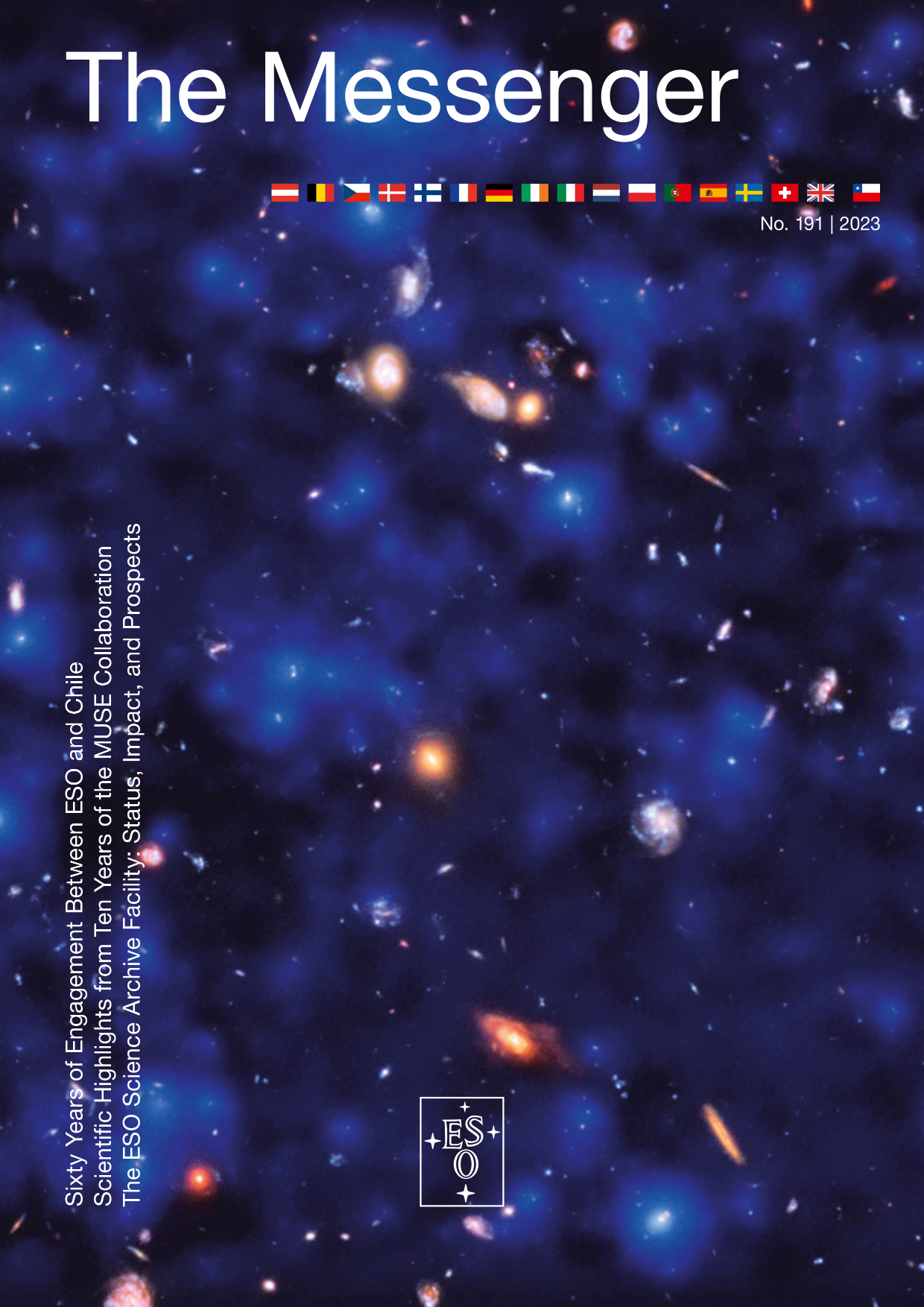
The Messenger Issue 191

Highlights include:

  • Barcons, X.: Sixty Years of Engagement Between ESO and Chile: Past, Present and Future
  • Bacon, R., Brinchmann, J. et al.: Scientific Highlights from Ten Years of the MUSE Collaboration
  • Romaniello, M., Arnaboldi, M. et al.: The ESO Science Archive Facility: Status, Impact, and Prospects

Read the full PDF

Past Issues
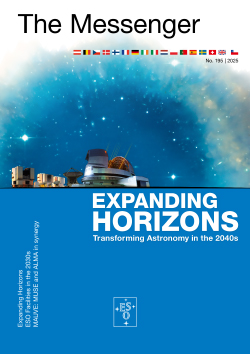
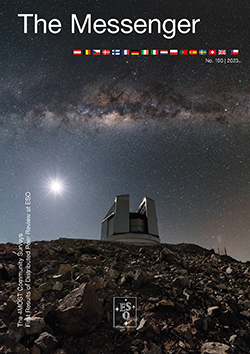
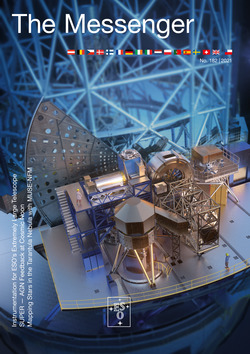
Messenger Issue 195
2025Issue 195
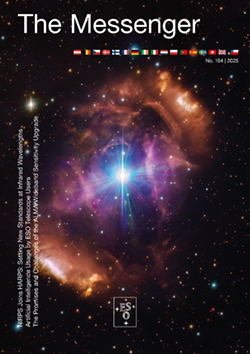
Messenger Issue 194
2025Issue 194
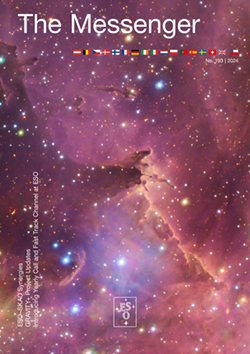
Messenger Issue 193
2024Issue 193
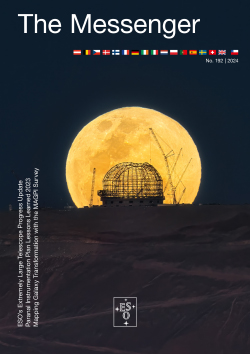
Messenger Issue 192
2024Issue 192
Messenger Issue 190
2023Issue 190
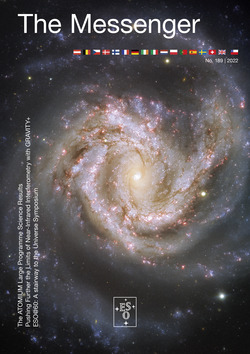
Messenger Issue 189
2022Issue 189
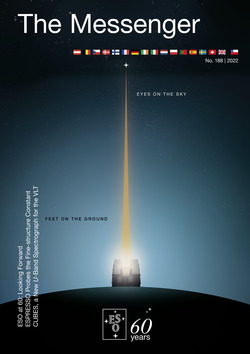
Messenger Issue 188
2022Issue 188
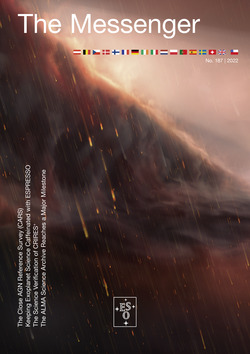
Messenger Issue 187
2022Issue 187
Messenger Issue 186
2022Issue 186
Messenger Issue 185
2021Issue 185
Messenger Issue 184
2021Issue 184
Messenger Issue 183
2021Issue 183
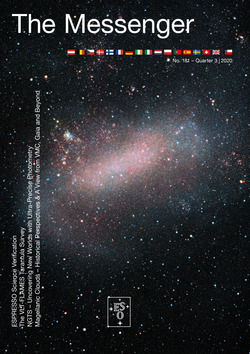
Messenger Issue 182
2021Issue 182
Messenger Issue 181
2020Issue 181
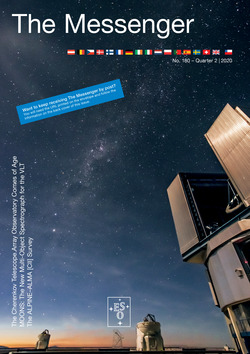
Messenger Issue 180
2020Issue 180
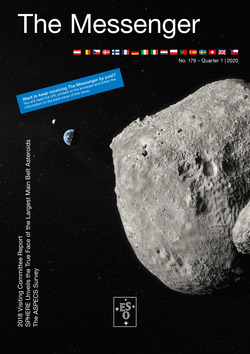
Messenger Issue 179
2020Issue 179
Messenger Issue 178
2019Issue 178
Messenger Issue 177
2019Issue 177
Messenger Issue 176
2019Issue 176
Table of Content No. 191 | 2023
The Organisation
Barcons, X.
Sixty Years of Engagement Between ESO and Chile: Past, Present and Future
More...
ADS BibCode: 2023Msngr.191....3B
Authors:
Barcons, X.
Abstract:
On 6 November 1963 ESO and the Republic of Chile started a journey together that enabled the establishment in Chile of all ESO’s observatories and telescopes so far. Despite all the challenges that the world went through over these six decades, a strong partner- ship between ESO and Chile has been forged. A vibrant user community in Chile has grown and matured, and ESO is proud to have accompanied this remarkable evolution. In this article I look at the past and present of the engagement between ESO and Chile and argue in favour of a future joint path.

Díaz Trigo, M., De Breuck, C. et al.
Ten Years of ALMA: Achievements and Future Perspectives
More...
ADS BibCode: 2023Msngr.191....6T
Authors:
Díaz Trigo, M., De Breuck, C., Hatziminaoglou, E., Rossi, S., Schmid, E., Zwaan, M.
Abstract:
This year marks the 10th anniversary of the inauguration of the Atacama Large Millimeter/submillimeter Array (ALMA), the world’s largest radio observatory. Over the past decade, ALMA, an international collaboration in which ESO, representing its Member States, is the European partner, has revolutionised our view of the Universe from the Solar System to the most distant galaxies. ALMA has produced iconic images that have attracted worldwide attention, such as that of the planet-forming disc around the young star HL Tau, and contributed to the first image of the shadow of a black hole at the heart of the galaxy M87. In this article we look back at the main achievements of ALMA and provide an outlook into the future.

Astronomical Science
Bacon, R., Brinchmann, J. et al.
Scientific Highlights from Ten Years of the MUSE Collaboration
More...
ADS BibCode: 2023Msngr.191...11B
Authors:
Bacon, R., Brinchmann, J., Bouché, N., Contini, T., Kamann, S., Krajnović, D., Monreal Ibero, A., Richard, J., Urrutia, T., Wisotzki, L., and the MUSE collaboration
Abstract:
We present the scientific highlights of ten years of exploitation of the Multi Unit Spectroscopic Explorer (MUSE) Guaranteed Time Observations performed in the context of the MUSE collaboration. These ten years have been particularly rich in discoveries and have resulted in more than 120 refereed papers. In this article we focus on the main results, grouped into four broad topical categories: resolved stellar populations, nearby galaxies, galaxy demographics, and the circumgalactic medium.

Meingast, S., Alves, J. et al.
The VISTA Star Formation Atlas (VISIONS)
More...
ADS BibCode: 2023Msngr.191...18M
Authors:
Meingast, S., Alves, J., Bouy, H., for the VISIONS collaboration
Abstract:
VISIONS is a public survey that explores five nearby star-forming molecular cloud complexes. The observing programme finished in March 2022, after collecting more than one million individual images in the near-infrared passbands J, H, and KS over a period of five years. VISIONS aims to provide a comprehensive legacy archive similar to the Two Micron All Sky Survey. In addition, multi-epoch observations facilitate proper motion measurements for sources inaccessible to Gaia. VISIONS addresses science cases related to the identification of young stars, their 3D motions, the evolution of embedded star clusters, and the characteristics of interstellar dust.

Telescopes and Instrumentation
Concas, A., Davies, R. et al.
ERIS Science Verifications
More...
ADS BibCode: 2023Msngr.191...25C
Authors:
Concas, A., Davies, R., Petr-Gotzens, M., Heida, M., Kuntschner, H., Leibundgut, B., Marsset, M., De Rosa, R., Tacconi-Garman, L., Wahhaj, Z., Wevers, T., Parraguez, D., Blanchard, I.
Abstract:
The Enhanced Resolution Imager and Spectrograph (ERIS) is the new near-infrared instrument at the Cassegrain focus of Unit Telescope 4 (UT4) of ESO’s Very Large Telescope. Its Science Verification (SV) was scheduled from 2 to 6 December 2022 during which time conditions were mostly good. Most of the planned SV observing programme could be accomplished. Out of 87 submitted proposals 23 observing programmes were scheduled for a total of 40 hours of observations. The allocation had assumed observations in four nights (eight hours each) and included a slight oversubscription. Five of the seven top-ranked proposals could be fully completed, the other two received partial data. In total, eleven programmes could be completed, seven were partially observed and three programmes could not be started. Some smaller technical problems with the adaptive optics affected parts of the observations.

Romaniello, M., Arnaboldi, M. et al.
The ESO Science Archive Facility: Status, Impact, and Prospects
More...
ADS BibCode: 2023Msngr.191...29R
Authors:
Romaniello, M., Arnaboldi, M., Barbieri, M., Delmotte, N., Dobrzycki, A., Fourniol, N., Freudling, W., Grave, J., Mascetti, L., Micol, A., Retzlaff, J., Rosse, N., Tax, T., Vuong, M., Hainaut, O., Rejkuba, M., Sterzik, M.
Abstract:
Scientific data collected at ESO’s observatories are freely and openly accessible online through the ESO Science Archive Facility. In addition to the raw data straight out of the instruments, the ESO Science Archive also contains four million processed science files available for use by scientists and astronomy enthusiasts worldwide. ESO subscribes to the FAIR (Findable, Accessible, Interoperable, Reusable) guiding principles for scientific data management and stewardship. All data in the ESO Science Archive are distributed according to the terms of the Creative Commons Attribution 4.0 International licence (CC BY 4.0).

Pritchard, J., Coccato, L. et al.
Telluric Correction of VLT Spectra: The New Graphical Interface to Molecfit
More...
ADS BibCode: 2023Msngr.191...34P
Authors:
Pritchard, J., Coccato, L., Freudling, W., Smette, A.
Abstract:
The removal of absorption features due to Earth’s atmosphere is a fundamental and delicate process in the reduction of spectroscopic observations, in particular in the near- and mid-infrared. In this paper we present the new graphical user interface of Molecfit, a package that aims to model the full atmospheric transmission by fitting key absorption features in spectra.

López-Fernández, I., Gallego, J. et al.
Ultra-wideband Cryogenic Low Noise Amplifiers: a Cool and Crucial Component for Future Submillimetre Radio Telescopes
More...
ADS BibCode: 2023Msngr.191...37L
Authors:
López-Fernández, I., Gallego, J., Diez, C., Malo, I., Amils, R., Tan, G.
Abstract:
This article reports on the evolution in designing state-of-the-art cryogenic, wideband, low-noise amplifiers as used in the intermediate frequency stages of ALMA receivers. The most recent designs are presented which demonstrate exceptional bandwidth and noise performance; those are crucial in enabling the planned ALMA Wideband Sensitivity Upgrade.

Emerson, J., Ivanov, V. et al.
VIRCAM Operations End at VISTA
More...
ADS BibCode: 2023Msngr.191...42E
Authors:
Emerson, J., Ivanov, V., Szeifert, T., Haeussler, B., Muñoz Mateos, J., Rejkuba, M., Arnaboldi, M., Petr-Gotzens, M., Hilker, M., Irwin, M., Cross, N.
Abstract:
The VISTA InfraRed CAMera (VIRCAM) at the Visible and Infrared Survey Telescope for Astronomy (VISTA) made its last observation on the night of 5/6 March 2023 after more than a decade of infrared surveys. Its place at VISTA’s focal plane is soon to be taken by the 4-metre Multi-Object Spectroscopic Telescope (4MOST) working in the visible region. Here we look back and summarise the experience gained and the great legacy of VIRCAM.

Astronomical News
de Gregorio-Monsalvo, I., Hilker, M. et al.
Celebrating 25 Years of Remarkable Science and Engineering with the VLT
More...
ADS BibCode: 2023Msngr.191...47G
Authors:
de Gregorio-Monsalvo, I., Hilker, M., Leibundgut, B.
Abstract:
Twenty-five years ago, on 25 May 1998, a significant milestone was reached for ESO and for European astronomy as the Very Large Telescope (VLT) captured its first images. On the occasion of its first light, the 8-metre Unit Telescope UT1 offered impressive images of our Universe. These included a successful tracking test in the globular cluster Omega Centauri, detailed images of the central region of another globular cluster, Messier 4, the fine structure of the Butterfly Nebula, high-velocity ejecta near Eta Carinae, and a captivating picture showcasing stars, dust, and gas in Centaurus A.

Guglielmetti, F., Mérand, A. et al.
Report on the ESO workshop: VLTI and ALMA Synthesis Imaging Workshop
More...
ADS BibCode: 2023Msngr.191...50G
Authors:
Guglielmetti, F., Mérand, A., Wittkowski, M., Tychoniec, L., González-Torà, G., Zwaan, M., Andreani, P., De Breuck, C.
Abstract:
Supported by the EU-funded Opticon RadioNet Pilot (ORP), the VLTI and ALMA Synthesis Imaging Workshop was held at ESO Headquarters on 9–12 January 2023. The hybrid format of the workshop allowed one hundred registered participants from six continents to gather, bringing with them a wide range of expertise: theorists, observers and data scientists. The need for such a broad range of skills originates in the workshop’s focus on interferometric image-reconstruction algorithms applied to data from instruments across the optical/infrared and millimetre/radio domain, allowing the diverse communities to build synergies and explore innovative techniques applicable to both regimes. The three-day workshop was organised into six topics, each followed by discussion. Four distinguished lecturers established a shared understanding of data analysis processes (including data characteristics, handling and reduction) and presented innovative techniques employing artificial intelligence used by the two communities. Traditional imaging methods, as well as techniques for morphology fitting and other popular tools and methods, were presented and discussed by keynote speakers. Given the nature and goals of the workshop, most of the speakers were invited. ORP supported a number of speakers as well as students to allow growth within a young community in the rapidly evolving area of image analysis.

Mérand, A., Cirasuolo, M. et al.
Report on the ESO workshop: Disks and Planets across ESO Facilities
More...
ADS BibCode: 2023Msngr.191...56M
Authors:
Mérand, A., Cirasuolo, M., Díaz Trigo, M., Leibundgut, B.
Abstract:
The observation of protoplanetary discs and exoplanets is a relatively recent and rapidly evolving research field. Many questions are still being posed, driven by both observations and theoretical developments. Discs and exoplanets now constitute a central observational field in astrophysics, and one of the main motivations for ESO and its community to build the Atacama Large Millimeter/submillimeter Array and the Extremely Large Telescope. They are also behind many recent and future developments at the Paranal and La Silla observatories. A workshop was held at ESO Headquarters in November/December 2022 to reflect on the role of ESO facilities (present and future) in this landscape.

Bodensteiner, J., Kaasinen, M. et al.
Fellows at ESO
More...
ADS BibCode: 2023Msngr.191...58E
Authors:
Bodensteiner, J., Kaasinen, M., Berton, M.

Our use of Cookies

We use cookies that are essential for accessing our websites and using our services. We also use cookies to analyse, measure and improve our websites’ performance, to enable content sharing via social media and to display media content hosted on third-party platforms.

You can manage your cookie preferences and find out more by visiting 'Cookie Settings and Policy'.

ESO Cookies Policy


The European Organisation for Astronomical Research in the Southern Hemisphere (ESO) is the pre-eminent intergovernmental science and technology organisation in astronomy. It carries out an ambitious programme focused on the design, construction and operation of powerful ground-based observing facilities for astronomy.

This Cookies Policy is intended to provide clarity by outlining the cookies used on the ESO public websites, their functions, the options you have for controlling them, and the ways you can contact us for additional details.

What are cookies?

Cookies are small pieces of data stored on your device by websites you visit. They serve various purposes, such as remembering login credentials and preferences and enhance your browsing experience.

Categories of cookies we use

Essential cookies (always active): These cookies are strictly necessary for the proper functioning of our website. Without these cookies, the website cannot operate correctly, and certain services, such as logging in or accessing secure areas, may not be available; because they are essential for the website’s operation, they cannot be disabled.

Cookie ID/Name
Description/Purpose
Provider (1st party or 3rd party)
Browser session cookie or Stored cookie?
Duration
csrftoken
XSRF protection token. We use this cookie to protect against cross-site request forgery attacks.
1st party
Stored
1 year
user_privacy
Your privacy choices. We use this cookie to save your privacy preferences.
1st party
Stored
6 months
_grecaptcha
We use reCAPTCHA to protect our forms against spam and abuse. reCAPTCHA sets a necessary cookie when executed for the purpose of providing its risk analysis. We use www.recaptcha.net instead of www.google.com in order to avoid unnecessary cookies from Google.
3rd party
Stored
6 months

Analytics cookies: These cookies collect information about how visitors interact with our website, such as which pages are visited most often and how users navigate the site. This data helps us improve website performance, optimize content, and enhance the user experience; these cookies are only placed if you provide your consent. We use the following analytics cookies.

Matomo Cookies:

This website uses Matomo (formerly Piwik), an open source software which enables the statistical analysis of website visits. Matomo uses cookies (text files) which are saved on your computer and which allow us to analyze how you use our website. The website user information generated by the cookies will only be saved on the servers of our IT Department. We use this information to analyze www.eso.org visits and to prepare reports on website activities. These data will not be disclosed to third parties.

On behalf of ESO, Matomo will use this information for the purpose of evaluating your use of the website, compiling reports on website activity and providing other services relating to website activity and internet usage.

ON | OFF

Matomo cookies settings:

Cookie ID/Name
Description/Purpose
Provider (1st party or 3rd party)
Browser session cookie or Stored cookie?
Duration
Settings
_pk_id
Stores a unique visitor ID.
1st party
Stored
13 months
_pk_ses
Session cookie temporarily stores data for the visit.
1st party
Stored
30 minutes
_pk_ref
Stores attribution information (the referrer that brought the visitor to the website).
1st party
Stored
6 months
_pk_testcookie
Temporary cookie to check if a visitor’s browser supports cookies (set in Internet Explorer only).
1st party
Stored
Temporary cookie that expires almost immediately after being set.

Additional Third-party cookies on ESO websites: some of our pages display content from external providers, e.g. YouTube.

Such third-party services are outside of ESO control and may, at any time, change their terms of service, use of cookies, etc.

YouTube: Some videos on the ESO website are embedded from ESO’s official YouTube channel. We have enabled YouTube’s privacy-enhanced mode, meaning that no cookies are set unless the user actively clicks on the video to play it. Additionally, in this mode, YouTube does not store any personally identifiable cookie data for embedded video playbacks. For more details, please refer to YouTube’s embedding videos information page.

Cookies can also be classified based on the following elements.

Regarding the domain, there are:

As for their duration, cookies can be:

How to manage cookies

Cookie settings: You can modify your cookie choices for the ESO webpages at any time by clicking on the link Cookie settings at the bottom of any page.

In your browser: If you wish to delete cookies or instruct your browser to delete or block cookies by default, please visit the help pages of your browser:

Please be aware that if you delete or decline cookies, certain functionalities of our website may be not be available and your browsing experience may be affected.

You can set most browsers to prevent any cookies being placed on your device, but you may then have to manually adjust some preferences every time you visit a site/page. And some services and functionalities may not work properly at all (e.g. profile logging-in, shop check out).

Updates to the ESO Cookies Policy

The ESO Cookies Policy may be subject to future updates, which will be made available on this page.

Additional information

For any queries related to cookies, please contact: pdprATesoDOTorg.

As ESO public webpages are managed by our Department of Communication, your questions will be dealt with the support of the said Department.