European
Southern
Observatory

The Messenger
The Messenger is ESO’s journal for science and technology. It serves as a link between ESO and its broad astronomical community by providing information about scientific, technical, and other developments. It also delivers relevant news about astronomy and astrophysics to a broader public, including policy-makers, government officials, journalists, teachers, and amateur astronomers, as well as to interested scientists from other fields.

The Messenger is published twice per year and is available for free download as a PDF here and via the digital publishing platform Scribd.
Subscribe
If you wish to receive the new issue directly into your inbox, sign up here:
Issue 174
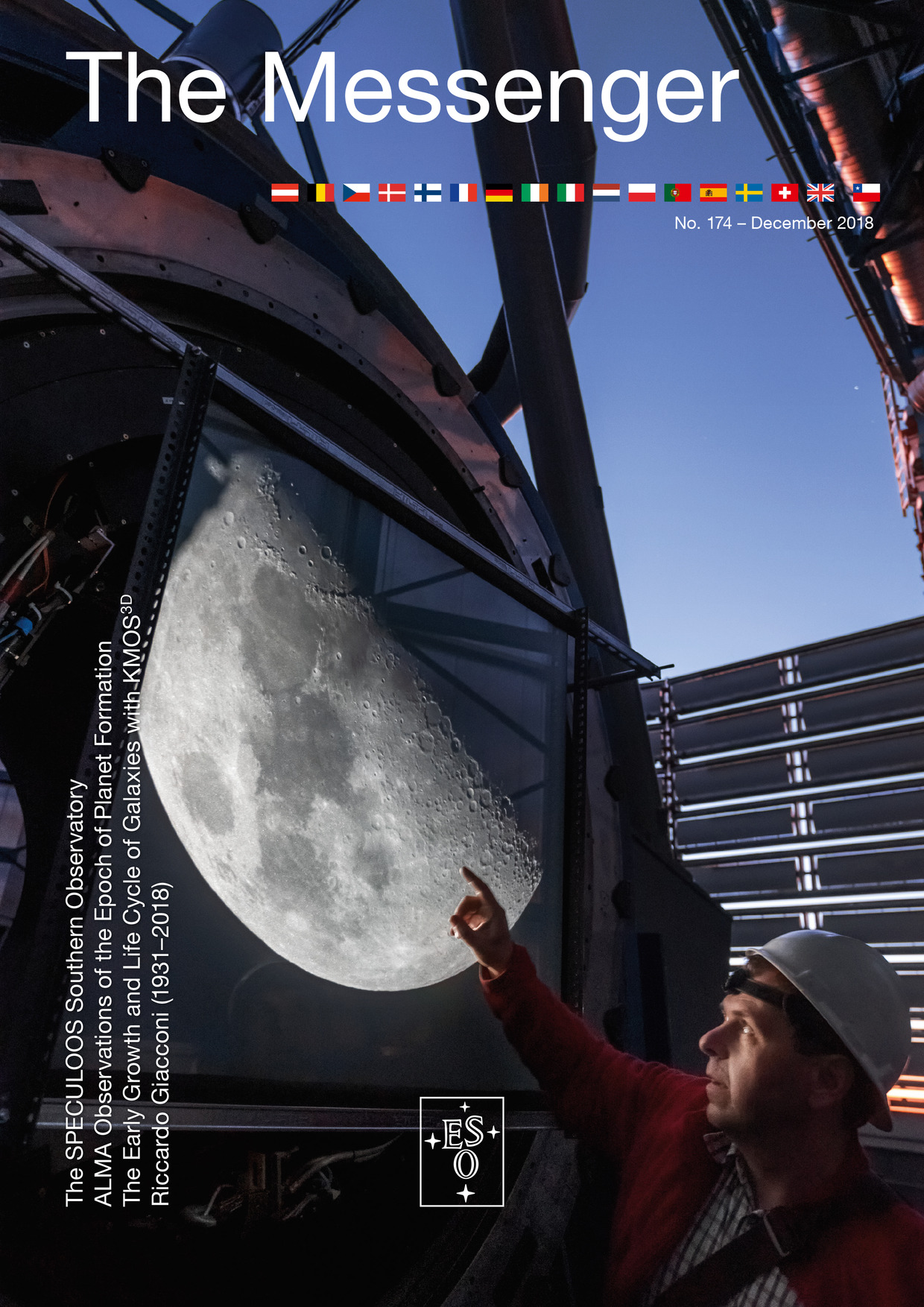
Messenger Issue 174

The Messenger Issue 174

Highlights include:

  • Jehin, E., Gillon, M. et al.: The SPECULOOS Southern Observatory Begins its Hunt for Rocky Planets
  • Andrews, S., Huang, J. et al.: ALMA Observations of the Epoch of Planet Formation
  • Förster Schreiber, N., Wilman, D. et al.: Witnessing the Early Growth and Life Cycle of Galaxies with KMOS3D
  • Barcons, X., Spyromilio, J.: Riccardo Giacconi (1931–2018)

Read the full PDF

Past Issues
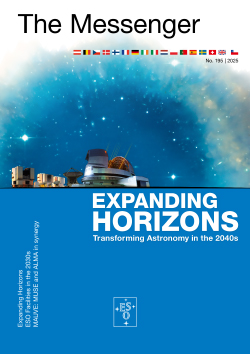
Messenger Issue 195
2025Issue 195
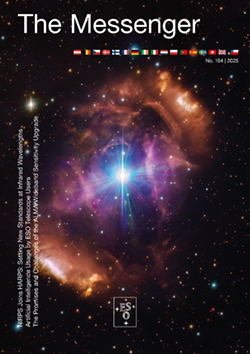
Messenger Issue 194
2025Issue 194
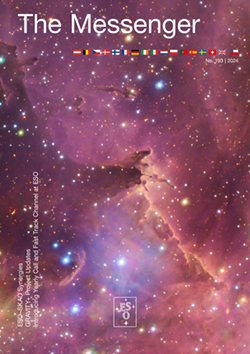
Messenger Issue 193
2024Issue 193
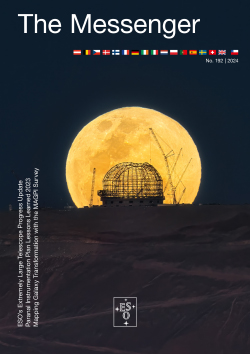
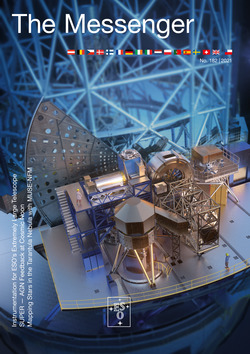
Messenger Issue 192
2024Issue 192
Messenger Issue 191
2023Issue 191
Messenger Issue 190
2023Issue 190
Messenger Issue 189
2022Issue 189
Messenger Issue 188
2022Issue 188
Messenger Issue 187
2022Issue 187
Messenger Issue 186
2022Issue 186
Messenger Issue 185
2021Issue 185
Messenger Issue 184
2021Issue 184
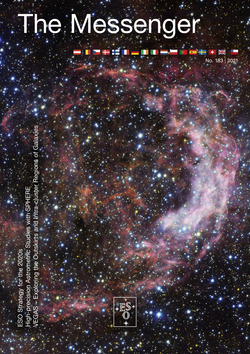
Messenger Issue 183
2021Issue 183
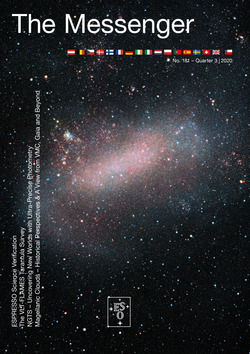
Messenger Issue 182
2021Issue 182
Messenger Issue 181
2020Issue 181
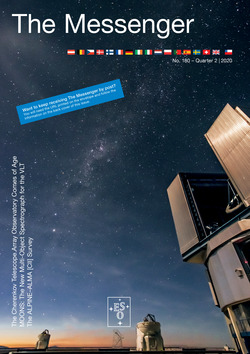
Messenger Issue 180
2020Issue 180
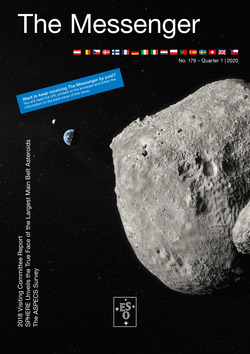
Messenger Issue 179
2020Issue 179
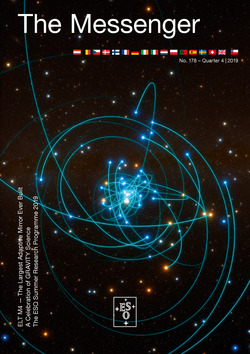
Messenger Issue 178
2019Issue 178
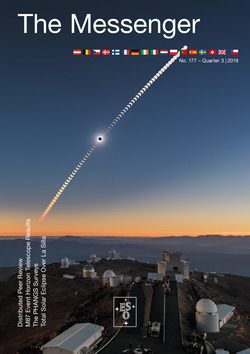
Messenger Issue 177
2019Issue 177
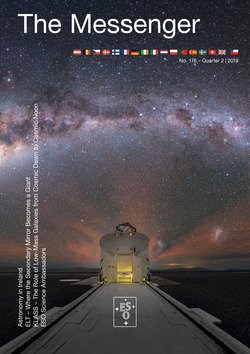
Messenger Issue 176
2019Issue 176
Table of Content No. 174 | 2018
Telescopes and Instrumentation
Jehin, E., Gillon, M. et al.
The SPECULOOS Southern Observatory Begins its Hunt for Rocky Planets
More...
ADS BibCode: 2018Msngr.174....2J
Authors:
Jehin, E., Gillon, M., Queloz, D., Delrez, L., Burdanov, A., Murray, C., Sohy, S., Ducrot, E., Sebastian, D., Thompson, S., McCormac, J., Almleaky, Y., Burgasser, A., Demory, B., de Wit, J., Barkaoui, K., Pozuelos, F., Triaud, A., Grootel, V.
Abstract:
The SPECULOOS Southern Observatory (SSO), a new facility of four 1- metre robotic telescopes, began scientific operations at Cerro Paranal on 1 January 2019. The main goal of the SPECULOOS project is to explore approximately 1000 of the smallest (≤ 0.15 R), brightest (Kmag ≤ 12.5), and nearest (d ≤ 40 pc) very low mass stars and brown dwarfs. It aims to discover transiting temperate terrestrial planets well-suited for detailed atmospheric characterisation with future giant telescopes like ESO’s Extremely Large Telescope (ELT) and the NASA James Webb Telescope (JWST). The SSO is the core facility of SPECULOOS. The exquisite astronomical conditions at Cerro Paranal will enable SPECULOOS to detect exoplanets as small as Mars. Here, we briefly describe SPECULOOS, and present the features and performance of the SSO facility.

de Wit, W., Wittkowski, M. et al.
The Life and Times of AMBER: The VLTI’s Astronomical Multi-BEam combineR
More...
ADS BibCode: 2018Msngr.174....8W
Authors:
de Wit, W., Wittkowski, M., Rantakyrö, F., Schöller, M., Mérand, A., Petrov, R., Weigelt, G., Malbet, F., Massi, F., Kraus, S., Ohnaka, K., Millour, F., Lagarde, S., Haubois, X., Bourget, P., Percheron, I., Berger, J., Richichi, A.
Abstract:
The sharpest images on Paranal are produced by the beam-combining instruments of the Very Large Telescope Interferometer (VLTI). Currently, the VLTI is close to completing a transitional period, moving away from the first generation of instruments (AMBER, MIDI) and offering new instruments and subsystems to the community. In this article, we report on the life and achievements of the recently decommissioned, near-infrared beam combiner instrument AMBER, the most prolific optical interferometric instrument to date.

Möller, T., Schilke, P. et al.
Modelling Data in CASA
More...
ADS BibCode: 2018Msngr.174...14M
Authors:
Möller, T., Schilke, P., Hogerheijde, M., Stewart, I., Schaaf, R., Harsono, D.
Abstract:
The Common Astronomy Software Applications (CASA) package provides a powerful tool for post-processing Atacama Large Millimeter/submillimeter Array (ALMA) and Karl G. Jansky Very Large Array (VLA) observations, but contains only rudimentary functions for modelling the data. In order to derive physical parameters as well as information on the location and the kinematics of the emitting gas, modelling of the observed data is inescapable. Such modelling can take the form of inference — where physical parameters are inferred from the data — or forward modelling — where model calculations are used to produce synthetic observations for comparison with data. We present two interfaces that allow the use of modelling tools for both flavours from within CASA: the eXtended CASA Line Analysis Sofware Suite (XCLASS); and Adaptable Radiative Transfer Innovations for Submillimeter Telescopes (ARTIST).

Astronomical Science
Andrews, S., Huang, J. et al.
ALMA Observations of the Epoch of Planet Formation
More...
ADS BibCode: 2018Msngr.174...19A
Authors:
Andrews, S., Huang, J., Pérez, L., Isella, A., Dullemond, C., Kurtovic, N., Guzmán, V., Carpenter, J., Wilner, D., Zhang, S., Zhu, Z., Birnstiel, T., Bai, X., Benisty, M., Hughes, A., Öberg, K., Ricci, L.
Abstract:
Planetary systems form in the discs of gas and dust that orbit young stars. In the past few years, observations of these discs at (sub-)millimetre wavelengths with very fine angular resolution have started to uncover the hallmarks of small-scale substructures in the spatial distributions of their pebble-sized particles. These are some of the fundamental signatures of the planet formation epoch, since they trace localised concentrations of material that facilitate the formation of much larger planetary building blocks, and may themselves be created by young planets interacting with their birth environments.

Evans, C., Castro, N. et al.
A First Spectroscopic Census of the Dwarf Galaxy Leo P
More...
ADS BibCode: 2018Msngr.174...24E
Authors:
Evans, C., Castro, N., Gonzalez, O., Garcia, M., Bastian, N., Cioni, M., Clark, S., Davies, B., Ferguson, A., Kamann, S., Lennon, D., Patrick, L., Vink, J., Weisz, D.
Abstract:
A longstanding quest in studies of luminous, massive stars has been to understand the role of environment on their evolution. The abundance of metals in their atmospheres has a significant impact on their physical properties, strongly influencing the feedback they have on their surroundings and the nature of their explosive deaths. To date we have been unable to study massive stars with metallicities below 10% that of the Sun. The low oxygen abundance (3% solar) and relative proximity (~1.6 Mpc) of Leo P, a low-luminosity dwarf galaxy discovered in 2013, provides a tantalising opportunity to investigate massive stars with near-primordial compositions. Here we introduce observations of Leo P with the Multi Unit Spectroscopic Explorer (MUSE) instrument on the VLT, which have revealed its spectroscopic content for the first time.

Förster Schreiber, N., Wilman, D. et al.
Witnessing the Early Growth and Life Cycle of Galaxies with KMOS3D
More...
ADS BibCode: 2018Msngr.174...28S
Authors:
Förster Schreiber, N., Wilman, D., Wisnioski, E., Fossati, M., Mendel, J., Bender, R., Genzel, R., Beifiori, A., Belli, S., Brammer, G., Burkert, A., Chan, J., Davies, R., Davies, R., Fabricius, M., Galametz, A., Herrera-Camus, R., Lang, P., Lutz, D., Momcheva, I., Naab, T., Nelson, E., Price, S., Renzini, A., Saglia, R., Seitz, S., Shimizu, T., Sternberg, A., Tacconi, L., Tadaki, K., Übler, H., van Dokkum, P., Wuyts, S.
Abstract:
Near-infrared integral field unit (IFU) spectrographs are powerful tools for investigating galaxy evolution. We report on our recently completed multi- year KMOS3D survey of Hα, [N II] and [SII] line emission of galaxies at redshift z ~ 0.7–2.7 with the K-band Multi-Object Spectrograph (KMOS) at the Very Large Telescope (VLT). With deep observations of 745 targets spanning over two orders of magnitude in galaxy mass, five billion years of cosmic time, and all levels of star formation, KMOS3D provides an unparalleled population-wide census of spatially-resolved kinematics, star formation, outflows and nebular gas conditions. The dataset sheds new light on the physical mechanisms driving the early growth and lifecycle of galaxies, and provides a rich legacy for the astronomical community.

Bulla, M., Covino, S. et al.
Shedding Light on the Geometry of Kilonovae
More...
ADS BibCode: 2018Msngr.174...34B
Authors:
Bulla, M., Covino, S., Patat, F., Kyutoku, K., Maund, J., Tanaka, M., Toma, K., Wiersema, K., D’Avanzo, P., Higgins, A., Mundell, C., Palazzi, E.
Abstract:
We present the first results of a campaign aimed at characterising the linear polarisation signals and thus the geometry of binary neutron star mergers (i.e., kilonovae). We carried out the first polarimetric observations of a kilonova called AT 2017gfo, using the FOcal Reducer/low dispersion Spectrograph 2 (FORS2). We predicted for the first time the polarisation signatures expected from kilonovae and highlighted the best strategy to detect linear polarisation in future events. Our studies demonstrate how the detection of polarisation will constrain crucial parameters of these systems, such as the inclination and composition, distribution and extent of the different components of the ejecta.

Astronomical News
Meakins, S., Gómez, M. et al.
ESO Conference Proceedings 2.0 at Zenodo
More...
ADS BibCode: 2018Msngr.174...38M
Authors:
Meakins, S., Gómez, M., Bordelon, D., Grothkopf, U.
Abstract:
As of the past few years, ESO no longer publishes conference proceedings, mainly because of the large effort involved in their production and the relatively small impact of proceedings papers. In order to continue to preserve a record of ESO-hosted conferences, the ESO Library has implemented a system called "Conference Proceedings 2.0". Presentation slides and posters are made available through Zenodo, a CERN-developed platform for the permanent storage of digital research output, ensuring that content is citable, discoverable, and archived.

Smiljanic, R., Hussain, G. et al.
Report on the ESO Workshop "A Revolution in Stellar Physics with Gaia and Large Surveys"
More...
ADS BibCode: 2018Msngr.174...40S
Authors:
Smiljanic, R., Hussain, G., Pasquini, L.
Abstract:
The exquisite astrometry and photometry of ESA’s Gaia satellite combined with data from other large photometric, spectroscopic, and asteroseismic stellar surveys are enabling a revolution in our understanding of stellar physics. The goal of this workshop was to bring together a diverse community working on or making use of various aspects of stellar physics. The discussions covered both recent advances in the field and expectations for when new data and surveys become available.

Manara, C., Schneider, P. et al.
Report on the ESO Workshop "Take a Closer Look: The Innermost Region of Protoplanetary Discs and its Connection to the Origin of Planets"
More...
ADS BibCode: 2018Msngr.174...44M
Authors:
Manara, C., Schneider, P., Hussain, G., Facchini, S., Miotello, A.
Abstract:
About 150 scientists from all over the world convened at the ESO Headquarters to discuss the origin of close-in exoplanets and the properties of the inner regions of protoplanetary discs, where these planets are formed. In a cordial atmosphere, made possible by the collaborative attitude of the very diverse group of attendees, the discussion led to a deeper appreciation of the importance of several observing techniques and of advances in modelling to tackle key open questions. In addition, the participants had the chance to experience a special show at the ESO Supernova Planetarium & Visitor Centre, which highlighted the potential of this facility.

Chen, C., Gallenne, A. et al.
Fellows at ESO
More...
ADS BibCode: 2018Msngr.174...48E
Authors:
Chen, C., Gallenne, A., Wylezalek, D.

Barcons, X., Spyromilio, J.
Riccardo Giacconi (1931–2018)
More...
ADS BibCode: 2018Msngr.174...53B
Authors:
Barcons, X., Spyromilio, J.

ESO
Personnel Movements
More...
ADS BibCode: 2018Msngr.174...55E
Authors:
ESO

Our use of Cookies

We use cookies that are essential for accessing our websites and using our services. We also use cookies to analyse, measure and improve our websites’ performance, to enable content sharing via social media and to display media content hosted on third-party platforms.

You can manage your cookie preferences and find out more by visiting 'Cookie Settings and Policy'.

ESO Cookies Policy


The European Organisation for Astronomical Research in the Southern Hemisphere (ESO) is the pre-eminent intergovernmental science and technology organisation in astronomy. It carries out an ambitious programme focused on the design, construction and operation of powerful ground-based observing facilities for astronomy.

This Cookies Policy is intended to provide clarity by outlining the cookies used on the ESO public websites, their functions, the options you have for controlling them, and the ways you can contact us for additional details.

What are cookies?

Cookies are small pieces of data stored on your device by websites you visit. They serve various purposes, such as remembering login credentials and preferences and enhance your browsing experience.

Categories of cookies we use

Essential cookies (always active): These cookies are strictly necessary for the proper functioning of our website. Without these cookies, the website cannot operate correctly, and certain services, such as logging in or accessing secure areas, may not be available; because they are essential for the website’s operation, they cannot be disabled.

Cookie ID/Name
Description/Purpose
Provider (1st party or 3rd party)
Browser session cookie or Stored cookie?
Duration
csrftoken
XSRF protection token. We use this cookie to protect against cross-site request forgery attacks.
1st party
Stored
1 year
user_privacy
Your privacy choices. We use this cookie to save your privacy preferences.
1st party
Stored
6 months
_grecaptcha
We use reCAPTCHA to protect our forms against spam and abuse. reCAPTCHA sets a necessary cookie when executed for the purpose of providing its risk analysis. We use www.recaptcha.net instead of www.google.com in order to avoid unnecessary cookies from Google.
3rd party
Stored
6 months

Analytics cookies: These cookies collect information about how visitors interact with our website, such as which pages are visited most often and how users navigate the site. This data helps us improve website performance, optimize content, and enhance the user experience; these cookies are only placed if you provide your consent. We use the following analytics cookies.

Matomo Cookies:

This website uses Matomo (formerly Piwik), an open source software which enables the statistical analysis of website visits. Matomo uses cookies (text files) which are saved on your computer and which allow us to analyze how you use our website. The website user information generated by the cookies will only be saved on the servers of our IT Department. We use this information to analyze www.eso.org visits and to prepare reports on website activities. These data will not be disclosed to third parties.

On behalf of ESO, Matomo will use this information for the purpose of evaluating your use of the website, compiling reports on website activity and providing other services relating to website activity and internet usage.

ON | OFF

Matomo cookies settings:

Cookie ID/Name
Description/Purpose
Provider (1st party or 3rd party)
Browser session cookie or Stored cookie?
Duration
Settings
_pk_id
Stores a unique visitor ID.
1st party
Stored
13 months
_pk_ses
Session cookie temporarily stores data for the visit.
1st party
Stored
30 minutes
_pk_ref
Stores attribution information (the referrer that brought the visitor to the website).
1st party
Stored
6 months
_pk_testcookie
Temporary cookie to check if a visitor’s browser supports cookies (set in Internet Explorer only).
1st party
Stored
Temporary cookie that expires almost immediately after being set.

Additional Third-party cookies on ESO websites: some of our pages display content from external providers, e.g. YouTube.

Such third-party services are outside of ESO control and may, at any time, change their terms of service, use of cookies, etc.

YouTube: Some videos on the ESO website are embedded from ESO’s official YouTube channel. We have enabled YouTube’s privacy-enhanced mode, meaning that no cookies are set unless the user actively clicks on the video to play it. Additionally, in this mode, YouTube does not store any personally identifiable cookie data for embedded video playbacks. For more details, please refer to YouTube’s embedding videos information page.

Cookies can also be classified based on the following elements.

Regarding the domain, there are:

As for their duration, cookies can be:

How to manage cookies

Cookie settings: You can modify your cookie choices for the ESO webpages at any time by clicking on the link Cookie settings at the bottom of any page.

In your browser: If you wish to delete cookies or instruct your browser to delete or block cookies by default, please visit the help pages of your browser:

Please be aware that if you delete or decline cookies, certain functionalities of our website may be not be available and your browsing experience may be affected.

You can set most browsers to prevent any cookies being placed on your device, but you may then have to manually adjust some preferences every time you visit a site/page. And some services and functionalities may not work properly at all (e.g. profile logging-in, shop check out).

Updates to the ESO Cookies Policy

The ESO Cookies Policy may be subject to future updates, which will be made available on this page.

Additional information

For any queries related to cookies, please contact: pdprATesoDOTorg.

As ESO public webpages are managed by our Department of Communication, your questions will be dealt with the support of the said Department.