European
Southern
Observatory

The Messenger
The Messenger is ESO’s journal for science and technology. It serves as a link between ESO and its broad astronomical community by providing information about scientific, technical, and other developments. It also delivers relevant news about astronomy and astrophysics to a broader public, including policy-makers, government officials, journalists, teachers, and amateur astronomers, as well as to interested scientists from other fields.

The Messenger is published twice per year and is available for free download as a PDF here and via the digital publishing platform Scribd.
Subscribe
If you wish to receive the new issue directly into your inbox, sign up here:
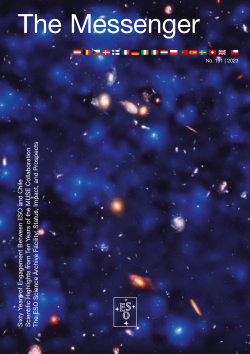
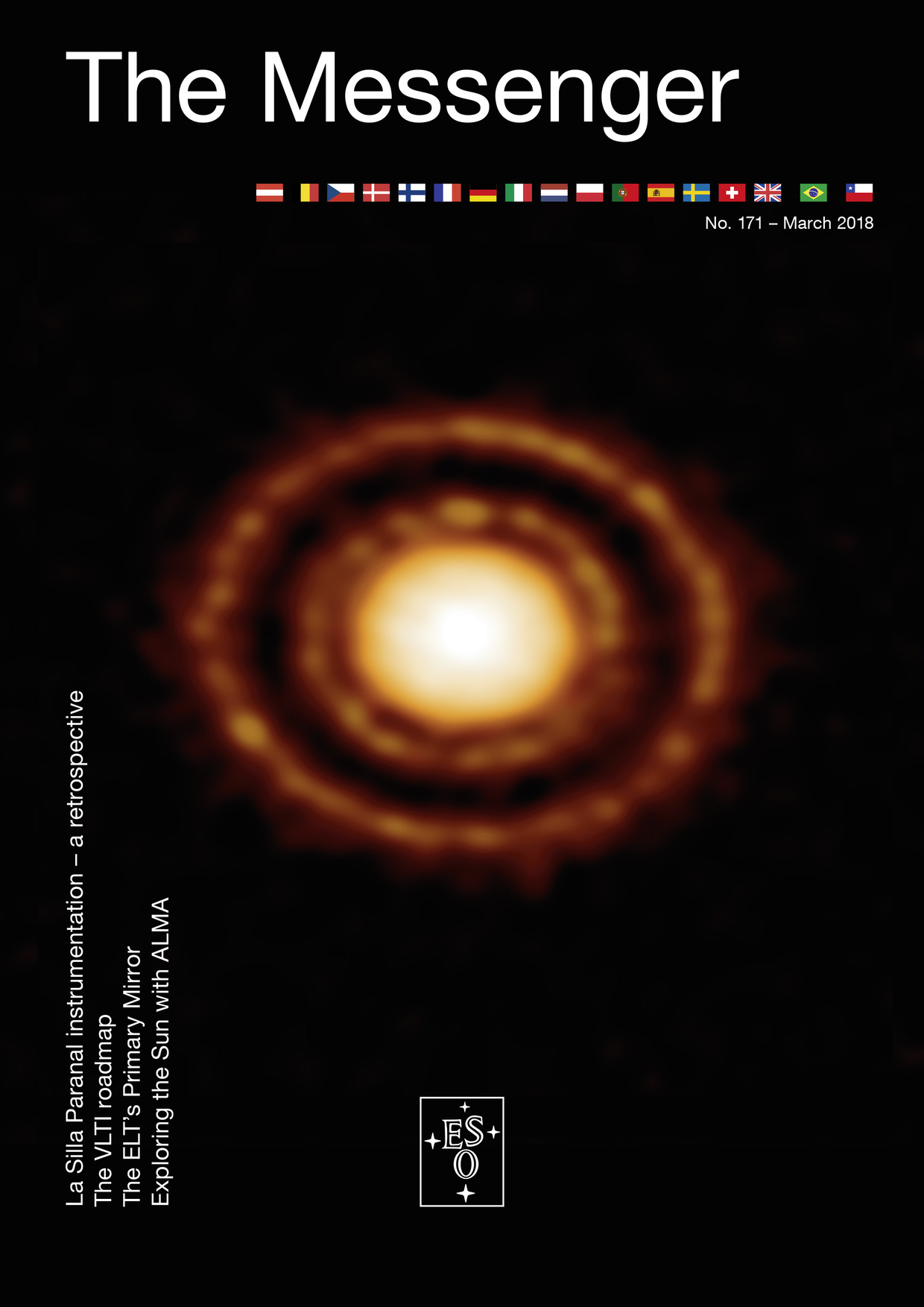
Issue 171
Messenger Issue 171

The Messenger Issue 171

Highlights include:

  • D’Odorico, S.: 40+ Years of Instrumentation for the La Silla Paranal Observatory
  • Mérand, A.: The VLTI Roadmap
  • Cirasuolo, M., Tamai, R. et al.: The ELT in 2017: The Year of the Primary Mirror
  • Bastian, T., Bárta, M. et al.: Exploring the Sun with ALMA

Read the full PDF

Past Issues
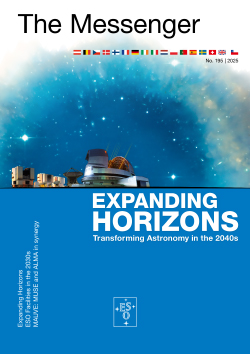
Messenger Issue 195
2025Issue 195
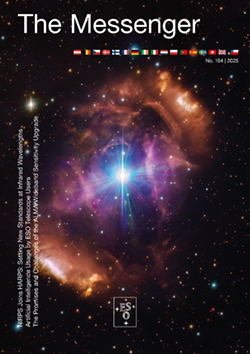
Messenger Issue 194
2025Issue 194
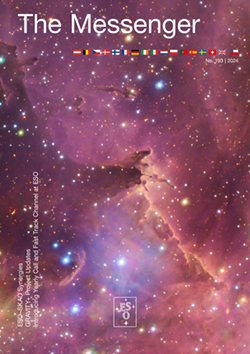
Messenger Issue 193
2024Issue 193
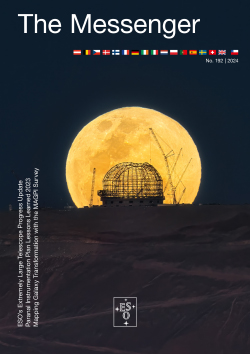
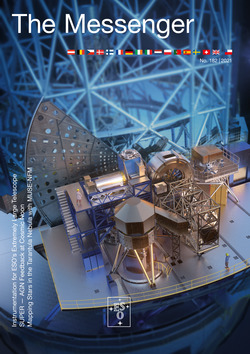
Messenger Issue 192
2024Issue 192
Messenger Issue 191
2023Issue 191
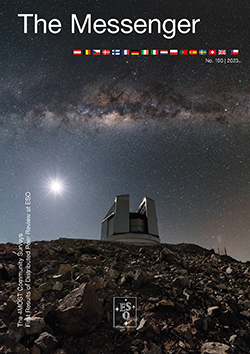
Messenger Issue 190
2023Issue 190
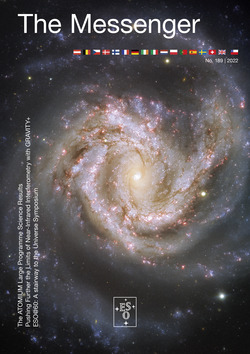
Messenger Issue 189
2022Issue 189
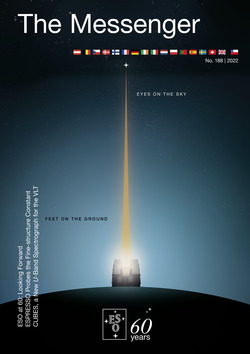
Messenger Issue 188
2022Issue 188
Messenger Issue 187
2022Issue 187
Messenger Issue 186
2022Issue 186
Messenger Issue 185
2021Issue 185
Messenger Issue 184
2021Issue 184
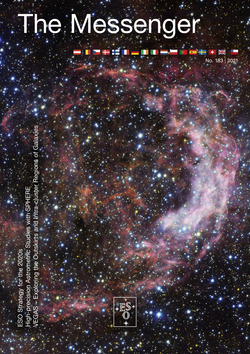
Messenger Issue 183
2021Issue 183
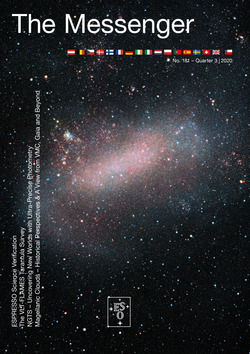
Messenger Issue 182
2021Issue 182
Messenger Issue 181
2020Issue 181
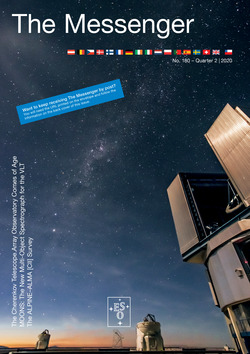
Messenger Issue 180
2020Issue 180
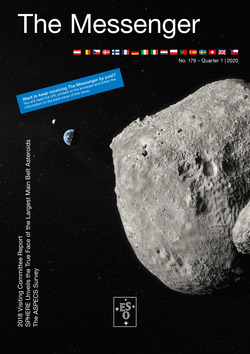
Messenger Issue 179
2020Issue 179
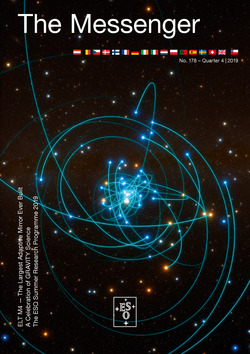
Messenger Issue 178
2019Issue 178
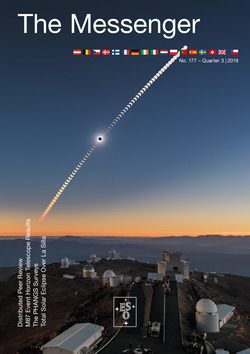
Messenger Issue 177
2019Issue 177
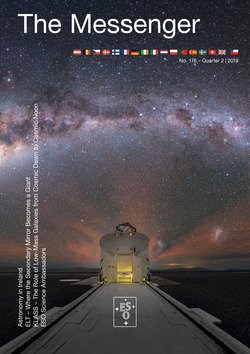
Messenger Issue 176
2019Issue 176
Table of Content No. 171 | 2018
Telescopes and Instrumentation
D’Odorico, S.
40+ Years of Instrumentation for the La Silla Paranal Observatory
More...
ADS BibCode: 2018Msngr.171....2D
Authors:
D’Odorico, S.
Abstract:
As ESO Period 100 comes to a close, I look back at the development of ESO’s instrumentation programme over more than 40 years. Instrumentation and detector activities were initially started by a small group of designers, engineers, technicians and astronomers while ESO was still at CERN in Geneva in the late 1970s. They have since led to the development of a successful suite of optical and infrared instruments for the La Silla Paranal Observatory, as testified by the continuous growth in the number of proposals for observing time and in the publications based on data from ESO telescopes. The instrumentation programme evolved significantly with the VLT and most instruments were developed by national institutes in close cooperation with ESO. This policy was a cornerstone of the VLT programme from the beginning and a key to its success.

Hainaut, O., Bierwirth, T. et al.
End-to-End Operations in the ELT Era
More...
ADS BibCode: 2018Msngr.171....8H
Authors:
Hainaut, O., Bierwirth, T., Brillant, S., Mieske, S., Patat, F., Rejkuba, M., Romaniello, M., Sterzik, M.
Abstract:
The Data Flow System is the infrastructure on which Very Large Telescope (VLT) observations are performed at the Observatory, before and after the observations themselves take place. Since its original conception in the late 1990s, it has evolved to accommodate new observing modes and new instruments on La Silla and Paranal. Several updates and upgrades are needed to overcome its obsolescence and to integrate requirements from the new instruments from the community and, of course, from ESO’s Extremely Large Telescope (ELT), which will be integrated into Paranal’s operations. We describe the end-to-end operations and the resulting roadmap guiding their further development.

Mérand, A.
The VLTI Roadmap
More...
ADS BibCode: 2018Msngr.171...14M
Authors:
Mérand, A.
Abstract:
ESO’s Very Large Telescope Interferometer (VLTI) was a unique facility when it was conceived more than 30 years ago, and it remains competitive today in the field of milli-arcsecond angular resolution astronomy. Over the past decade, while the VLTI matured into an operationally efficient facility, it became limited by its first-generation instruments. As the second generation of VLTI instrumentation achieves first light, further developments for this unique facility are being planned and are described here.

Cirasuolo, M., Tamai, R. et al.
The ELT in 2017: The Year of the Primary Mirror
More...
ADS BibCode: 2018Msngr.171...20C
Authors:
Cirasuolo, M., Tamai, R., Cayrel, M., Koehler, B., Biancat Marchet, F., González, J., Dimmler, M., Tuti, M., & the ELT team
Abstract:
The Extremely Large Telescope (ELT) is at the core of ESO’s vision to deliver the largest optical and infrared telescope in the world. With its unrivalled sensitivity and angular resolution the ELT will transform our view of the Universe: from exoplanets to resolved stellar populations, from galaxy evolution to cosmology and fundamental physics. This article focuses on one of the most challenging aspects of the entire programme, the 39-metre primary mirror (M1). 2017 was a particularly intense year for M1, the main highlight being the approval by ESO’s Council to proceed with construction of the entire mirror. In addition, several contracts have been placed to ensure that the giant primary mirror will be operational at first light.

Astronomical Science
Bastian, T., Bárta, M. et al.
Exploring the Sun with ALMA
More...
ADS BibCode: 2018Msngr.171...25B
Authors:
Bastian, T., Bárta, M., Brajša, R., Chen, B., Pontieu, B., Gary, D., Fleishman, G., Hales, A., Iwai, K., Hudson, H., Kim, S., Kobelski, A., Loukitcheva, M., Shimojo, M., Skokić, I., Wedemeyer, S., White, S., Yan, Y.
Abstract:
The Atacama Large Millimeter/submillimeter Array (ALMA) Observatory opens a new window onto the Universe. The ability to perform continuum imaging and spectroscopy of astrophysical phenomena at millimetre and submillimetre wavelengths with unprecedented sensitivity opens up new avenues for the study of cosmology and the evolution of galaxies, the formation of stars and planets, and astrochemistry. ALMA also allows fundamentally new observations to be made of objects much closer to home, including the Sun. The Sun has long served as a touchstone for our understanding of astrophysical processes, from the nature of stellar interiors, to magnetic dynamos, non-radiative heating, stellar mass loss, and energetic phenomena such as solar flares. ALMA offers new insights into all of these processes.

Cami, J., Cox, N. et al.
The ESO Diffuse Interstellar Band Large Exploration Survey (EDIBLES)
More...
ADS BibCode: 2018Msngr.171...31C
Authors:
Cami, J., Cox, N., Farhang, A., Smoker, J., Elyajouri, M., Lallement, R., Bacalla, X., Bhatt, N., Bron, E., Cordiner, M., de Koter, A., Ehrenfreund, P., Evans, C., Foing, B., Javadi, A., Joblin, C., Kaper, L., Khosroshahi, H., Laverick, M., Le Petit, F., Linnartz, H., Marshall, C., Monreal-Ibero, A., Mulas, G., Roueff, E., Royer, P., Salama, F., Sarre, P., Smith, K., Spaans, M., van Loon, J., Wade, G.
Abstract:
The ESO Diffuse Interstellar Band Large Exploration Survey (EDIBLES) is a Large Programme that is collecting high-signal-to-noise (S/N) spectra with UVES of a large sample of O and B-type stars covering a large spectral range. The goal of the programme is to extract a unique sample of high-quality interstellar spectra from these data, representing different physical and chemical environments, and to characterise these environments in great detail. An important component of interstellar spectra is the diffuse interstellar bands (DIBs), a set of hundreds of unidentified interstellar absorption lines. With the detailed line-of-sight information and the high-quality spectra, EDIBLES will derive strong constraints on the potential DIB carrier molecules. EDIBLES will thus guide the laboratory experiments necessary to identify these interstellar “mystery molecules”, and turn DIBs into powerful diagnostics of their environments in our Milky Way Galaxy and beyond. We present some preliminary results showing the unique capabilities of the EDIBLES programme.

Baudry, A., Herpin, F. et al.
APEX Band 9 Reveals Vibrationally Excited Water Sources in Evolved Stars
More...
ADS BibCode: 2018Msngr.171...37B
Authors:
Baudry, A., Herpin, F., Humphreys, E., Torstensson, K., Vlemmings, W., Richards, A., Gray, M., De Breuck, C., Olberg, M.
Abstract:
We have used the Atacama Pathfinder Experiment (APEX) telescope with the sensitive Swedish-ESO PI APEX (SEPIA) Band 9 receiver to discover several new vibrationally excited line sources of water at 658 GHz in the atmosphere of selected O-rich evolved stars. We have shown that this transition is masing and can be used to probe the gas in the dust formation zone or the wind beyond the central star. The 658 GHz line is widespread in evolved stars but most sources are weaker than about 300–500 Jy. However, some exceptional cases reach up to a few thousand Jy. New models incorporating several vibrationally excited transitions of water allow us to predict the physical conditions prevailing in 658 GHz sources. The strongest ones could be mapped with ALMA to study the small-scale clumpiness of the gas in the dust formation zone or, more generally, the stellar wind.

Astronomical News
Benz, W.
New President of Council
More...
ADS BibCode: 2018Msngr.171...43B
Authors:
Benz, W.

Roche, P.
Review of the Last Three Years at ESO
More...
ADS BibCode: 2018Msngr.171...44R
Authors:
Roche, P.

Andreani, P., Laing, R. et al.
Report on the ESO Workshop "QUESO: Submillimetre/Millimetre/Centimetre Q & U (and V)"
More...
ADS BibCode: 2018Msngr.171...46A
Authors:
Andreani, P., Laing, R., Lu, H.
Abstract:
Polarised emission encodes essential physical information about many components of the Universe, ranging from dust grains and magnetic fields in molecular clouds, protoplanetary discs and evolved stars, through to the formation and propagation of relativistic outflows in Active Galactic Nuclei, and to the effects of inflation and primordial gravitational waves on Cosmic Microwave Background (CMB) anisotropies. The aim of this workshop was to bring together current and future ALMA users, observatory calibration experts and software developers from a broad range of research fields making use of polarimetric techniques in the frequency range between approximately 5 and 1000 GHz. This range was deliberately restricted in order to focus attention on common problems and to promote cross-fertilisation between different subject areas. The meeting provided an opportunity for the polarimetric community to develop collaborations, understand the latest technological developments and decide on common priorities for the future.

Evans, C., Puech, M. et al.
Report on the MOSAIC Science Colloquium "Spectroscopic Surveys with the ELT: A Gigantic Step into the Deep Universe"
More...
ADS BibCode: 2018Msngr.171...47E
Authors:
Evans, C., Puech, M., Hammer, F., Gallego, J., Sánchez, A., García, L., Iglesias, J.
Abstract:
The Phase A design of MOSAIC, a powerful multi-object spectrograph intended for ESO’s Extremely Large Telescope, concluded in late 2017. With the design complete, a three-day workshop was held last October in Toledo to discuss the breakthrough spectroscopic surveys that MOSAIC can deliver across a broad range of contemporary astronomy.

Kakkad, D., Bartlett, E. et al.
Fellows at ESO
More...
ADS BibCode: 2018Msngr.171...49E
Authors:
Kakkad, D., Bartlett, E., Lu, H.

ESO
Personnel Movements
More...
ADS BibCode: 2018Msngr.171...52E
Authors:
ESO

ESO
Annual Index 2017 (Nos. 167–170)
More...
ADS BibCode: 2018Msngr.171...53E
Authors:
ESO

Our use of Cookies

We use cookies that are essential for accessing our websites and using our services. We also use cookies to analyse, measure and improve our websites’ performance, to enable content sharing via social media and to display media content hosted on third-party platforms.

You can manage your cookie preferences and find out more by visiting 'Cookie Settings and Policy'.

ESO Cookies Policy


The European Organisation for Astronomical Research in the Southern Hemisphere (ESO) is the pre-eminent intergovernmental science and technology organisation in astronomy. It carries out an ambitious programme focused on the design, construction and operation of powerful ground-based observing facilities for astronomy.

This Cookies Policy is intended to provide clarity by outlining the cookies used on the ESO public websites, their functions, the options you have for controlling them, and the ways you can contact us for additional details.

What are cookies?

Cookies are small pieces of data stored on your device by websites you visit. They serve various purposes, such as remembering login credentials and preferences and enhance your browsing experience.

Categories of cookies we use

Essential cookies (always active): These cookies are strictly necessary for the proper functioning of our website. Without these cookies, the website cannot operate correctly, and certain services, such as logging in or accessing secure areas, may not be available; because they are essential for the website’s operation, they cannot be disabled.

Cookie ID/Name
Description/Purpose
Provider (1st party or 3rd party)
Browser session cookie or Stored cookie?
Duration
csrftoken
XSRF protection token. We use this cookie to protect against cross-site request forgery attacks.
1st party
Stored
1 year
user_privacy
Your privacy choices. We use this cookie to save your privacy preferences.
1st party
Stored
6 months
_grecaptcha
We use reCAPTCHA to protect our forms against spam and abuse. reCAPTCHA sets a necessary cookie when executed for the purpose of providing its risk analysis. We use www.recaptcha.net instead of www.google.com in order to avoid unnecessary cookies from Google.
3rd party
Stored
6 months

Analytics cookies: These cookies collect information about how visitors interact with our website, such as which pages are visited most often and how users navigate the site. This data helps us improve website performance, optimize content, and enhance the user experience; these cookies are only placed if you provide your consent. We use the following analytics cookies.

Matomo Cookies:

This website uses Matomo (formerly Piwik), an open source software which enables the statistical analysis of website visits. Matomo uses cookies (text files) which are saved on your computer and which allow us to analyze how you use our website. The website user information generated by the cookies will only be saved on the servers of our IT Department. We use this information to analyze www.eso.org visits and to prepare reports on website activities. These data will not be disclosed to third parties.

On behalf of ESO, Matomo will use this information for the purpose of evaluating your use of the website, compiling reports on website activity and providing other services relating to website activity and internet usage.

ON | OFF

Matomo cookies settings:

Cookie ID/Name
Description/Purpose
Provider (1st party or 3rd party)
Browser session cookie or Stored cookie?
Duration
Settings
_pk_id
Stores a unique visitor ID.
1st party
Stored
13 months
_pk_ses
Session cookie temporarily stores data for the visit.
1st party
Stored
30 minutes
_pk_ref
Stores attribution information (the referrer that brought the visitor to the website).
1st party
Stored
6 months
_pk_testcookie
Temporary cookie to check if a visitor’s browser supports cookies (set in Internet Explorer only).
1st party
Stored
Temporary cookie that expires almost immediately after being set.

Additional Third-party cookies on ESO websites: some of our pages display content from external providers, e.g. YouTube.

Such third-party services are outside of ESO control and may, at any time, change their terms of service, use of cookies, etc.

YouTube: Some videos on the ESO website are embedded from ESO’s official YouTube channel. We have enabled YouTube’s privacy-enhanced mode, meaning that no cookies are set unless the user actively clicks on the video to play it. Additionally, in this mode, YouTube does not store any personally identifiable cookie data for embedded video playbacks. For more details, please refer to YouTube’s embedding videos information page.

Cookies can also be classified based on the following elements.

Regarding the domain, there are:

As for their duration, cookies can be:

How to manage cookies

Cookie settings: You can modify your cookie choices for the ESO webpages at any time by clicking on the link Cookie settings at the bottom of any page.

In your browser: If you wish to delete cookies or instruct your browser to delete or block cookies by default, please visit the help pages of your browser:

Please be aware that if you delete or decline cookies, certain functionalities of our website may be not be available and your browsing experience may be affected.

You can set most browsers to prevent any cookies being placed on your device, but you may then have to manually adjust some preferences every time you visit a site/page. And some services and functionalities may not work properly at all (e.g. profile logging-in, shop check out).

Updates to the ESO Cookies Policy

The ESO Cookies Policy may be subject to future updates, which will be made available on this page.

Additional information

For any queries related to cookies, please contact: pdprATesoDOTorg.

As ESO public webpages are managed by our Department of Communication, your questions will be dealt with the support of the said Department.