European
Southern
Observatory

The Messenger
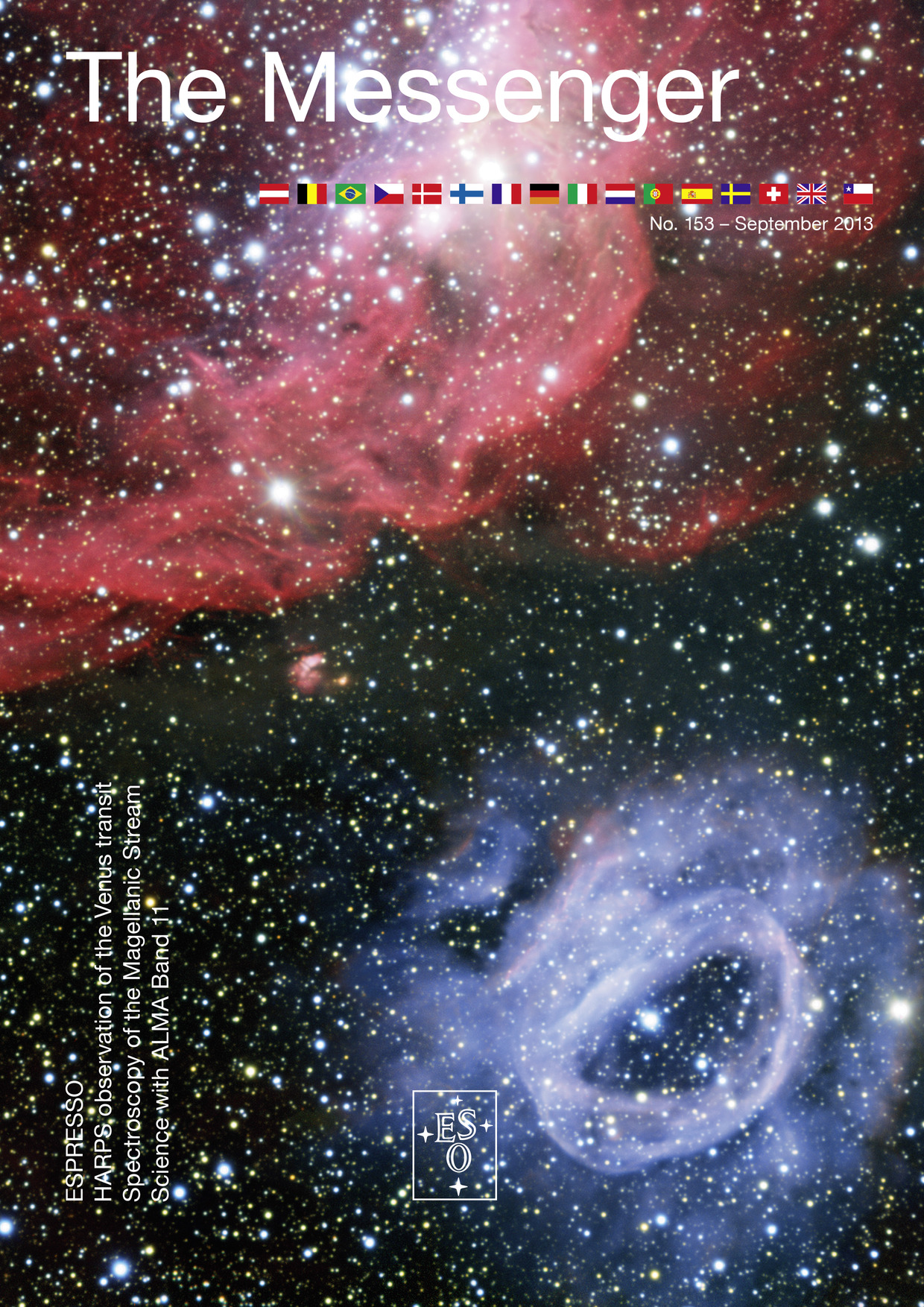
The Messenger is ESO’s journal for science and technology. It serves as a link between ESO and its broad astronomical community by providing information about scientific, technical, and other developments. It also delivers relevant news about astronomy and astrophysics to a broader public, including policy-makers, government officials, journalists, teachers, and amateur astronomers, as well as to interested scientists from other fields.

The Messenger is published twice per year and is available for free download as a PDF here and via the digital publishing platform Scribd.
Subscribe
If you wish to receive the new issue directly into your inbox, sign up here:
Issue 153
Messenger Issue 153

The Messenger Issue 153

Highlights include:

  • Pepe, F., Cristiani, S. et al.: ESPRESSO — An Echelle SPectrograph for Rocky Exoplanets Search and Stable Spectroscopic Observations
  • Molaro, P., Monaco, L. et al.: HARPS Observations of the 2012 Transit of Venus
  • Walsh, J., Gillessen, S. et al.: Following the G2 Gas Cloud towards the Galactic Centre
  • Fox, A. J., Richter, P. et al.: The Magellanic Stream — A Tail of Two Galaxies
  • Rigopoulou, D., Laing, R. et al.: Report on the Workshop ''Science with ALMA Band 11 (1.0–1.6 THz)''

Read the full PDF

Past Issues
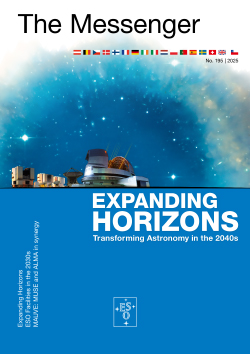
Messenger Issue 195
2025Issue 195
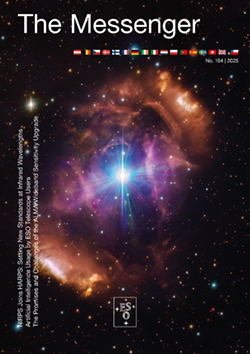
Messenger Issue 194
2025Issue 194
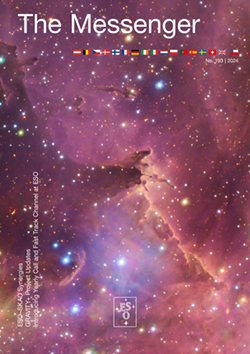
Messenger Issue 193
2024Issue 193
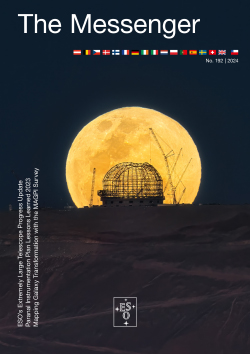
Messenger Issue 192
2024Issue 192
Messenger Issue 191
2023Issue 191
Messenger Issue 190
2023Issue 190
Messenger Issue 189
2022Issue 189
Messenger Issue 188
2022Issue 188
Messenger Issue 187
2022Issue 187
Messenger Issue 186
2022Issue 186
Messenger Issue 185
2021Issue 185
Messenger Issue 184
2021Issue 184
Messenger Issue 183
2021Issue 183
Messenger Issue 182
2021Issue 182
Messenger Issue 181
2020Issue 181
Messenger Issue 180
2020Issue 180
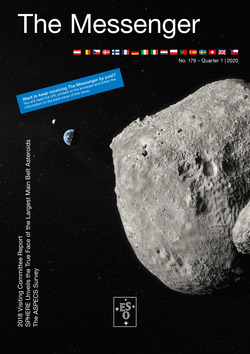
Messenger Issue 179
2020Issue 179
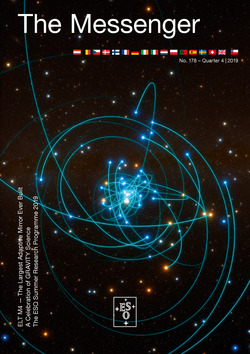
Messenger Issue 178
2019Issue 178
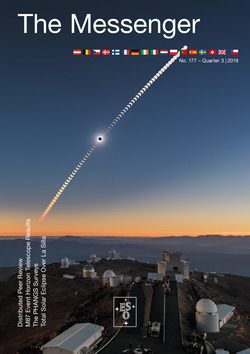
Messenger Issue 177
2019Issue 177
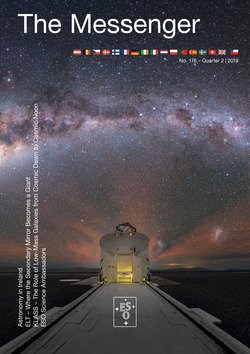
Messenger Issue 176
2019Issue 176
Table of Content No. 153 | 2013
Telescopes and Instrumentation
Kraus, M., Tamai, R. et al.
The ESO Product Data Management System — A New Home for ESO’s Technical Documents
More...
ADS BibCode: 2013Msngr.153....2K
Authors:
Kraus, M.; Tamai, R.; Jolley, P.; Hess, G.
Abstract:
Originally the technical archives at ESO grew organically and lacked a single coherent storage and access system. A search for a powerful product data management (PDM) system to unify the document archives of observatory, telescope and instrument technical material was initiated. After a careful assessment of the possible systems, it was decided to implement the Kronodoc system and its recent introduction as the ESO PDM system is described.

Aerts, C., Hussain, G. et al.
Normal Programme Applications for HARPS are Most Welcome
More...
ADS BibCode: 2013Msngr.153....5A
Authors:
Aerts, C.; Hussain, G.; Patat, F.

Pepe, F., Cristiani, S. et al.
ESPRESSO — An Echelle SPectrograph for Rocky Exoplanets Search and Stable Spectroscopic Observations
More...
ADS BibCode: 2013Msngr.153....6P
Authors:
Pepe, F.; Cristiani, S.; Rebolo, R.; Santos, N. C.; Dekker, H.; Mégevand, D.; Zerbi, F. M.; Cabral, A.; Molaro, P.; Di Marcantonio, P.; Abreu, M.; Affolter, M.; Aliverti, M.; Allende Prieto, C.; Amate, M.; Avila, G.; Baldini, V.; Bristow, P.; Broeg, C.; Cirami, R.; Coelho, J.; Conconi, P.; Coretti, I.; Cupani, G.; D’Odorico, V.; De Caprio, V.; Delabre, B.; Dorn, R.; Figueira, P.; Fragoso, A.; Galeotta, S.; Genolet, L.; Gomes, R.; González Hernández, J. I.; Hughes, I.; Iwert, O.; Kerber, F.; Landoni, M.; Lizon, J.-L.; Lovis, C.; Maire, C.; Mannetta, M.; Martins, C.; Monteiro, M. A.; Oliveira, A.; Poretti, E.; Rasilla, J. L.; Riva, M.; Santana Tschudi, S.; Santos, P.; Sosnowska, D.; Sousa, S.; Spanò, P.; Tenegi, F.; Toso, G.; Vanzella, E.; Viel, M.; Zapatero Osorio, M. R.
Abstract:
ESPRESSO is the next generation European exoplanet hunter, combining the efficiency of a modern echelle spectrograph with extreme radial velocity and spectroscopic precision. ESPRESSO will be installed in the Combined Coudé Laboratory of the VLT and linked to the four Unit Telescopes (UT) through optical coudé trains, operated either with a single UT or with up to four UTs for 1.5 magnitude gain. The instrumental radial velocity precision will reach the 10 cm s–1 level and ESPRESSO will achieve a gain of two magnitudes with respect to its predecessor HARPS. This is the first VLT instrument using the incoherent combination of light from four telescopes and, together with the extreme precision requirements, calls for many innovative design solutions while ensuring the technical heritage of HARPS.

Astronomical Science
de Laverny, P., Recio-Blanco, A. et al.
The AMBRE Project: Stellar Parameterisation of ESO Archived Spectra
More...
ADS BibCode: 2013Msngr.153...18L
Authors:
de Laverny, P.; Recio-Blanco, A.; Worley, C. C.; De Pascale, M.; Hill, V.; Bijaoui, A.
Abstract:
AMBRE is a Galactic archaeology project set up by ESO and the Observatoire de la Côte d’Azur in order to determine the stellar atmospheric parameters for the archived spectra from the ESO spectrographs FEROS, HARPS, UVES and GIRAFFE. A total of about 230000 spectra have now been homogeneously analysed and, for most (i.e., the slow-rotating FGKM-type stars), parameterised by their effective temperatures, surface gravities, global metallicities, α-element to iron abundance ratios and radial velocities. The determination of the stellar parameters is carried out using a pipeline that has been specifically developed for AMBRE. This pipeline is based on the MATISSE algorithm initially developed for the analysis of the Gaia Radial Velocity Spectrometer data.

Molaro, P., Monaco, L. et al.
HARPS Observations of the 2012 Transit of Venus
More...
ADS BibCode: 2013Msngr.153...22M
Authors:
Molaro, P.; Monaco, L.; Barbieri, M.; Zaggia, S.
Abstract:
On 6 June 2012 the black disc of Venus passed across the Solar disc, taking nearly eight hours to complete the transit. The event was followed by millions of people worldwide. The transit of Venus is one of the rarest astronomical events, occurring approximately every 120 years. By means of HARPS spectroscopic observations, and using the Moon as a mirror, we detected the Rossiter–McLaughlin effect due to the eclipse by Venus of the Solar disc with a precision of few cm s–1. The observation demonstrates that this effect can be measured even for transits of exoplanets of Earth size, or even smaller, provided enough photons can be collected by a very high resolution and extremely stable spectrograph, such as the planned HIRES instrument for the E-ELT.

Walsh, J., Gillessen, S. et al.
Following the G2 Gas Cloud towards the Galactic Centre
More...
ADS BibCode: 2013Msngr.153...25W
Authors:
Walsh, J.; Gillessen, S.; Genzel, R.; Fritz, T. K.; Eisenhauer, F.; Pfuhl, O.; Ott, T.; Schartmann, M.; Ballone, A.; Burkert, A.; Hau, G.; Girard, J.; O’Neal, J.; Bonnet, H.
Abstract:
A gas cloud was detected within half an arcsecond of Sagittarius A* in 2011 in L'-band and subsequently in line emission of H and He. The emitting cloud can be traced back in time to 2002 and is in an orbit with a pericentre very close to the central massive black hole at the Galactic Centre. Named G2, the cloud is passing the pericentre from mid-2013 to probably mid-2014 and is being intensively monitored by many facilities. An update on the progress of G2 is reported, based on recent VLT observations with SINFONI.

Fox, A. J., Richter, P. et al.
The Magellanic Stream — A Tail of Two Galaxies
More...
ADS BibCode: 2013Msngr.153...28F
Authors:
Fox, A. J.; Richter, P.; Wakker, B. P.; Lehner, N.; Howk, J. C.; Bland-Hawthorn, J.
Abstract:
Interactions between spiral galaxies and their dwarf satellites are often spectacular, producing extended streams of stripped gas and triggering new generations of star formation. The most striking local example lies in the outer halo of the Milky Way in the form of the Magellanic Stream. Extending for over 140 degrees, the Stream is a giant ribbon of gas trailing the orbit of the Large and Small Magellanic Clouds. Since its discovery over 40 years ago, the Stream has puzzled observers and theorists alike and raised many questions. New spectroscopic observations with the Hubble Space Telescope and VLT/UVES are addressing these questions and finding the origin of the Stream to be surprisingly complex.

Astronomical News
Ramsay, S., Liske, J. et al.
Report on the Workshop ''Shaping E-ELT Science and Instrumentation''
More...
ADS BibCode: 2013Msngr.153...32R
Authors:
Ramsay, S.; Liske, J.; Padovani, P.; Spyromilio, J.
Abstract:
The workshop brought together astronomers from the ESO community, and beyond, with the aim of developing the science cases for the future instrumentation programme for the European Extremely Large Telescope (E-ELT). The two first-light instruments have already been chosen and the workshop focussed on the science cases for the following three instruments. After a review of the instrumentation programmes of E-ELT and the two other ELT projects, the sessions covered the scientific justifications for a mid-infrared instrument, a high resolution spectrograph and a multi-object spectrograph. A session was also devoted to future instrument concepts and other science cases. The workshop concluded with parallel discussions on the multi-object and high resolution spectrograph options and an open discussion.

Rigopoulou, D., Laing, R. et al.
Report on the Workshop ''Science with ALMA Band 11 (1.0–1.6 THz)''
More...
ADS BibCode: 2013Msngr.153...35R
Authors:
Rigopoulou, D.; Laing, R.; Withington, S.; Magdis, G.; Graves, S.; Richer, J.; Ellison, B.
Abstract:
The workshop formed an important part of an ALMA Development Plan Study, funded by ESO, and covered the science cases for terahertz observations with ALMA. About fifty participants, mostly from Europe, but also from North America and East Asia attended. The meeting was very successful in identifying both extragalactic and Galactic science cases for all three accessible atmospheric transmission windows (centred at 1.04, 1.33 and 1.51 THz) and also discussed the potential of the ALMA site for terahertz observing.

Dąbrowski, B., Karlický, M.
Report on the 2nd Solar ALMA Workshop
More...
ADS BibCode: 2013Msngr.153...38D
Authors:
Dąbrowski, B.; Karlický, M.
Abstract:
The Czech node is one of the ALMA European Regional Centres and is the only one to support solar observations. The second workshop in the series is briefly described: the main themes were the scope of solar observation with ALMA, planning observations and the science that can be achieved.

Madsen, C.
Retirement of Massimo Tarenghi
More...
ADS BibCode: 2013Msngr.153...39M
Authors:
Madsen, C.
Abstract:
Massimo Tarenghi, chronologically MPG/ESO project scientist, NTT project manager, VLT programme manager and first Director, ALMA Director and ESO Representative in Chile, has retired after 35 years at ESO. A brief summary of his achievements is presented.

Walsh, J., Emsellem, E. et al.
Science Days at ESO
More...
ADS BibCode: 2013Msngr.153...42W
Authors:
Walsh, J.; Emsellem, E.; Melo, C.
Abstract:
The motivation for Science Days at ESO, when everyone has an opportunity to briefly present their current research, is outlined. The Science Day held in Garching in 2013 is briefly described as an example.

Mehner, A., Davis, T.
Fellows at ESO
More...
ADS BibCode: 2013Msngr.153...432
Authors:
Mehner, A.; Davis, T.

ESO
Announcement of the ESO Workshop ''3D2014 — Gas and Stars in Galaxies: A Multi-wavelength 3D Perspective''
More...
ADS BibCode: 2013Msngr.153...45.
Authors:
ESO

ESO
Announcement of the ESO Workshop ''Astrotomography II — Imaging at the Microarcsecond Scale''
More...
ADS BibCode: 2013Msngr.153...46.
Authors:
ESO

ESO
Personnel Movements
More...
ADS BibCode: 2013Msngr.153...47.
Authors:
ESO

Our use of Cookies

We use cookies that are essential for accessing our websites and using our services. We also use cookies to analyse, measure and improve our websites’ performance, to enable content sharing via social media and to display media content hosted on third-party platforms.

You can manage your cookie preferences and find out more by visiting 'Cookie Settings and Policy'.

ESO Cookies Policy


The European Organisation for Astronomical Research in the Southern Hemisphere (ESO) is the pre-eminent intergovernmental science and technology organisation in astronomy. It carries out an ambitious programme focused on the design, construction and operation of powerful ground-based observing facilities for astronomy.

This Cookies Policy is intended to provide clarity by outlining the cookies used on the ESO public websites, their functions, the options you have for controlling them, and the ways you can contact us for additional details.

What are cookies?

Cookies are small pieces of data stored on your device by websites you visit. They serve various purposes, such as remembering login credentials and preferences and enhance your browsing experience.

Categories of cookies we use

Essential cookies (always active): These cookies are strictly necessary for the proper functioning of our website. Without these cookies, the website cannot operate correctly, and certain services, such as logging in or accessing secure areas, may not be available; because they are essential for the website’s operation, they cannot be disabled.

Cookie ID/Name
Description/Purpose
Provider (1st party or 3rd party)
Browser session cookie or Stored cookie?
Duration
csrftoken
XSRF protection token. We use this cookie to protect against cross-site request forgery attacks.
1st party
Stored
1 year
user_privacy
Your privacy choices. We use this cookie to save your privacy preferences.
1st party
Stored
6 months
_grecaptcha
We use reCAPTCHA to protect our forms against spam and abuse. reCAPTCHA sets a necessary cookie when executed for the purpose of providing its risk analysis. We use www.recaptcha.net instead of www.google.com in order to avoid unnecessary cookies from Google.
3rd party
Stored
6 months

Analytics cookies: These cookies collect information about how visitors interact with our website, such as which pages are visited most often and how users navigate the site. This data helps us improve website performance, optimize content, and enhance the user experience; these cookies are only placed if you provide your consent. We use the following analytics cookies.

Matomo Cookies:

This website uses Matomo (formerly Piwik), an open source software which enables the statistical analysis of website visits. Matomo uses cookies (text files) which are saved on your computer and which allow us to analyze how you use our website. The website user information generated by the cookies will only be saved on the servers of our IT Department. We use this information to analyze www.eso.org visits and to prepare reports on website activities. These data will not be disclosed to third parties.

On behalf of ESO, Matomo will use this information for the purpose of evaluating your use of the website, compiling reports on website activity and providing other services relating to website activity and internet usage.

ON | OFF

Matomo cookies settings:

Cookie ID/Name
Description/Purpose
Provider (1st party or 3rd party)
Browser session cookie or Stored cookie?
Duration
Settings
_pk_id
Stores a unique visitor ID.
1st party
Stored
13 months
_pk_ses
Session cookie temporarily stores data for the visit.
1st party
Stored
30 minutes
_pk_ref
Stores attribution information (the referrer that brought the visitor to the website).
1st party
Stored
6 months
_pk_testcookie
Temporary cookie to check if a visitor’s browser supports cookies (set in Internet Explorer only).
1st party
Stored
Temporary cookie that expires almost immediately after being set.

Additional Third-party cookies on ESO websites: some of our pages display content from external providers, e.g. YouTube.

Such third-party services are outside of ESO control and may, at any time, change their terms of service, use of cookies, etc.

YouTube: Some videos on the ESO website are embedded from ESO’s official YouTube channel. We have enabled YouTube’s privacy-enhanced mode, meaning that no cookies are set unless the user actively clicks on the video to play it. Additionally, in this mode, YouTube does not store any personally identifiable cookie data for embedded video playbacks. For more details, please refer to YouTube’s embedding videos information page.

Cookies can also be classified based on the following elements.

Regarding the domain, there are:

As for their duration, cookies can be:

How to manage cookies

Cookie settings: You can modify your cookie choices for the ESO webpages at any time by clicking on the link Cookie settings at the bottom of any page.

In your browser: If you wish to delete cookies or instruct your browser to delete or block cookies by default, please visit the help pages of your browser:

Please be aware that if you delete or decline cookies, certain functionalities of our website may be not be available and your browsing experience may be affected.

You can set most browsers to prevent any cookies being placed on your device, but you may then have to manually adjust some preferences every time you visit a site/page. And some services and functionalities may not work properly at all (e.g. profile logging-in, shop check out).

Updates to the ESO Cookies Policy

The ESO Cookies Policy may be subject to future updates, which will be made available on this page.

Additional information

For any queries related to cookies, please contact: pdprATesoDOTorg.

As ESO public webpages are managed by our Department of Communication, your questions will be dealt with the support of the said Department.