European
Southern
Observatory

The Messenger
The Messenger is ESO’s journal for science and technology. It serves as a link between ESO and its broad astronomical community by providing information about scientific, technical, and other developments. It also delivers relevant news about astronomy and astrophysics to a broader public, including policy-makers, government officials, journalists, teachers, and amateur astronomers, as well as to interested scientists from other fields.

The Messenger is published twice per year and is available for free download as a PDF here and via the digital publishing platform Scribd.
Subscribe
If you wish to receive the new issue directly into your inbox, sign up here:
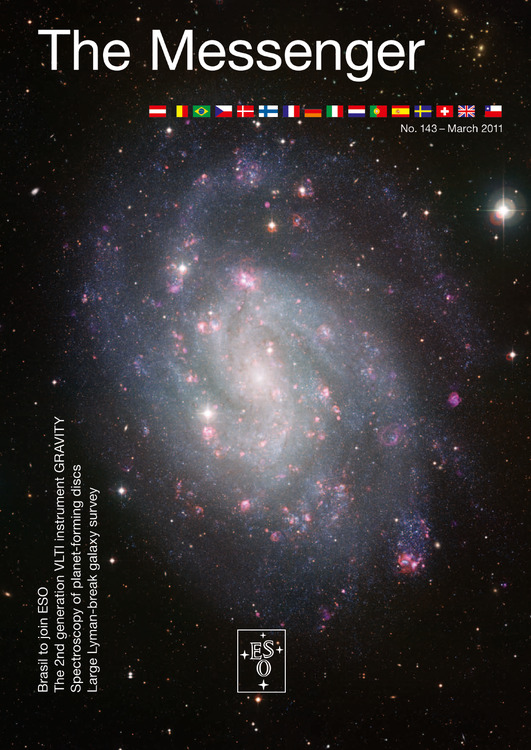
Issue 143
Messenger Issue 143

The Messenger Issue 143

Highlights include:

  • Nikolic, B., Richer, J. et al.: Tests of Radiometric Phase Correction with ALMA
  • Eisenhauer, F., Perrin, G. et al.: GRAVITY: Observing the Universe in Motion
  • Fosbury, R., Koch, G. et al.: Ozone: Twilit Skies, and (Exo-)planet Transits
  • Péroux, C., Bouché, N. et al.: The SINFONI Integral Field Spectroscopy Survey for Galaxy Counterparts to Damped Lyman-α Systems
  • Hainaut, O., Sandu, O. et al.: ESO’s Hidden Treasures Competition

Read the full PDF

Past Issues
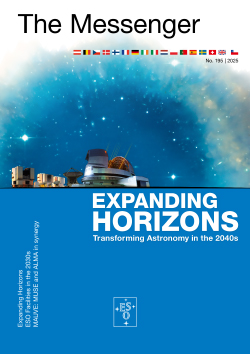
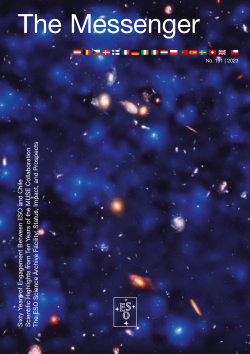
Messenger Issue 195
2025Issue 195
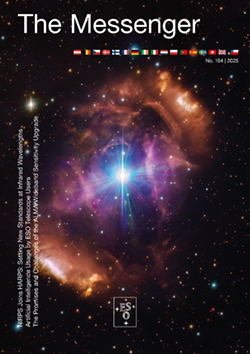
Messenger Issue 194
2025Issue 194
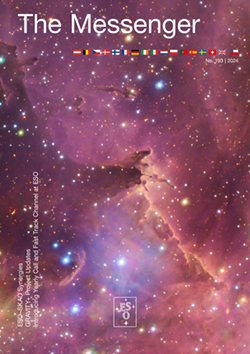
Messenger Issue 193
2024Issue 193
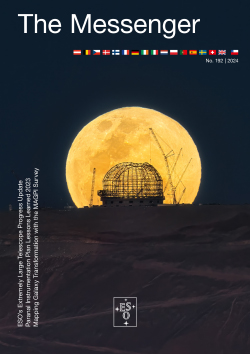
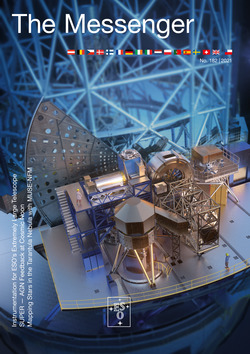
Messenger Issue 192
2024Issue 192
Messenger Issue 191
2023Issue 191
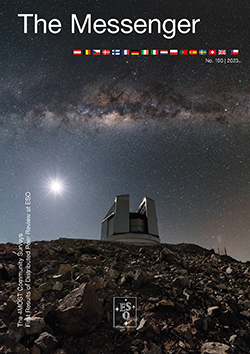
Messenger Issue 190
2023Issue 190
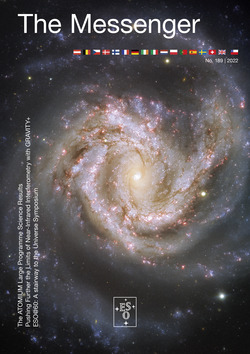
Messenger Issue 189
2022Issue 189
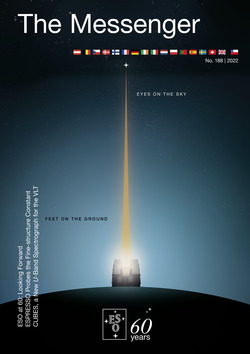
Messenger Issue 188
2022Issue 188
Messenger Issue 187
2022Issue 187
Messenger Issue 186
2022Issue 186
Messenger Issue 185
2021Issue 185
Messenger Issue 184
2021Issue 184
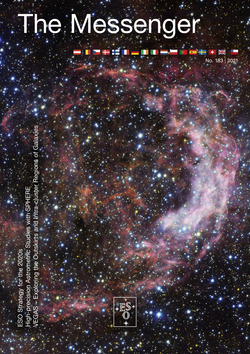
Messenger Issue 183
2021Issue 183
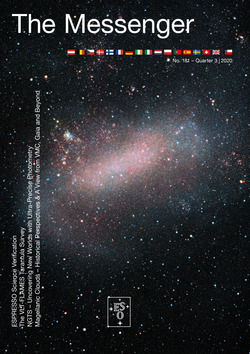
Messenger Issue 182
2021Issue 182
Messenger Issue 181
2020Issue 181
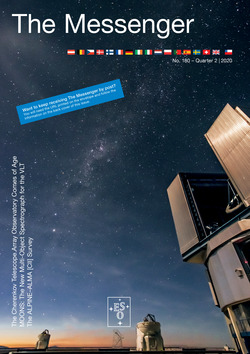
Messenger Issue 180
2020Issue 180
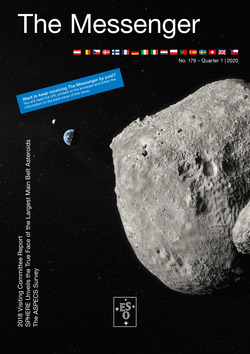
Messenger Issue 179
2020Issue 179
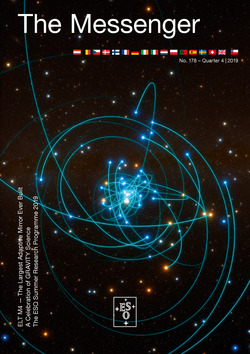
Messenger Issue 178
2019Issue 178
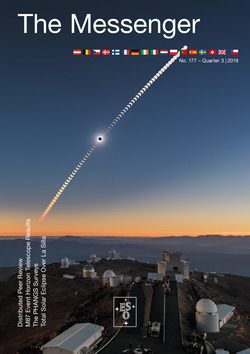
Messenger Issue 177
2019Issue 177
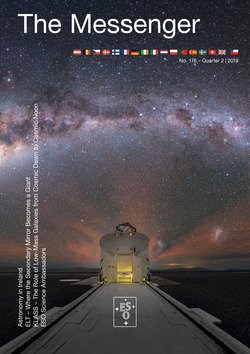
Messenger Issue 176
2019Issue 176
Table of Content No. 143 | 2011
The Organisation
de Zeeuw, T., Pottasch, S. et al.
Adriaan Blaauw, 1914–2010
More...
ADS BibCode: 2011Msngr.143....2Z
Authors:
de Zeeuw, T.; Pottasch, S.; Wilson, R.
Abstract:
In the last issue of The Messenger (142, p. 51) only a brief obituary of Adriaan Blaauw, the second Director General of ESO, could be included at the time of going to press. There follow three tributes to Adriaan Blaauw: by Tim de Zeeuw, current ESO Director General; by his long-term colleague at the Kapteyn Institute, Stuart Pottasch; and by Raymond Wilson, who led the Optics Group during his tenure as Director General.

de Zeeuw, T.
Brazil to Join ESO
More...
ADS BibCode: 2011Msngr.143....5Z
Authors:
de Zeeuw, T.

Telescopes and Instrumentation
Piskunov, N., Snik, F. et al.
HARPSpol — The New Polarimetric Mode for HARPS
More...
ADS BibCode: 2011Msngr.143....7P
Authors:
Piskunov, N.; Snik, F.; Dolgopolov, A.; Kochukhov, O.; Rodenhuis, M.; Valenti, J.; Jeffers, S.; Makaganiuk, V.; Johns-Krull, C.; Stempels, E.; Keller, C.
Abstract:
The HARPS spectrograph can now perform a full polarisation analysis of spectra. It has been equipped with a polarimetric unit, HARPSpol, which was jointly designed and produced by Uppsala, Utrecht and Rice Universities and by the STScI. Here we present the new instrument, demonstrate its polarisation capabilities and show the first scientific results.

Nikolic, B., Richer, J. et al.
Tests of Radiometric Phase Correction with ALMA
More...
ADS BibCode: 2011Msngr.143...11N
Authors:
Nikolic, B.; Richer, J.; Bolton, R.; Hills, R.
Abstract:
Of the many challenges facing ALMA, one of the greatest is overcoming the natural seeing limit set by the atmosphere to achieve very high resolution images. Its longest antenna separations (baselines) permit ALMA to synthesise the effect of a single antenna with a diameter exceeding 15 km, but an accurate radio “adaptive optics” system is required to ensure ALMA’s images are diffraction limited. With initial test data now available from the first ALMA antennas in Chile, we describe current progress towards this goal.

Eisenhauer, F., Perrin, G. et al.
GRAVITY: Observing the Universe in Motion
More...
ADS BibCode: 2011Msngr.143...16E
Authors:
Eisenhauer, F.; Perrin, G.; Brandner, W.; Straubmeier, C.; Perraut, K.; Amorim, A.; Schöller, M.; Gillessen, S.; Kervella, P.; Benisty, M.; Araujo-Hauck, C.; Jocou, L.; Lima, J.; Jakob, G.; Haug, M.; Clénet, Y.; Henning, T.; Eckart, A.; Berger, J.-P.; Garcia, P.; Abuter, R.; Kellner, S.; Paumard, T.; Hippler, S.; Fischer, S.; Moulin, T.; Villate, J.; Avila, G.; Gräter, A.; Lacour, S.; Huber, A.; Wiest, M.; Nolot, A.; Carvas, P.; Dorn, R.; Pfuhl, O.; Gendron, E.; Kendrew, S.; Yazici, S.; Anton, S.; Jung, Y.; Thiel, M.; Choquet, É; Klein, R.; Teixeira, P.; Gitton, P.; Moch, D.; Vincent, F.; Kudryavtseva, N.; Ströbele, S.; Sturm, S.; Fédou, P.; Lenzen, R.; Jolley, P.; Kister, C.; Lapeyrère, V.; Naranjo, V.; Lucuix, C.; Hofmann, R.; Chapron, F.; Neumann, U.; Mehrgan, L.; Hans, O.; Rousset, G.; Ramos, J.; Suarez, M.; Lederer, R.; Reess, J.-M.; Rohloff, R.-R.; Haguenauer, P.; Bartko, H.; Sevin, A.; Wagner, K.; Lizon, J.-L.; Rabien, S.; Collin, C.; Finger, G.; Davies, R.; Rouan, D.; Wittkowski, M.; Dodds-Eden, K.; Ziegler, D.; Cassaing, F.; Bonnet, H.; Casali, M.; Genzel, R.; Lena, P.
Abstract:
GRAVITY is the second generation Very Large Telescope Interferometer instrument for precision narrow-angle astrometry and interferometric imaging. With its fibre-fed integrated optics, wavefront sensors, fringe tracker, beam stabilisation and a novel metrology concept, GRAVITY will push the sensitivity and accuracy of astrometry and interferometric imaging far beyond what is offered today. Providing precision astrometry of order 10 microarcseconds, and imaging with 4-milliarcsecond resolution, GRAVITY will revolutionise dynamical measurements of celestial objects: it will probe physics close to the event horizon of the Galactic Centre black hole; unambiguously detect and measure the masses of black holes in massive star clusters throughout the Milky Way; uncover the details of mass accretion and jets in young stellar objects and active galactic nuclei; and probe the motion of binary stars, exoplanets and young stellar discs. The instrument capabilities of GRAVITY are outlined and the science opportunities that will open up are summarised.

Gilmozzi, R., Kissler-Patig, M.
The E-ELT has Successfully Passed the Phase B Final Design Review
More...
ADS BibCode: 2011Msngr.143...25G
Authors:
Gilmozzi, R.; Kissler-Patig, M.

Astronomical Science
Fosbury, R., Koch, G. et al.
Ozone: Twilit Skies, and (Exo-)planet Transits
More...
ADS BibCode: 2011Msngr.143...27F
Authors:
Fosbury, R.; Koch, G.; Koch, J.
Abstract:
Although only a trace constituent gas in the Earth’s atmosphere, ozone plays a critical role in protecting the Earth’s surface from receiving a damaging flux of solar ultraviolet radiation. What is not generally appreciated, however, is that the intrinsically weak, visible Chappuis absorption band becomes an important influence on the colour of the entire sky when the Sun is low or just below the horizon. This effect has been explored using spectra of the sunset and also of the eclipsed Moon; phenomena that involve a similar passage of sunlight tangential to the Earth’s surface. This geometry will also be relevant in future attempts to perform transit spectroscopy of exo-Earths.

Pontoppidan, K.M., van Dishoeck, E. et al.
Planet-forming Regions at the Highest Spectral and Spatial Resolution with VLT–CRIRES
More...
ADS BibCode: 2011Msngr.143...32P
Authors:
Pontoppidan, K.M.; van Dishoeck, E.; Blake, G.A.; Smith, R.; Brown, J.; Herczeg, G.J.; Bast, J.; Mandell, A.; Smette, A.; Thi, W.-F.; Young, E.D.; Morris, M.R.; Dent, W.; Käufl, H.U.
Abstract:
The inner regions (< 10 AU) of discs surrounding young pre-main sequence stars are thought to be places of active planet formation. The disc surfaces are traced by molecular emission lines in the infrared. We have carried out a spectroscopic 3–5 μm survey at the highest spectral resolution (as high as R = 100000) using CRIRES on the VLT, and have used the data to map the dynamics and chemistry of molecular gas, with the aims of constraining disc evolution and learning more about the process of planet formation. In this paper, we provide a brief overview of our CRIRES observing campaign and discuss the results obtained.

Péroux, C., Bouché, N. et al.
The SINFONI Integral Field Spectroscopy Survey for Galaxy Counterparts to Damped Lyman-α Systems
More...
ADS BibCode: 2011Msngr.143...37P
Authors:
Péroux, C.; Bouché, N.; Kulkarni, V.; York, D.; Vladilo, G.
Abstract:
A complete picture of galaxy formation can only be obtained by detailed study of the processes by which galaxies convert their gas into stars. One approach is to relate the H I gas and the stars in galaxies. Damped and sub-damped Lyman-α systems (DLAs), which are galaxies probed by the absorption they produce in the spectra of background quasars, are purely selected on H I gas, but identifying the galaxy responsible for the absorber with more traditional methods remains challenging. Integral field spectroscopy provides an efficient way of detecting faint galaxies near bright quasars, further providing immediate redshift confirmation. Here, we report on the detection of DLA and sub-DLA systems identified in Hα emission with VLT/SINFONI at near-infrared wavelengths.

Shanks, T., Bielby, R. et al.
The VLT VIMOS Lyman-break Galaxy Redshift Survey — First Results
More...
ADS BibCode: 2011Msngr.143...42S
Authors:
Shanks, T.; Bielby, R.; Infante, L.
Abstract:
We have completed the largest spectroscopic survey of Lyman-break galaxies (LBGs) at z ≈ 3, using the uniquely wide field of the VLT VIMOS multi-object spectrograph. The survey now contains about 2100 galaxy redshifts over the range 2 < z < 3.5 and is being used to investigate gas outflows from galaxies and large-scale structures at z ≈ 3. These results are having an immediate impact on theories of galaxy formation and producing new tests of the standard cosmological model. In particular, we find: further evidence from their clustering that LBGs may be the progenitors of spiral galaxies; new evidence for gas outflows from star-forming galaxies as required by theoretical galaxy formation models; and new evidence for gravitational infall of galaxies into clusters at a rate that is consistent with the standard cosmology.

Astronomical News
Grosbøl, P., Carraro, G. et al.
Report on the ESO Workshop ''Spiral Structure in the Milky Way: Confronting Observations and Theory''
More...
ADS BibCode: 2011Msngr.143...47G
Authors:
Grosbøl, P.; Carraro, G.; Beletsky, Y.
Abstract:
The main objectives of the workshop were to review current observational evidence for spiral arms in our Galaxy and confront them with models of spiral structure in order to arrive at a consistent picture. Of primary importance was to understand just what additional information is required to resolve outstanding issues related to the spiral structure in the Milky Way, especially as new survey instruments (e.g., ALMA, VISTA and VST) are coming online and major space missions like GAIA will be launched in the near future.

Randich, S., Covino, S. et al.
Report on the Workshop ''The First Year of Science with X-shooter''
More...
ADS BibCode: 2011Msngr.143...49R
Authors:
Randich, S.; Covino, S.; Cristiani, S.
Abstract:
The workshop was held with the aim of bringing together X-shooter users to discuss scientific results, performance and technical aspects, after the first year of successful operations of the instrument. The workshop was also organised to commemorate Roberto Pallavicini, whose scientific and human contribution to the development of X-shooter was invaluable and a source of continuous inspiration for all of us. A touching presentation focusing on the scientific personality of Roberto was given by Luca Pasquini on the second day of the workshop.

Testi, L., Pilbratt, G. et al.
Report on the ESO Workshop ''The Impact of Herschel Surveys on ALMA Early Science''
More...
ADS BibCode: 2011Msngr.143...52T
Authors:
Testi, L.; Pilbratt, G.; Andreani, P.
Abstract:
The ESA Herschel Space Observatory is currently producing new and exciting results, thanks to its unprecedented sensitivity, spectral resolution and wide-area surveying capabilities at far-infrared and submillimetre wavelengths. Many of the new discoveries by Herschel will require high angular resolution follow-up observations with ALMA. The goal of the workshop was to discuss the priorities for ALMA Early Science follow-up of the Herschel photometric and spectroscopic surveys. The possibility, or need for, simultaneous observing programmes with ALMA and Herschel was also discussed.

Sarazin, M.
Site Surveys for the Extremely Large Telescopes and More: Sharing the Experience and the Data
More...
ADS BibCode: 2011Msngr.143...56S
Authors:
Sarazin, M.
Abstract:
As the site surveys for the Extremely Large Telescopes are nearing completion, two workshops gathered site testing specialists and atmospheric physicists to discuss the instrumental and data analysis issues. The two workshops are briefly reported.

Hainaut, O., Sandu, O. et al.
ESO’s Hidden Treasures Competition
More...
ADS BibCode: 2011Msngr.143...57H
Authors:
Hainaut, O.; Sandu, O.; Christensen, L.L.
Abstract:
ESO’s Hidden Treasures astrophotography competition gave amateur astronomers the opportunity to search ESO’s Science Archive for a well-hidden cosmic gem. The competition attracted nearly one hundred entries and the winners were announced in January 2011. Astronomy enthusiast Igor Chekalin from Russia won the first prize — a trip to the Very Large Telescope at Paranal — in this difficult but rewarding challenge.

ESO
Fellows at ESO
More...
ADS BibCode: 2011Msngr.143...59.
Authors:
ESO

ESO
Personnel Movements
More...
ADS BibCode: 2011Msngr.143...60.
Authors:
ESO

ESO
ESO Studentship Programme
More...
ADS BibCode: 2011Msngr.143...61.
Authors:
ESO

ESO
Announcement of the ESO Workshop ''Multiwavelength Views of the ISM in High-redshift Galaxies''
More...
ADS BibCode: 2011Msngr.143Q..62.
Authors:
ESO

ESO
Announcement of the ESO/MPE/MPA/Excellence Cluster/USM Joint Astronomy Workshop ''Formation and Early Evolution of Very Low Mass Stars and Brown Dwarfs''
More...
ADS BibCode: 2011Msngr.143R..62.
Authors:
ESO

ESO
Announcement of the Workshop ''Feeding the Giants: ELTs in the Era of Surveys''
More...
ADS BibCode: 2011Msngr.143...63.
Authors:
ESO

Annual Index
ESO
Annual Index 2010 (Nos. 139–142)
More...
ADS BibCode: 2011Msngr.143...64.
Authors:
ESO

Our use of Cookies

We use cookies that are essential for accessing our websites and using our services. We also use cookies to analyse, measure and improve our websites’ performance, to enable content sharing via social media and to display media content hosted on third-party platforms.

You can manage your cookie preferences and find out more by visiting 'Cookie Settings and Policy'.

ESO Cookies Policy


The European Organisation for Astronomical Research in the Southern Hemisphere (ESO) is the pre-eminent intergovernmental science and technology organisation in astronomy. It carries out an ambitious programme focused on the design, construction and operation of powerful ground-based observing facilities for astronomy.

This Cookies Policy is intended to provide clarity by outlining the cookies used on the ESO public websites, their functions, the options you have for controlling them, and the ways you can contact us for additional details.

What are cookies?

Cookies are small pieces of data stored on your device by websites you visit. They serve various purposes, such as remembering login credentials and preferences and enhance your browsing experience.

Categories of cookies we use

Essential cookies (always active): These cookies are strictly necessary for the proper functioning of our website. Without these cookies, the website cannot operate correctly, and certain services, such as logging in or accessing secure areas, may not be available; because they are essential for the website’s operation, they cannot be disabled.

Cookie ID/Name
Description/Purpose
Provider (1st party or 3rd party)
Browser session cookie or Stored cookie?
Duration
csrftoken
XSRF protection token. We use this cookie to protect against cross-site request forgery attacks.
1st party
Stored
1 year
user_privacy
Your privacy choices. We use this cookie to save your privacy preferences.
1st party
Stored
6 months
_grecaptcha
We use reCAPTCHA to protect our forms against spam and abuse. reCAPTCHA sets a necessary cookie when executed for the purpose of providing its risk analysis. We use www.recaptcha.net instead of www.google.com in order to avoid unnecessary cookies from Google.
3rd party
Stored
6 months

Analytics cookies: These cookies collect information about how visitors interact with our website, such as which pages are visited most often and how users navigate the site. This data helps us improve website performance, optimize content, and enhance the user experience; these cookies are only placed if you provide your consent. We use the following analytics cookies.

Matomo Cookies:

This website uses Matomo (formerly Piwik), an open source software which enables the statistical analysis of website visits. Matomo uses cookies (text files) which are saved on your computer and which allow us to analyze how you use our website. The website user information generated by the cookies will only be saved on the servers of our IT Department. We use this information to analyze www.eso.org visits and to prepare reports on website activities. These data will not be disclosed to third parties.

On behalf of ESO, Matomo will use this information for the purpose of evaluating your use of the website, compiling reports on website activity and providing other services relating to website activity and internet usage.

ON | OFF

Matomo cookies settings:

Cookie ID/Name
Description/Purpose
Provider (1st party or 3rd party)
Browser session cookie or Stored cookie?
Duration
Settings
_pk_id
Stores a unique visitor ID.
1st party
Stored
13 months
_pk_ses
Session cookie temporarily stores data for the visit.
1st party
Stored
30 minutes
_pk_ref
Stores attribution information (the referrer that brought the visitor to the website).
1st party
Stored
6 months
_pk_testcookie
Temporary cookie to check if a visitor’s browser supports cookies (set in Internet Explorer only).
1st party
Stored
Temporary cookie that expires almost immediately after being set.

Additional Third-party cookies on ESO websites: some of our pages display content from external providers, e.g. YouTube.

Such third-party services are outside of ESO control and may, at any time, change their terms of service, use of cookies, etc.

YouTube: Some videos on the ESO website are embedded from ESO’s official YouTube channel. We have enabled YouTube’s privacy-enhanced mode, meaning that no cookies are set unless the user actively clicks on the video to play it. Additionally, in this mode, YouTube does not store any personally identifiable cookie data for embedded video playbacks. For more details, please refer to YouTube’s embedding videos information page.

Cookies can also be classified based on the following elements.

Regarding the domain, there are:

As for their duration, cookies can be:

How to manage cookies

Cookie settings: You can modify your cookie choices for the ESO webpages at any time by clicking on the link Cookie settings at the bottom of any page.

In your browser: If you wish to delete cookies or instruct your browser to delete or block cookies by default, please visit the help pages of your browser:

Please be aware that if you delete or decline cookies, certain functionalities of our website may be not be available and your browsing experience may be affected.

You can set most browsers to prevent any cookies being placed on your device, but you may then have to manually adjust some preferences every time you visit a site/page. And some services and functionalities may not work properly at all (e.g. profile logging-in, shop check out).

Updates to the ESO Cookies Policy

The ESO Cookies Policy may be subject to future updates, which will be made available on this page.

Additional information

For any queries related to cookies, please contact: pdprATesoDOTorg.

As ESO public webpages are managed by our Department of Communication, your questions will be dealt with the support of the said Department.