European
Southern
Observatory

The Messenger
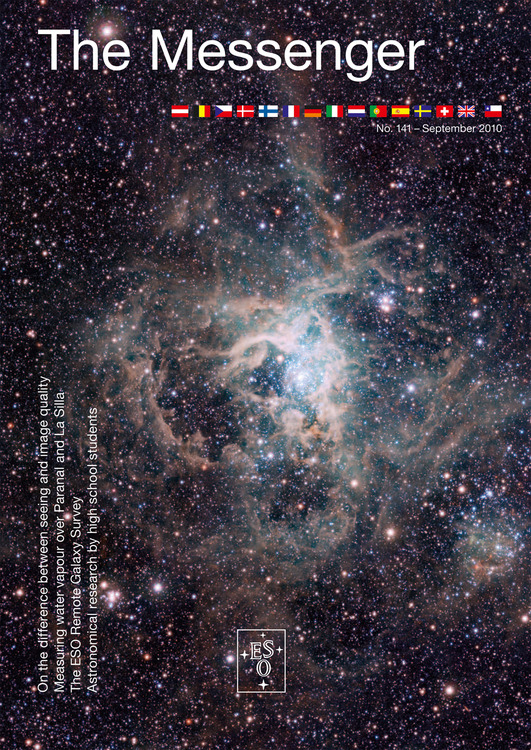
The Messenger is ESO’s journal for science and technology. It serves as a link between ESO and its broad astronomical community by providing information about scientific, technical, and other developments. It also delivers relevant news about astronomy and astrophysics to a broader public, including policy-makers, government officials, journalists, teachers, and amateur astronomers, as well as to interested scientists from other fields.

The Messenger is published twice per year and is available for free download as a PDF here and via the digital publishing platform Scribd.
Subscribe
If you wish to receive the new issue directly into your inbox, sign up here:
Issue 141
Messenger Issue 141

The Messenger Issue 141

Highlights include:

  • Martinez, P., Kolb, J. et al.: On the Difference between Seeing and Image Quality: When the Turbulence Outer Scale Enters the Game
  • Schuller, F., Beuther, H. et al.: The APEX Telescope Large Area Survey of the Galaxy (ATLASGAL)
  • Saito, R., Hempel, M. et al.: VISTA Variables in the Vía Láctea (VVV): Current Status and First Results
  • Fosbury, R., Trygg, T.: Solargraphs of ESO
  • Sartori, L., Pelloni, C.: The Experience of Two High School Students Doing Astronomical Research at ESO

Read the full PDF

Past Issues
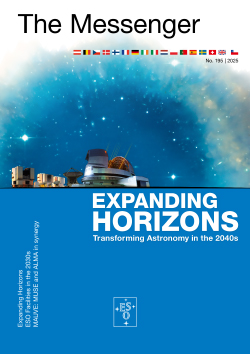
Messenger Issue 195
2025Issue 195
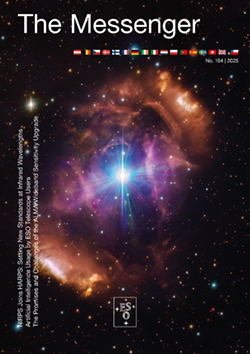
Messenger Issue 194
2025Issue 194
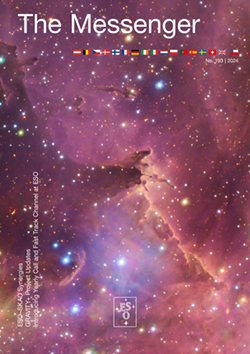
Messenger Issue 193
2024Issue 193
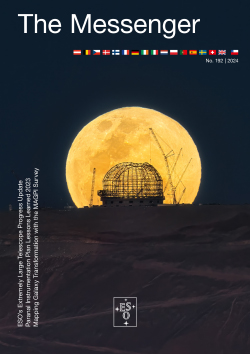
Messenger Issue 192
2024Issue 192
Messenger Issue 191
2023Issue 191
Messenger Issue 190
2023Issue 190
Messenger Issue 189
2022Issue 189
Messenger Issue 188
2022Issue 188
Messenger Issue 187
2022Issue 187
Messenger Issue 186
2022Issue 186
Messenger Issue 185
2021Issue 185
Messenger Issue 184
2021Issue 184
Messenger Issue 183
2021Issue 183
Messenger Issue 182
2021Issue 182
Messenger Issue 181
2020Issue 181
Messenger Issue 180
2020Issue 180
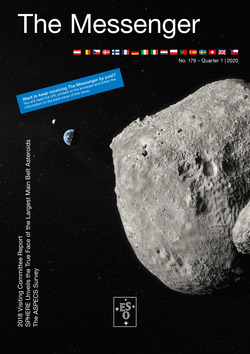
Messenger Issue 179
2020Issue 179
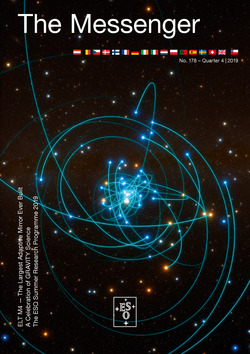
Messenger Issue 178
2019Issue 178
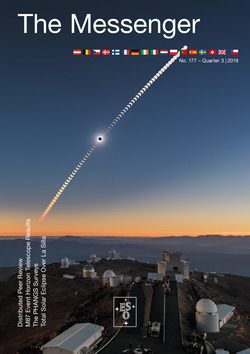
Messenger Issue 177
2019Issue 177
Messenger Issue 176
2019Issue 176
Table of Content No. 141 | 2010
Telescopes and Instrumentation
Kenworthy, M., Quanz, S. et al.
A New Coronagraph for NAOS–CONICA — the Apodising Phase Plate
More...
ADS BibCode: 2010Msngr.141....2K
Authors:
Kenworthy, M.; Quanz, S.; Meyer, M.; Kasper, M.; Girard, J.; Lenzen, R.; Codona, J.; Hinz, P.
Abstract:
In April 2010, a new coronagraphic optical element, called an Apodising Phase Plate (APP), was installed in NAOS–CONICA (NACO). The APP coronagraph is optimised for use at 4.05 µm with both narrow- and broadband filters. Unlike other types of coronagraph, it requires no alignment overhead and can be used immediately after switching from direct imaging for observing targets of interest where high contrast is required.

Martinez, P., Kolb, J. et al.
On the Difference between Seeing and Image Quality: When the Turbulence Outer Scale Enters the Game
More...
ADS BibCode: 2010Msngr.141....5M
Authors:
Martinez, P.; Kolb, J.; Sarazin, M.; Tokovinin, A.
Abstract:
We attempt to clarify the frequent confusion between seeing and image quality for large telescopes. The full width at half maximum of a stellar image is commonly considered to be equal to the atmospheric seeing. However the outer scale of the turbulence, which corresponds to a reduction in the low frequency content of the phase perturbation spectrum, plays a significant role in the improvement of image quality at the focus of a telescope. The image quality is therefore different (and in some cases by a large factor) from the atmospheric seeing that can be measured by dedicated seeing monitors, such as a differential image motion monitor.

Kerber, F., Querel, R. et al.
Balloons over the La Silla Paranal Observatory
More...
ADS BibCode: 2010Msngr.141....9K
Authors:
Kerber, F.; Querel, R.; Hanuschik, R.; Chacón, A.; Sarazin, M.; on behalf of the project team
Abstract:
Precipitable water vapour (PWV) in the atmosphere is one of several key properties required to characterise overall quality of an astronomical site for observations at infrared wavelengths. Through analysis of archival data and by mounting a series of dedicated PWV measurement campaigns, we achieved our goal of establishing the Paranal Observatory as a reference site for evaluation of locations for the European Extremely Large Telescope (E-ELT) project. For the first time in an astronomical study, all measurement methods have been successfully validated with respect to balloon-borne radiosondes, the accepted standard in atmospheric research.

Astronomical Science
Barucci, M.A., Alvarez-Candal, A. et al.
The Outer Frontiers of the Solar System: Trans-Neptunian Objects and Centaurs
More...
ADS BibCode: 2010Msngr.141...15B
Authors:
Barucci, M.A.; Alvarez-Candal, A.; Belskaya, I.; de Bergh, C.; DeMeo, F.; Dotto, E.; Fornasier, S.; Merlin, F.; Perna, D.
Abstract:
The icy bodies in orbit beyond Neptune and known as Trans-Neptunian objects (TNOs), or Kuiper Belt objects, are the most distant objects of the Solar System accessible to direct investigation from the ground. The study of these objects, containing the least processed material of the Solar System, can help in understanding the still-puzzling accretion/evolution processes that governed planetary formation in our Solar System as well as in other dusty star discs. An ESO large programme has been devoted to obtaining simultaneous high quality visible and near-infrared spectroscopy and photometry of about forty objects with various dynamical properties. A few selected objects have also been observed with polarimetry to define their surface characteristics better and with detailed photometry to determine their rotational properties. The results provide a unique insight into the physical and surface properties of these remote objects.

Schuller, F., Beuther, H. et al.
The APEX Telescope Large Area Survey of the Galaxy (ATLASGAL)
More...
ADS BibCode: 2010Msngr.141...20S
Authors:
Schuller, F.; Beuther, H.; Bontemps, S.; Bronfman, L.; Carlhoff, P.; Cesaroni, R.; Contreras, Y.; Csengari, T.; Deharveng, L.; Garay, G.; Henning, T.; Herpin, F.; Immer, K.; Lefloch, B.; Linz, H.; Mardones, D.; Menten, K.; Minier, V.; Molinari, S.; Motte, F.; Nguyen Luong, Q.; Nyman, L.-Å.; Rathborne, J.; Reveret, V.; Risacher, C.; Russeil, D.; Schilke, P.; Schneider, N.; Tackenberg, J.; Testi, L.; Troost, T.; Vasyunina, T.; Walmsley, M.; Wienen, M.; Wyrowski, F.; Zavagno, A.
Abstract:
Thermal emission from dust at submillimetre wavelengths is a direct tracer of high column densities and, thus, of dense cloud regions in which new stars are forming. Surveys of the Galactic Plane in thermal dust emission have the potential to deliver an unbiased view of high-mass star formation throughout the Milky Way. The Atacama Pathfinder Experiment (APEX) telescope is ideally located for mapping the inner Galaxy. Using the Large APEX Bolometer Camera (LABOCA), we have recently completed the APEX Telescope Large Area Survey of the Galaxy (ATLASGAL). This survey, which covers 360 square degrees at 870 µm, provides the first unbiased sample of cold dusty clumps in the Galaxy at submillimetre wavelengths and reveals the clumpy structure of the cold interstellar medium over very large scales that have previously been little explored.

Saito, R., Hempel, M. et al.
VISTA Variables in the Vía Láctea (VVV): Current Status and First Results
More...
ADS BibCode: 2010Msngr.141...24S
Authors:
Saito, R.; Hempel, M.; Alonso-García, J.; Toledo, I.; Borissova, J.; González, O.; Beamin, J.C.; Minniti, D.; Lucas, P.; Emerson, J.; Ahumada, A.; Aigrain, S.; Alonso, M.V.; Amôres, E.; Angeloni, R.; Arias, J.; Bandyopadhyay, R.; Barbá, R.; Barbuy, B.; Baume, G.; Bedin, L.; Bica, E.; Bronfman, L.; Carraro, G.; Catelan, M.; Clariá, J.; Contreras, C.; Cross, N.; Davis, C.; de Grijs, R.; Dékány, I.; Drew, J.; Fariña, C.; Feinstein, C.; Fernández Lajús, E.; Folkes, S.; Gamen, R.; Geisler, D.; Gieren, W.; Goldman, B.; Gosling, A.; Gunthardt, G.; Gurovich, S.; Hambly, N.; Hanson, M.; Hoare, M.; Irwin, M.; Ivanov, V.; Jordán, A.; Kerins, E.; Kinemuchi, K.; Kurtev, R.; Longmore, A.; López-Corredoira, M.; Maccarone, T.; Martín, E.; Masetti, N.; Mennickent, R.; Merlo, D.; Messineo, M.; Mirabel, F.; Monaco, L.; Moni Bidin, C.; Morelli, L.; Padilla, N.; Palma, T.; Parisi, M.C.; Parker, Q.; Pavani, D.; Pietrukowicz, P.; Pietrzynski, G.; Pignata, G.; Rejkuba, M.; Rojas, A.; Roman-Lopes, A.; Ruiz, M.T.; Sale, S.; Saviane, I.; Schreiber, M.; Schröder, A.; Sharma, S.; Smith, M.; Sodré Jr., L.; Soto, M.; Stephens, A.; Tamura, M.; Tappert, C.; Thompson, M.; Valenti, E.; Vanzi, L.; Weidmann, W.; Zoccali, M.
Abstract:
VISTA Variables in the Vía Láctea (VVV) is a public ESO near-IR variability survey aimed at scanning the Milky Way Bulge and an adjacent section of the mid-plane. VVV observations started in October 2009 during ESO science verification. Regular observations for the first year of the survey have been conducted since February 2010 and will cover a total area of 520 square degrees in five passbands and five epochs. Here we address the first results obtained from the VVV Survey as well as the current status of the observations.

Giuffrida, G., Sbordone, L. et al.
A Wide-angle VIMOS Survey of the Sagittarius Dwarf Spheroidal Galaxy
More...
ADS BibCode: 2010Msngr.141...29G
Authors:
Giuffrida, G.; Sbordone, L.; Zaggia, S.; Marconi, G.; Bonifacio, P.; Izzo, C.; Szeifert, T.; Buonanno, R.
Abstract:
Using VIMOS in imaging and spectroscopy modes and FLAMES spectroscopy data, we have mapped the Sagittarius dwarf spheroidal galaxy (Sgr dSph) photometrically and spectroscopically over eight fields along the galaxy minor and major axes. We have found, for the first time, striking evidence of multiple populations in the peripheral zones of this near companion of the Milky Way. These data, together with previous analyses of the Sgr dSph core and streams, supply a detailed picture of this galaxy, and will give us the opportunity to reconstruct the history of this object and its influence on the evolution of the Milky Way.

Bremer, M., Lehnert, M. et al.
Studying the Properties of Early Galaxies with the ESO Remote Galaxy Survey
More...
ADS BibCode: 2010Msngr.141...32B
Authors:
Bremer, M.; Lehnert, M.; Douglas, L.; Stanway, E.; Davies, L.; Clowe, D.; Milvang-Jensen, B.; Birkinshaw, M.
Abstract:
We present a discussion of and results from the ESO Remote Galaxy Survey (ERGS), a spectroscopic survey of Lyman-break galaxies with z ~ 5 and above. The survey directly explores the properties of these early star-forming galaxies, increasing the observational detail in our picture of early galaxy evolution. The survey provides a sample of galaxies ideally matched in spatial distribution to the capabilities of current and imminently available instrumentation. We discuss the results of the first follow-on studies of the sample in the mm/sub-mm that signpost the potential of these facilities for exploring early galaxy evolution.

Astronomical News
Neumayer, N., Emsellem, E.
Report on the ESO Workshop ''Central Massive Objects: The Stellar Nuclei – Black Hole Connection''
More...
ADS BibCode: 2010Msngr.141...37N
Authors:
Neumayer, N.; Emsellem, E.
Abstract:
An overview of the ESO workshop on black holes and nuclear star clusters is presented. The meeting reviewed the status of our observational and theoretical understanding of central massive objects, as well as the search for intermediate mass black holes in globular clusters. There will be no published proceedings, but presentations are available at http://www.eso.org/sci/meetings/cmo2010/program.html.

Casali, M.
The 2010 SPIE Symposium on Astronomical Telescopes and Instrumentation
More...
ADS BibCode: 2010Msngr.141...40C
Authors:
Casali, M.
Abstract:
A brief overview of the 2010 SPIE Symposium on Astronomical Telescopes and Instrumentation, with emphasis on the ESO contributions, is presented.

Laing, R., Maiolino, R. et al.
Report on the ESO Workshop ''Science with ALMA Band 5''
More...
ADS BibCode: 2010Msngr.141...41L
Authors:
Laing, R.; Maiolino, R.; Rykaczewski, H.; Testi, L.
Abstract:
A small complement of receivers for the ALMA Band 5 (163–211 GHz) is under construction. This workshop was devoted to the scientific potential and goals of a full set of Band 5 receivers for ALMA, with emphasis on the detection of water in the local Universe and the 158 µm emission line of C+ from high redshift galaxies.

Fosbury, R., Trygg, T.
Solargraphs of ESO
More...
ADS BibCode: 2010Msngr.141...43F
Authors:
Fosbury, R.; Trygg, T.
Abstract:
The recently developed technique of simple pinhole camera “solargraphy” enables images of the path of the Sun to be recorded over long periods. Solargraphy cameras have been installed at the three ESO observatory sites in Chile and at ESO Headquarters in Garching. These intriguing images are presented and described. They illustrate, in a very direct way, the clear skies at the observatories.

Sartori, L., Pelloni, C.
The Experience of Two High School Students Doing Astronomical Research at ESO
More...
ADS BibCode: 2010Msngr.141...46S
Authors:
Sartori, L.; Pelloni, C.
Abstract:
As a project for diploma work at the end of Swiss high school, long-slit kinematic data for two giant elliptical galaxies, observed with the FORS1 spectrograph at the ESO VLT, were reduced by two students. The reduction of these data was our first research experience. The preparation and reduction of the long-slit data is outlined. We also describe our impressions of this first encounter with the scientific research world.

Primas, F., Casali, M. et al.
ESO Astronomers Emeriti — Sandro D’Odorico and Alan Moorwood
More...
ADS BibCode: 2010Msngr.141...50P
Authors:
Primas, F.; Casali, M.; Walsh, J.
Abstract:
In May and June 2010, Sandro D’Odorico and Alan Moorwood, both driving forces behind many ESO instruments and very active in research, retired after three decades at ESO. The ESO Director General, Tim de Zeeuw, elevated both to the newly inaugurated position of ESO Astronomer Emeritus. Celebrations on their transition to these esteemed positions were held and are briefly described.

ESO
New Staff at ESO
More...
ADS BibCode: 2010Msngr.141...51.
Authors:
ESO

ESO
Fellows at ESO
More...
ADS BibCode: 2010Msngr.141...53.
Authors:
ESO

ESO
Announcement of the ESO Workshop ''Dynamics of Low-Mass Stellar Systems: From Star Clusters to Dwarf Galaxies''
More...
ADS BibCode: 2010Msngr.141...54.
Authors:
ESO

ESO
Announcement of the ESO/Universidad de Valparaíso Workshop ''Evolution of Compact Binaries''
More...
ADS BibCode: 2010Msngr.141Q..55.
Authors:
ESO

ESO
Personnel Movements
More...
ADS BibCode: 2010Msngr.141R..55.
Authors:
ESO

Our use of Cookies

We use cookies that are essential for accessing our websites and using our services. We also use cookies to analyse, measure and improve our websites’ performance, to enable content sharing via social media and to display media content hosted on third-party platforms.

You can manage your cookie preferences and find out more by visiting 'Cookie Settings and Policy'.

ESO Cookies Policy


The European Organisation for Astronomical Research in the Southern Hemisphere (ESO) is the pre-eminent intergovernmental science and technology organisation in astronomy. It carries out an ambitious programme focused on the design, construction and operation of powerful ground-based observing facilities for astronomy.

This Cookies Policy is intended to provide clarity by outlining the cookies used on the ESO public websites, their functions, the options you have for controlling them, and the ways you can contact us for additional details.

What are cookies?

Cookies are small pieces of data stored on your device by websites you visit. They serve various purposes, such as remembering login credentials and preferences and enhance your browsing experience.

Categories of cookies we use

Essential cookies (always active): These cookies are strictly necessary for the proper functioning of our website. Without these cookies, the website cannot operate correctly, and certain services, such as logging in or accessing secure areas, may not be available; because they are essential for the website’s operation, they cannot be disabled.

Cookie ID/Name
Description/Purpose
Provider (1st party or 3rd party)
Browser session cookie or Stored cookie?
Duration
csrftoken
XSRF protection token. We use this cookie to protect against cross-site request forgery attacks.
1st party
Stored
1 year
user_privacy
Your privacy choices. We use this cookie to save your privacy preferences.
1st party
Stored
6 months
_grecaptcha
We use reCAPTCHA to protect our forms against spam and abuse. reCAPTCHA sets a necessary cookie when executed for the purpose of providing its risk analysis. We use www.recaptcha.net instead of www.google.com in order to avoid unnecessary cookies from Google.
3rd party
Stored
6 months

Analytics cookies: These cookies collect information about how visitors interact with our website, such as which pages are visited most often and how users navigate the site. This data helps us improve website performance, optimize content, and enhance the user experience; these cookies are only placed if you provide your consent. We use the following analytics cookies.

Matomo Cookies:

This website uses Matomo (formerly Piwik), an open source software which enables the statistical analysis of website visits. Matomo uses cookies (text files) which are saved on your computer and which allow us to analyze how you use our website. The website user information generated by the cookies will only be saved on the servers of our IT Department. We use this information to analyze www.eso.org visits and to prepare reports on website activities. These data will not be disclosed to third parties.

On behalf of ESO, Matomo will use this information for the purpose of evaluating your use of the website, compiling reports on website activity and providing other services relating to website activity and internet usage.

ON | OFF

Matomo cookies settings:

Cookie ID/Name
Description/Purpose
Provider (1st party or 3rd party)
Browser session cookie or Stored cookie?
Duration
Settings
_pk_id
Stores a unique visitor ID.
1st party
Stored
13 months
_pk_ses
Session cookie temporarily stores data for the visit.
1st party
Stored
30 minutes
_pk_ref
Stores attribution information (the referrer that brought the visitor to the website).
1st party
Stored
6 months
_pk_testcookie
Temporary cookie to check if a visitor’s browser supports cookies (set in Internet Explorer only).
1st party
Stored
Temporary cookie that expires almost immediately after being set.

Additional Third-party cookies on ESO websites: some of our pages display content from external providers, e.g. YouTube.

Such third-party services are outside of ESO control and may, at any time, change their terms of service, use of cookies, etc.

YouTube: Some videos on the ESO website are embedded from ESO’s official YouTube channel. We have enabled YouTube’s privacy-enhanced mode, meaning that no cookies are set unless the user actively clicks on the video to play it. Additionally, in this mode, YouTube does not store any personally identifiable cookie data for embedded video playbacks. For more details, please refer to YouTube’s embedding videos information page.

Cookies can also be classified based on the following elements.

Regarding the domain, there are:

As for their duration, cookies can be:

How to manage cookies

Cookie settings: You can modify your cookie choices for the ESO webpages at any time by clicking on the link Cookie settings at the bottom of any page.

In your browser: If you wish to delete cookies or instruct your browser to delete or block cookies by default, please visit the help pages of your browser:

Please be aware that if you delete or decline cookies, certain functionalities of our website may be not be available and your browsing experience may be affected.

You can set most browsers to prevent any cookies being placed on your device, but you may then have to manually adjust some preferences every time you visit a site/page. And some services and functionalities may not work properly at all (e.g. profile logging-in, shop check out).

Updates to the ESO Cookies Policy

The ESO Cookies Policy may be subject to future updates, which will be made available on this page.

Additional information

For any queries related to cookies, please contact: pdprATesoDOTorg.

As ESO public webpages are managed by our Department of Communication, your questions will be dealt with the support of the said Department.