European
Southern
Observatory

The Messenger
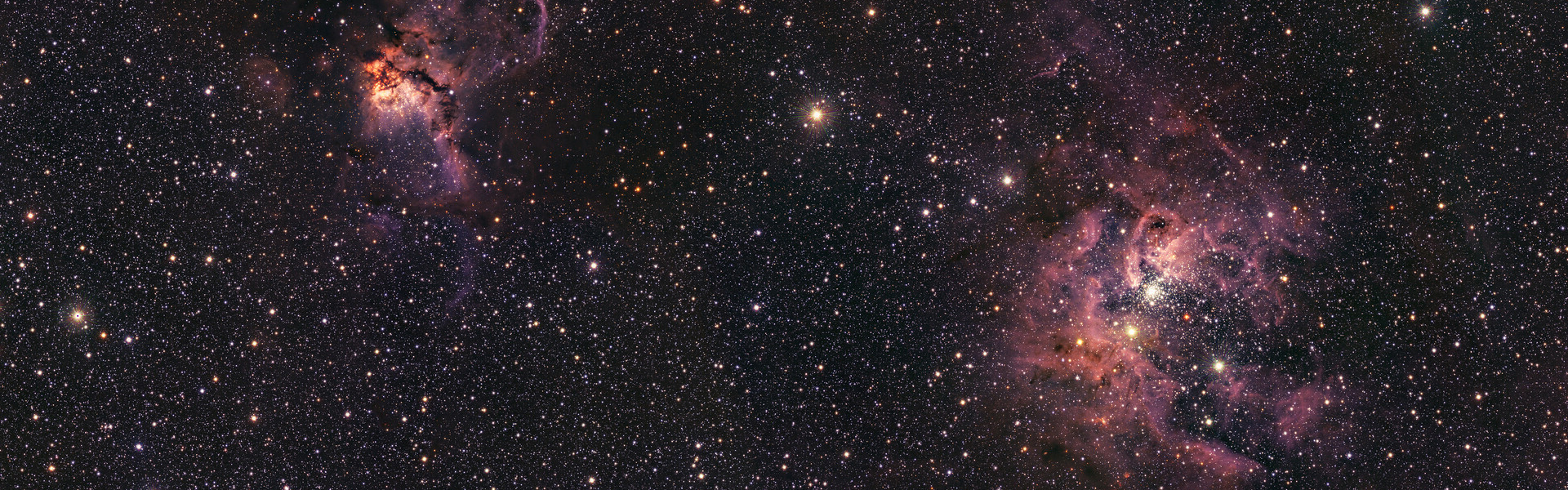
The Messenger is ESO’s journal for science and technology. It serves as a link between ESO and its broad astronomical community by providing information about scientific, technical, and other developments. It also delivers relevant news about astronomy and astrophysics to a broader public, including policy-makers, government officials, journalists, teachers, and amateur astronomers, as well as to interested scientists from other fields.

The Messenger is published twice per year and is available for free download as a PDF here and via the digital publishing platform Scribd.
Subscribe
If you wish to receive the new issue directly into your inbox, sign up here:
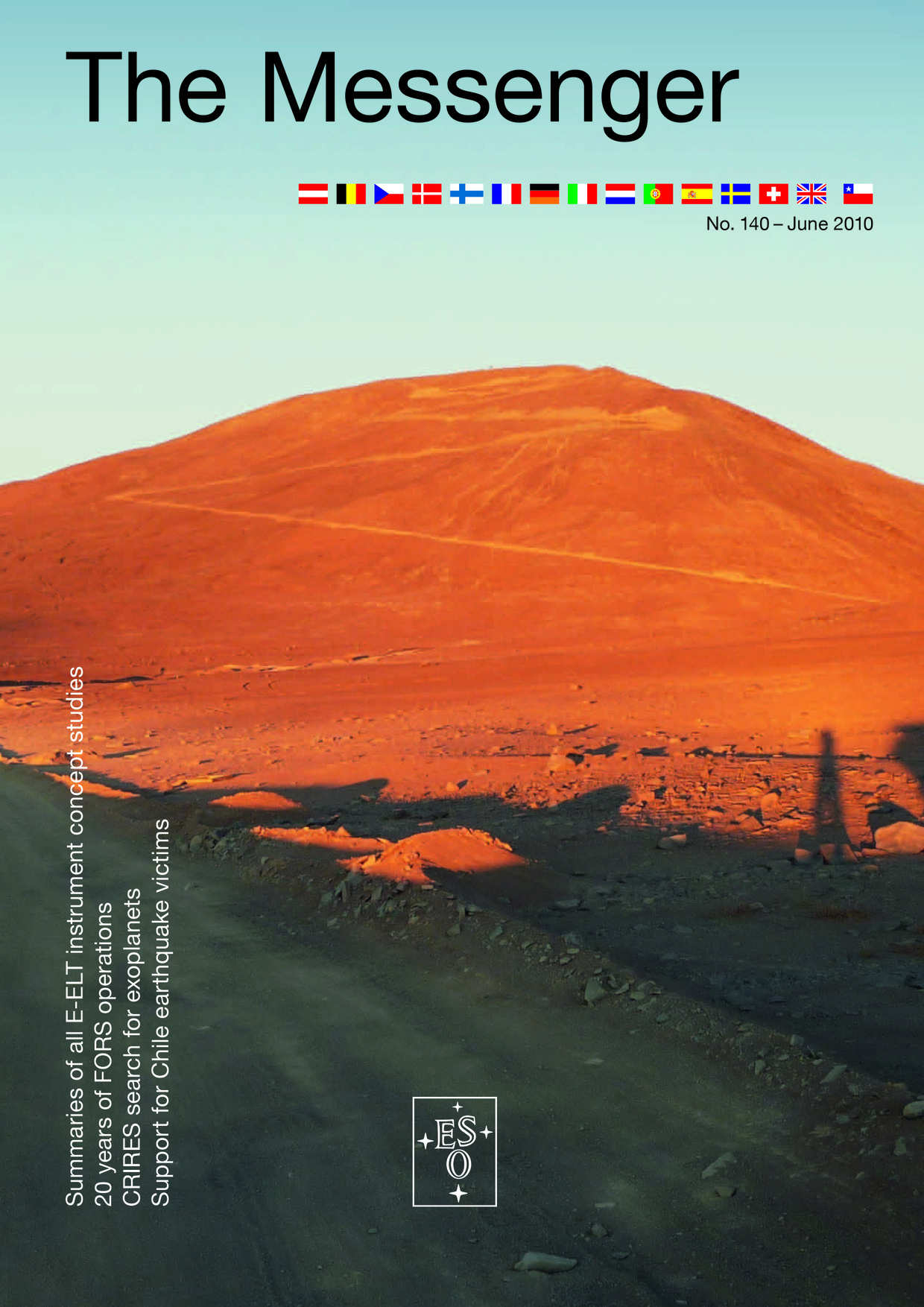
Issue 140
Messenger Issue 140

The Messenger Issue 140

Highlights include:

  • Martinez, P., Aller-Carpentier, E. et al.: The High Order Test Bench: Evaluating High Contrast Imaging Concepts for SPHERE and EPICS
  • D’Odorico, S., Ramsay, S. et al.: An Introduction to the E-ELT Instrumentation and Post-focal Adaptive Optics Module Studies
  • Vink, J.: Spectropolarimetry of Wolf–Rayet Stars in the Magellanic Clouds: Constraining the Progenitors of Gamma-ray Bursts
  • Rupprecht, G., Böhnhardt, H. et al.: Twenty Years of FORS Science Operations on the VLT

Read the full PDF

Past Issues
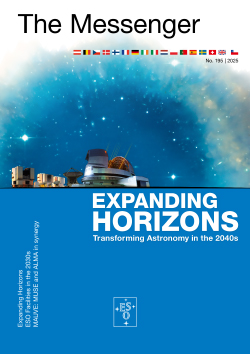
Messenger Issue 195
2025Issue 195
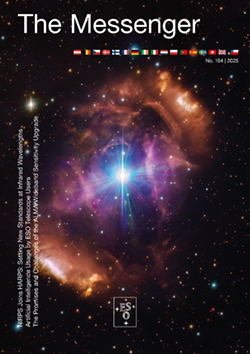
Messenger Issue 194
2025Issue 194
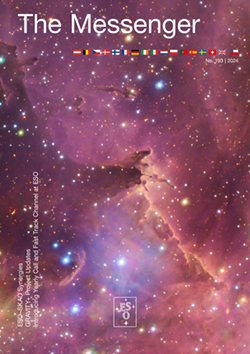
Messenger Issue 193
2024Issue 193
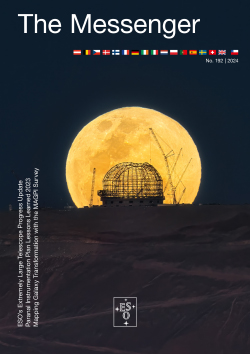
Messenger Issue 192
2024Issue 192
Messenger Issue 191
2023Issue 191
Messenger Issue 190
2023Issue 190
Messenger Issue 189
2022Issue 189
Messenger Issue 188
2022Issue 188
Messenger Issue 187
2022Issue 187
Messenger Issue 186
2022Issue 186
Messenger Issue 185
2021Issue 185
Messenger Issue 184
2021Issue 184
Messenger Issue 183
2021Issue 183
Messenger Issue 182
2021Issue 182
Messenger Issue 181
2020Issue 181
Messenger Issue 180
2020Issue 180
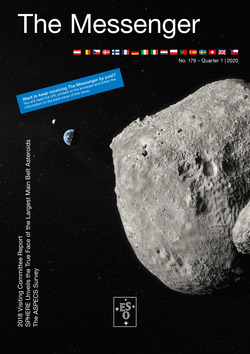
Messenger Issue 179
2020Issue 179
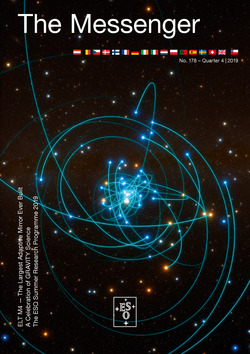
Messenger Issue 178
2019Issue 178
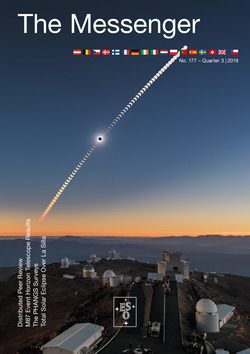
Messenger Issue 177
2019Issue 177
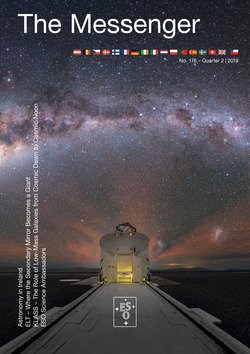
Messenger Issue 176
2019Issue 176
Table of Content No. 140 | 2010
Telescopes and Instrumentation
Rupprecht, G., Böhnhardt, H. et al.
Twenty Years of FORS Science Operations on the VLT
More...
ADS BibCode: 2010Msngr.140....2R
Authors:
Rupprecht, G.; Böhnhardt, H.; Moehler, S.; Møller, P.; Saviane, I.; Ziegler, B.
Abstract:
Celebrating the double jubilee of ten years in operation of FORS1 and FORS2, this article summarises, from an insider’s point of view, the history of the FORS instruments, arguably the most prolific on ESO’s Very Large Telescope. The FORS story began in the early 1990s and FORS1 was the first VLT user instrument to be commissioned. Both FORS instruments have undergone considerable evolution and quickly parted from the original concept of being identical twins. They have both made major contributions to scientific research and have helped shape VLT operations. In 2009, FORS1 was retired, but FORS2 continues, fusing the best of both.

Kasper, M., Zins, G. et al.
A New Lenslet Array for the NACO Laser Guide Star Wavefront Sensor
More...
ADS BibCode: 2010Msngr.140....8K
Authors:
Kasper, M.; Zins, G.; Feautrier, P.; O’Neal, J.; Michaud, L.; Rabou, P.; Stadler, E.; Charton, J.; Cumani, C.; Delboulbe, A.; Geimer, C.; Gillet, G.; Girard, J.; Huerta, N.; Kern, P.; Lizon, J.-L.; Lucuix, C.; Mouillet, D.; Moulin, T.; Rochat, S.; Sönke, C.
Abstract:
In February 2010, a new 14 × 14 lenslet array was installed in the NAOS–CONICA (NACO) visible wavefront sensor. Compared to the previously available array, this new array has a shorter focal length and hence a field of view that is large enough for the extended laser guide star (LGS) spot. This successful upgrade results in improved adaptive optics correction delivered by NACO with the LGS.

Martinez, P., Aller-Carpentier, E. et al.
The High Order Test Bench: Evaluating High Contrast Imaging Concepts for SPHERE and EPICS
More...
ADS BibCode: 2010Msngr.140...10M
Authors:
Martinez, P.; Aller-Carpentier, E.; Kasper, M.
Abstract:
The High Order Test bench (HOT) is an adaptive optics facility developed at ESO to test high contrast imaging instrument technologies and concepts. HOT reproduces realistically in the laboratory the conditions encountered at a telescope, including turbulence, high order adaptive optics correction and coronagraphy. Experiments carried out with HOT will be discussed mainly in the context of the SPHERE instrument.

Synopses of E-ELT Phase A and Instrument Concept Studies
D’Odorico, S., Ramsay, S. et al.
An Introduction to the E-ELT Instrumentation and Post-focal Adaptive Optics Module Studies
More...
ADS BibCode: 2010Msngr.140...17D
Authors:
D’Odorico, S.; Ramsay, S.; Hubin, N.; Gonzalez, J.C.; Zerbi, F.M.
Abstract:
The following eleven articles provide short summaries of the conceptual design studies for the European Extremely Large Telescope instruments and post-focal adaptive optics modules. The background and scope of these studies is outlined in this introduction.

Fusco, T.
ATLAS: An Advanced Tomographic Laser-assisted Adaptive Optics System
More...
ADS BibCode: 2010Msngr.140...18F
Authors:
Fusco, T.
Abstract:
ATLAS is a generic laser tomographic adaptive optics system for the E-ELT. Based on modular, relatively simple, and yet innovative concepts, it aims at providing diffraction-limited images in the near-infrared for close to 100 percent sky coverage.

Pasquini, L., Cristiani, S. et al.
CODEX: An Ultra-stable High Resolution Spectrograph for the E-ELT
More...
ADS BibCode: 2010Msngr.140...20P
Authors:
Pasquini, L.; Cristiani, S.; Garcia-Lopez, R.; Haehnelt, M.; Mayor, M.
Abstract:
CODEX is the proposed optical high resolution spectrograph for the E-ELT. Designed to make the most of the unique light-gathering power of the E-ELT and to obtain superb stability, CODEX will open up a new parameter space in astrophysical spectroscopy. The wide-ranging science case has a large discovery potential in stellar, Galactic and extra-galactic astronomy as well as in fundamental physics.

Morris, S., Cuby, J.-G.
EAGLE: An Adaptive Optics Fed, Multiple Integral Field Unit, Near-infrared Spectrograph
More...
ADS BibCode: 2010Msngr.140...22M
Authors:
Morris, S.; Cuby, J.-G.
Abstract:
EAGLE will provide spatially-resolved (3D) spectroscopy in the near-infrared of ≥ 20 science targets (e.g., faint galaxies) simultaneously. It will sense and correct distortions from the atmosphere using multi-object adaptive optics, giving it an unrivalled survey efficiency even in the JWST era.

Kasper, M., Beuzit, J.-L.
EPICS: An Exoplanet Imaging Camera and Spectrograph for the E-ELT
More...
ADS BibCode: 2010Msngr.140...24K
Authors:
Kasper, M.; Beuzit, J.-L.
Abstract:
EPICS is an instrument project for the direct imaging and characterisation of exoplanets with the E-ELT. The instrument is optimised for observations in the visible and the near-infrared and has photometric, spectroscopic and polarimetric capabilities.

Thatte, N.
HARMONI: A Single Field, Visible and Near-infrared Integral Field Spectrograph for the E-ELT
More...
ADS BibCode: 2010Msngr.140...26T
Authors:
Thatte, N.
Abstract:
HARMONI provides a powerful E-ELT spectroscopic capability, in the visible and near-infrared (0.47–2.45 μm), at resolving powers ~ 4000, 10000 and 20000. Its integral field delivers ~ 32000 simultaneous spectra, at scales ranging from seeing-limited to diffraction-limited.

Diolaiti, E.
MAORY: A Multi-conjugate Adaptive Optics RelaY for the E-ELT
More...
ADS BibCode: 2010Msngr.140...28D
Authors:
Diolaiti, E.
Abstract:
MAORY provides atmospheric turbulence compensation for the E-ELT over a 2-arcminute field of view in the near-infrared. Correction performance and sky coverage are achieved by three deformable mirrors, driven by a wavefront sensing system based on laser and natural guide stars.

Brandl, B., Blommaert, J. et al.
METIS: A Mid-infrared E-ELT Imager and Spectrograph
More...
ADS BibCode: 2010Msngr.140...30B
Authors:
Brandl, B.; Blommaert, J.; Glasse, A.; Lenzen, R.; Pantin, E.
Abstract:
METIS is the only instrument concept for the E-ELT that covers the thermal infrared wavelengths from 2.9–14 µm. METIS contains a diffraction-limited imager and an integral field unit high resolution spectrograph. The science case for METIS includes exoplanets, circumstellar discs, Solar System objects, supermassive black holes and high-redshift galaxies.

Davies, R., Genzel, R.
MICADO: The Multi-adaptive Optics Imaging Camera for Deep Observations
More...
ADS BibCode: 2010Msngr.140...32D
Authors:
Davies, R.; Genzel, R.
Abstract:
MICADO will image a ~ 1 arcminute field of view at the diffraction limit of the E-ELT. Its simple and robust design is optimised to yield unprecedented sensitivity and resolution across this field and to bring high precision astrometry into the mainstream. Its auxiliary arm provides the flexibility to include spectroscopy and other capabilities.

Le Fèvre, O., Hill, L. et al.
OPTIMOS–DIORAMAS: A Wide-field Imaging and Multi-slit Spectrograph for the E-ELT
More...
ADS BibCode: 2010Msngr.140...34F
Authors:
Le Fèvre, O.; Hill, L.; Le Mignant, D.; Maccagni, D.; Tresse, L.; Paltani, S.
Abstract:
We present the science, design and performance of OPTIMOS–DIORAMAS, an imager and multi-slit spectrograph for the E-ELT. It covers a wide 6.8 × 6.8 arcminute field, a large wavelength range of 0.37 to 1.6 µm, with up to ~ 500 slits observed simultaneously.

Hammer, F., Kaper, L. et al.
OPTIMOS–EVE: A Fibre-fed Optical–Near-infrared Multi-object Spectrograph for the E-ELT
More...
ADS BibCode: 2010Msngr.140...36H
Authors:
Hammer, F.; Kaper, L.; Dalton, G.
Abstract:
OPTIMOS–EVE is a fibre-fed, optical-to-infrared multi-object spectrograph designed to explore the largest field of view provided by the E-ELT at seeing or GLAO-limited conditions. OPTIMOS–EVE can detect planets in nearby galaxies, explore stellar populations beyond the Local Group, and probe the physical conditions of galaxies including the most distant ones accessible with the E-ELT.

Origlia, L., Oliva, E. et al.
SIMPLE: A High Resolution Near-infrared Spectrograph for the E-ELT
More...
ADS BibCode: 2010Msngr.140...38O
Authors:
Origlia, L.; Oliva, E.; Maiolino, R.
Abstract:
SIMPLE is an optimised near-infrared spectrograph designed to deliver a complete 0.84–2.5 μm spectrum with resolution up to R = 130000 and limiting magnitudes to JHK ~ 20. Its most prominent science cases include the study of the intergalactic medium in the early Universe (at z > 6) and of the atmospheres of exoplanets transiting nearby low-mass stars.

Astronomical Science
Bean, J., Seifahrt, A. et al.
The CRIRES Search for Planets at the Bottom of the Main Sequence
More...
ADS BibCode: 2010Msngr.140...41B
Authors:
Bean, J.; Seifahrt, A.; Hartman, H.; Nilsson, H.; Wiedemann, G.; Reiners, A.; Dreizler, S.; Henry, T.
Abstract:
We present the first results obtained from our ongoing search for planets around very low-mass stars and brown dwarfs using radial velocities measured with the CRIRES spectrograph on the VLT. High-precision radial velocity measurements for a large sample of these previously neglected stars are enabled by observing at near-infrared wavelengths and using a new type of gas cell that we have developed. Unprecedented long-term near-infrared radial velocity precisions of ~ 5 ms–1 have been demonstrated using CRIRES with the cell. As a first scientific result, data obtained for the very low-mass star VB 10 have been used to refute a claimed planet detection based on astrometry. These results demonstrate the unique sensitivity of our methodology, and confirm its power to detect planets, including potentially habitable ones, around the most numerous stars in the Galaxy.

Vink, J.
Spectropolarimetry of Wolf–Rayet Stars in the Magellanic Clouds: Constraining the Progenitors of Gamma-ray Bursts
More...
ADS BibCode: 2010Msngr.140...46V
Authors:
Vink, J.
Abstract:
Wolf–Rayet stars have been identified as objects in their final phase of massive star evolution. It has been suggested that Wolf–Rayet stars are the progenitors of long-duration gamma-ray bursts in low-metallicity environments. However, this deduction has yet to be proven. Here we report on our initial results from a VLT/FORS linear spectropolarimetry survey of Wolf–Rayet stars in the Magellanic Clouds, which is intended to constrain the physical criteria — such as weaker stellar winds, rapid rotation, and associated asymmetry — of the collapsar model. Finally, we provide an outlook for polarisation studies with an extremely large telescope.

Rosati, P., The ESO–GOODS Team
ESO–GOODS: Closing the Book, Opening New Chapters
More...
ADS BibCode: 2010Msngr.140...50R
Authors:
Rosati, P.; The ESO–GOODS Team
Abstract:
The Great Observatories Origins Deep Survey (GOODS) was the first public multi-wavelength survey with an extensive coordination between space- and ground-based observations. ESO–GOODS, a public Large Programme carried out with ESO facilities, has provided essential complementary data to this project that have allowed the full scientific exploitation of a very rich multi-observatory dataset in the Chandra Deep Field South. The public release of all advanced data products from ESO–GOODS, completed in December 2009, is summarised here.

Astronomical News
Wittkowski, M., Testi, L.
Report on the ESO Workshop The Origin and Fate of the Sun: Evolution of Solar-mass Stars Observed with High Angular Resolution
More...
ADS BibCode: 2010Msngr.140...53W
Authors:
Wittkowski, M.; Testi, L.
Abstract:
The goal of the workshop was to review recent results on solar-mass stars obtained with infrared and millimetre interferometers, and to discuss their importance for our understanding of stellar evolution from star formation to the late stages. The workshop was preceded by a one-day ALMA+VLTI interferometry primer. A brief summary of the workshop is presented.

Kissler-Patig, M., McCaughrean, M.
Report on the ESO/ESA Workshop JWST and the ELTs: An Ideal Combination
More...
ADS BibCode: 2010Msngr.140...57K
Authors:
Kissler-Patig, M.; McCaughrean, M.
Abstract:
ESA and ESO jointly organised a workshop to explore the synergies between the JWST and ground-based, extremely large telescopes (ELTs). The main goal of the workshop was to bring the JWST and ELT (GMT, TMT, E-ELT) communities together, to identify the common science cases, and to outline instrumentation/upgrade priorities for the ELTs that would maximise the scientific return in key areas of scientific research requiring both facilities, namely: The End of the Dark Ages — First Light and Re-ionisation; The Assembly of Galaxies; The Birth of Stars and Protoplanetary Systems; and Planetary Systems and the Origins of Life. A lively meeting with intense discussions brought some interesting insights.

The ESO Solidarity Group
The ESO Solidarity Group in Support of the Earthquake Victims
More...
ADS BibCode: 2010Msngr.140...60G
Authors:
The ESO Solidarity Group

Pierce-Price, D.
ESO Participates in Germany’s Girls’ Day Activities
More...
ADS BibCode: 2010Msngr.140...60P
Authors:
Pierce-Price, D.

ESO
New Staff at ESO
More...
ADS BibCode: 2010Msngr.140...61.
Authors:
ESO

ESO
Fellows at ESO
More...
ADS BibCode: 2010Msngr.140...63.
Authors:
ESO

ESO
ESO Fellowship Programme 2010/2011
More...
ADS BibCode: 2010Msngr.140...65.
Authors:
ESO

ESO
Announcement of the ESO Workshop on The Impact of Herschel Surveys on ALMA Early Science
More...
ADS BibCode: 2010Msngr.140Q..66.
Authors:
ESO

ESO
Personnel Movements
More...
ADS BibCode: 2010Msngr.140R..66.
Authors:
ESO

Our use of Cookies

We use cookies that are essential for accessing our websites and using our services. We also use cookies to analyse, measure and improve our websites’ performance, to enable content sharing via social media and to display media content hosted on third-party platforms.

You can manage your cookie preferences and find out more by visiting 'Cookie Settings and Policy'.

ESO Cookies Policy


The European Organisation for Astronomical Research in the Southern Hemisphere (ESO) is the pre-eminent intergovernmental science and technology organisation in astronomy. It carries out an ambitious programme focused on the design, construction and operation of powerful ground-based observing facilities for astronomy.

This Cookies Policy is intended to provide clarity by outlining the cookies used on the ESO public websites, their functions, the options you have for controlling them, and the ways you can contact us for additional details.

What are cookies?

Cookies are small pieces of data stored on your device by websites you visit. They serve various purposes, such as remembering login credentials and preferences and enhance your browsing experience.

Categories of cookies we use

Essential cookies (always active): These cookies are strictly necessary for the proper functioning of our website. Without these cookies, the website cannot operate correctly, and certain services, such as logging in or accessing secure areas, may not be available; because they are essential for the website’s operation, they cannot be disabled.

Cookie ID/Name
Description/Purpose
Provider (1st party or 3rd party)
Browser session cookie or Stored cookie?
Duration
csrftoken
XSRF protection token. We use this cookie to protect against cross-site request forgery attacks.
1st party
Stored
1 year
user_privacy
Your privacy choices. We use this cookie to save your privacy preferences.
1st party
Stored
6 months
_grecaptcha
We use reCAPTCHA to protect our forms against spam and abuse. reCAPTCHA sets a necessary cookie when executed for the purpose of providing its risk analysis. We use www.recaptcha.net instead of www.google.com in order to avoid unnecessary cookies from Google.
3rd party
Stored
6 months

Analytics cookies: These cookies collect information about how visitors interact with our website, such as which pages are visited most often and how users navigate the site. This data helps us improve website performance, optimize content, and enhance the user experience; these cookies are only placed if you provide your consent. We use the following analytics cookies.

Matomo Cookies:

This website uses Matomo (formerly Piwik), an open source software which enables the statistical analysis of website visits. Matomo uses cookies (text files) which are saved on your computer and which allow us to analyze how you use our website. The website user information generated by the cookies will only be saved on the servers of our IT Department. We use this information to analyze www.eso.org visits and to prepare reports on website activities. These data will not be disclosed to third parties.

On behalf of ESO, Matomo will use this information for the purpose of evaluating your use of the website, compiling reports on website activity and providing other services relating to website activity and internet usage.

ON | OFF

Matomo cookies settings:

Cookie ID/Name
Description/Purpose
Provider (1st party or 3rd party)
Browser session cookie or Stored cookie?
Duration
Settings
_pk_id
Stores a unique visitor ID.
1st party
Stored
13 months
_pk_ses
Session cookie temporarily stores data for the visit.
1st party
Stored
30 minutes
_pk_ref
Stores attribution information (the referrer that brought the visitor to the website).
1st party
Stored
6 months
_pk_testcookie
Temporary cookie to check if a visitor’s browser supports cookies (set in Internet Explorer only).
1st party
Stored
Temporary cookie that expires almost immediately after being set.

Additional Third-party cookies on ESO websites: some of our pages display content from external providers, e.g. YouTube.

Such third-party services are outside of ESO control and may, at any time, change their terms of service, use of cookies, etc.

YouTube: Some videos on the ESO website are embedded from ESO’s official YouTube channel. We have enabled YouTube’s privacy-enhanced mode, meaning that no cookies are set unless the user actively clicks on the video to play it. Additionally, in this mode, YouTube does not store any personally identifiable cookie data for embedded video playbacks. For more details, please refer to YouTube’s embedding videos information page.

Cookies can also be classified based on the following elements.

Regarding the domain, there are:

As for their duration, cookies can be:

How to manage cookies

Cookie settings: You can modify your cookie choices for the ESO webpages at any time by clicking on the link Cookie settings at the bottom of any page.

In your browser: If you wish to delete cookies or instruct your browser to delete or block cookies by default, please visit the help pages of your browser:

Please be aware that if you delete or decline cookies, certain functionalities of our website may be not be available and your browsing experience may be affected.

You can set most browsers to prevent any cookies being placed on your device, but you may then have to manually adjust some preferences every time you visit a site/page. And some services and functionalities may not work properly at all (e.g. profile logging-in, shop check out).

Updates to the ESO Cookies Policy

The ESO Cookies Policy may be subject to future updates, which will be made available on this page.

Additional information

For any queries related to cookies, please contact: pdprATesoDOTorg.

As ESO public webpages are managed by our Department of Communication, your questions will be dealt with the support of the said Department.