European
Southern
Observatory

The Messenger
The Messenger is ESO’s journal for science and technology. It serves as a link between ESO and its broad astronomical community by providing information about scientific, technical, and other developments. It also delivers relevant news about astronomy and astrophysics to a broader public, including policy-makers, government officials, journalists, teachers, and amateur astronomers, as well as to interested scientists from other fields.

The Messenger is published twice per year and is available for free download as a PDF here and via the digital publishing platform Scribd.
Subscribe
If you wish to receive the new issue directly into your inbox, sign up here:
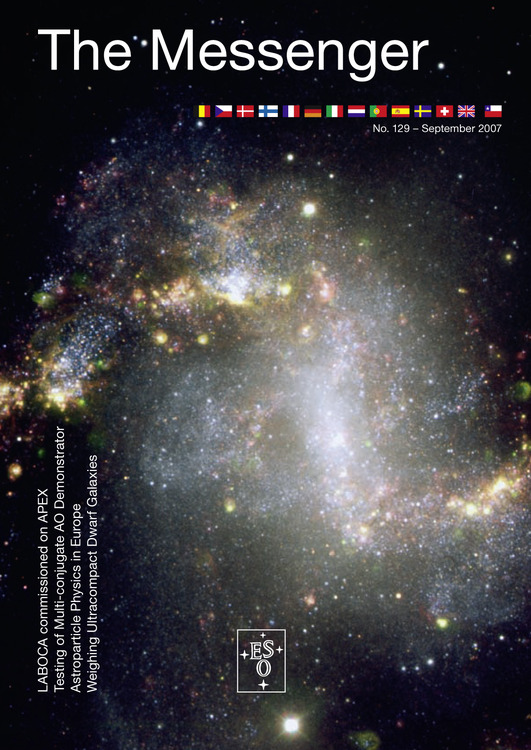
Issue 129
Messenger Issue 129

The Messenger Issue 129

Highlights include:

  • Hilker, M., Baumgardt, H. et al.: Weighing Ultracompact Dwarf Galaxies in the Fornax Cluster
  • Spiering, C.: Status and Perspectives of Astroparticle Physics in Europe
  • Araujo-Hauck, Constanza, Pasquini, Luca et al.: Future Wavelength Calibration Standards at ESO: the Laser Frequency Comb
  • Marchetti, E., Brast, R. et al.: On-sky Testing of the Multi-Conjugate Adaptive Optics Demonstrator
  • Siringo, G., Weiss, A. et al.: A New Era in Submillimetre Continuum Astronomy has Begun: LABOCA Starts Operation on APEX

Read the full PDF

Past Issues
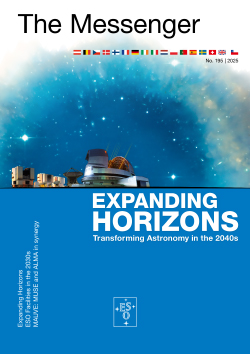
Messenger Issue 195
2025Issue 195
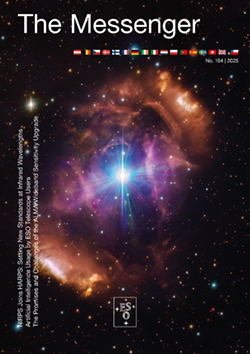
Messenger Issue 194
2025Issue 194
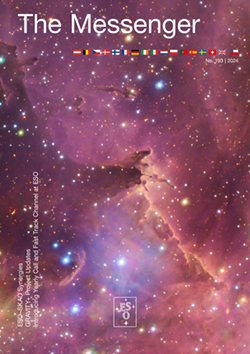
Messenger Issue 193
2024Issue 193
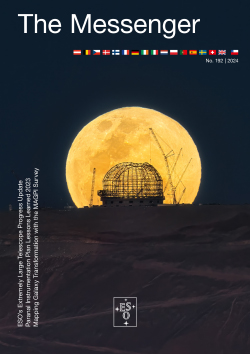
Messenger Issue 192
2024Issue 192
Messenger Issue 191
2023Issue 191
Messenger Issue 190
2023Issue 190
Messenger Issue 189
2022Issue 189
Messenger Issue 188
2022Issue 188
Messenger Issue 187
2022Issue 187
Messenger Issue 186
2022Issue 186
Messenger Issue 185
2021Issue 185
Messenger Issue 184
2021Issue 184
Messenger Issue 183
2021Issue 183
Messenger Issue 182
2021Issue 182
Messenger Issue 181
2020Issue 181
Messenger Issue 180
2020Issue 180
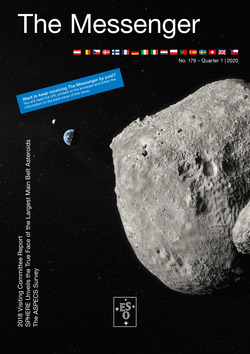
Messenger Issue 179
2020Issue 179
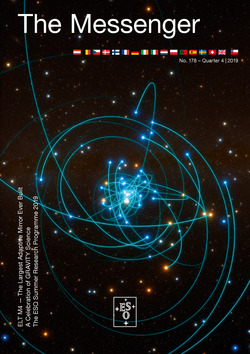
Messenger Issue 178
2019Issue 178
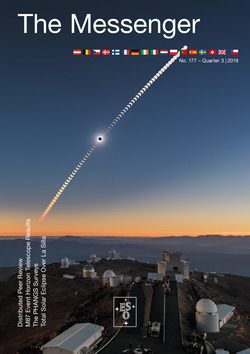
Messenger Issue 177
2019Issue 177
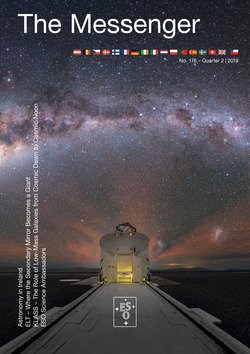
Messenger Issue 176
2019Issue 176
Table of Content No. 129 | 2007
Telescopes and Instrumentation
Siringo, G., Weiss, A. et al.
A New Era in Submillimetre Continuum Astronomy has Begun: LABOCA Starts Operation on APEX
More...
ADS BibCode: 2007Msngr.129....2S
Authors:
Siringo, G.; Weiss, A.; Kreysa, E.; Schuller, F.; Kovacs, A.; Beelen, A.; Esch, W.; Gemünd, H.-P.; Jethava, N.; Lundershausen, G.; Menten, K. M.; Güsten, R.; Bertoldi, F.; De Breuck, C.; Nyman, L.-Å.; Haller, E.; Beeman, J.
Abstract:
In May 2007, the Large APEX Bolometer Camera LABOCA was commissioned as a facility instrument on the APEX 12-m submillimetre telescope located at an altitude of 5100 m in northern Chile. The new 870-μm bolometer camera, in combination with the high efficiency of APEX and the excellent atmospheric transmission at the site, offers unprecedented capability in mapping submillimetre continuum emission. An overview of LABOCA and the prospects for science are presented.

Marchetti, E., Brast, R. et al.
On-sky Testing of the Multi-Conjugate Adaptive Optics Demonstrator
More...
ADS BibCode: 2007Msngr.129....8M
Authors:
Marchetti, E.; Brast, R.; Delabre, B.; Donaldson, R.; Fedrigo, E.; Frank, C.; Hubin., N.; Kolb, J.; Lizon, J.-L.; Marchesi, M.; Oberti, S.; Reiss, R.; Santos, J.; Soenke, C.; Tordo, S.; Baruffolo, A.; Bagnara, P.; The CAMCAO Consortium
Abstract:
The aim of the Multi-Conjugate Adaptive Optics Demonstrator (MAD) is to correct for atmospheric turbulence over a field of view which is much larger than the one typically covered by the exist-ing adaptive optics systems installed on 8-m-class telescopes. After a long period of testing at the ESO premises, MAD was installed at the VLT early in 2007 in order to evaluate its correction performance. Here we present the MAD project and the recent results obtained during the on-sky testing at the VLT UT3 telescope Melipal.

Saviane, I., Piirola, V. et al.
Circular Polarimetry Now Offered at EFOSC2
More...
ADS BibCode: 2007Msngr.129...14S
Authors:
Saviane, I.; Piirola, V.; Bagnulo, S.; Monaco, L.; Hutsemekers, D.; Katajainen, S.; Lehto, H.; Vornanen, T.; Berdyugin, A.; Hakala, P.
Abstract:
Starting from period P79, circular polarimetry measurements can be carried out with EFOSC2 at the ESO 3.6-m telescope. Here we describe the motivations behind the upgrade of the instrument, and a few results from the commissioning runs are used to show the excellent performance of the new polarimetry unit.

Ihle, G., Montano, N. et al.
The 3.6-m Dome: 30 Years After
More...
ADS BibCode: 2007Msngr.129...18I
Authors:
Ihle, G.; Montano, N.; Tamai, R.
Abstract:
After rotating for more than 30 years, the dome support wheels for the ESO 3.6-m telescope started to degrade, resulting in a shutdown in October 2006. The engineering process of reshaping the track and gradual replacement of the supporting wheels is described. The rotation of the dome is now returning to its original efficiency.

Kerber, F., Saitta, F. et al.
Calibration Sources for the Near-IR Arm of X-shooter
More...
ADS BibCode: 2007Msngr.129...21K
Authors:
Kerber, F.; Saitta, F.; Bristow, P.
Abstract:
We have studied the properties of wavelength calibration sources for the near- IR arm of X-shooter. In a novel approach we are combining laboratory measurements from a Fourier Transform Spectrometer (FTS), and literature data, with simulated data derived from a physi- cal model of X-shooter. The sources studied are pen ray lamps filled with the noble gases Ne, Ar, Kr, and Xe and Th-Ar hollow cathode lamps. As a product we provide a quantitative order by order analysis of the expected properties of the calibration lamps during X-shooter operations. Based on these we give recommendations for the selection of the best combination of lamps. The combination of laboratory measurements and instrument modeling provides a powerful tool for future instrument development.

Araujo-Hauck, Constanza, Pasquini, Luca et al.
Future Wavelength Calibration Standards at ESO: the Laser Frequency Comb
More...
ADS BibCode: 2007Msngr.129...24A
Authors:
Araujo-Hauck, Constanza; Pasquini, Luca; Manescau, Antonio; Udem, Thomas; Hänsch, Theodor W.; Holzwarth, Ronald; Sizmann, Andreas; Dekker, Hans; D'Odorico, Sandro; Murphy, Michael T.
Abstract:
A new technique for precise wavelength calibration of high-resolution spectrographs using frequency combs has recently been proposed. After introducing the basic concepts and advantages of this technique, we describe the ongoing development between ESO and the Max-Planck Institute for Quantum Optics for a novel wavelength calibration system that aims, within three years, to construct a laboratory demonstrator.

Wicenec, A., Knudstrup, J.
ESO's Next Generation Archive System in Full Operation
More...
ADS BibCode: 2007Msngr.129...27W
Authors:
Wicenec, A.; Knudstrup, J.
Abstract:
Considerations of the technical feasibility and the cost implications of a disk-based archiving system to store digital observations coming from the ever growing suite of ESO telescopes and instruments began in 2000. The so-called Next Generation Archiving System (NGAS) started archiving data in a prototype system in 2001. Now the second generation of NGAS hardware has been installed in the new ESO data centre and about 98% of all data since 1998 have been migrated onto disks hosted on NGAS computers. In addition all data currently produced by ESO instruments is directly archived onto NGAS hosts both in La Silla and Paranal. Currently the ESO archive keeps about 125 TB of data online and the system has been scaled up to cope with the next data wave coming from VISTA and OmegaCAM.

Astronomical Science
Spiering, C.
Status and Perspectives of Astroparticle Physics in Europe
More...
ADS BibCode: 2007Msngr.129...33S
Authors:
Spiering, C.
Abstract:
Astroparticle physics has evolved as an interdisciplinary field at the intersec- tion of particle physics, astronomy and cosmology. Over the last two decades, it has moved from infancy to technological maturity and is now envisaging projects on the 100 M€ scale. This price tag requires international coordination, cooperation and convergence to a few flagship projects. The Roadmap Committee of ApPEC (Astroparticle Physics European Coordination) has recently released a roadmap covering the next ten years. ApPEC is a corporation of European funding agencies promoting astroparticle physics.

Fox, A. J., Petitjean, P. et al.
Hot Gas in High-Redshift Protogalaxies: Observations of High-Ion Absorption in Damped Lyman-Alpha Systems
More...
ADS BibCode: 2007Msngr.129...38F
Authors:
Fox, A. J.; Petitjean, P.; Ledoux, C.; Srianand, R.
Abstract:
The neutral discs of high-redshift galaxies give rise to the Damped Lyman-a (DLA) systems seen in the spectra of background quasars. We show for the first time that a hot phase of gas is present in DLAs, observable in the absorption lines of five-times-ionised oxygen. This plasma phase, which could harbour a considerable fraction of all the metals produced by star formation at these epochs, can be explained as the feedback from star formation taking place in the neutral discs.

Falomo, R., Treves, A.
The Redshift of BL Lacertae Objects from High Signal-to-Noise VLT Spectra
More...
ADS BibCode: 2007Msngr.129...42F
Authors:
Falomo, R.; Treves, A.
Abstract:
BL Lacertae objects are active galactic nuclei dominated by non-thermal continuum emission and characterised by absence or extreme weakness of emission lines. These properties in several cases hinder the determination of their distance and thus the assessment of the properties of the class. High signal-to-noise optical spectra of these sources obtained with the VLT help to overcome these difficulties and allow one to obtain new redshifts and set stringent limits on the distance for pure lineless objects.

Treister, E., Gawiser, E. et al.
Results from the Multiwavelength Survey by Yale-Chile (MUSYC)
More...
ADS BibCode: 2007Msngr.129...45T
Authors:
Treister, E.; Gawiser, E.; van Dokkum, P.; Lira, P.; Urry, M.; The Musyc Collaboration
Abstract:
We present results from the MUSYC survey, which images a total of 1.2 square degrees spread over four fields in UBVRIz;K down to the spectroscopic limit, R ~ 25, K ~ 22 (AB). A significant fraction of the survey area has also been imaged by Chandra, XMM, GALEX, HST-ACS, near-infrared (JH), Spitzer-IRAC+MIPS, VLA, and ATCA. The main goals of this survey include the study of galaxy formation and evolution, Active Galactic Nuclei (AGN) and Galactic structure.

Hilker, M., Baumgardt, H. et al.
Weighing Ultracompact Dwarf Galaxies in the Fornax Cluster
More...
ADS BibCode: 2007Msngr.129...49H
Authors:
Hilker, M.; Baumgardt, H.; Infante, L.; Drinkwater, M.; Evstigneeva, E.; Gregg, M.
Abstract:
High-resolution spectra from the Ultraviolet and Visual Echelle Spectrograph (UVES) were used to derive internal velocity dispersions of Ultracompact Dwarf galaxies (UCDs) in the Fornax cluster of galaxies. The velocity dispersions, together with highly spatially resolved luminosity profiles from Hubble Space Telescope imaging (ACS camera), allowed us to derive the dynamical masses of the UCDs. We show that the mass-to-light ratios of UCDs in Fornax are consistent with those expected for pure stellar populations. No dark matter contribution is needed. Thus, these UCDs seem to be the result of star-cluster formation processes within galaxies, rather than being compact dwarf galaxies formed in dark-matter halos.

Crowther, Paul A., Hadfield, Lucy J.
VLT/FORS Surveys of Wolf-Rayet Stars beyond the Local Group: Type Ib/c Supernova Progenitors?
More...
ADS BibCode: 2007Msngr.129...53C
Authors:
Crowther, Paul A.; Hadfield, Lucy J.
Abstract:
Wolf-Rayet (WR) stars are the chemical-ly evolved descendents of O stars, such that they trace massive star formation. Here we present results of recent VLT/FORS surveys of WR stars in near- by spiral and irregular galaxies and consider individual WR stars as progenitors of Type Ib/c core-collapse supernovae. Young massive clusters hosting large WR populations may be used as templates for high-redshift Lyman break galaxies.

Protopapa, S., Herbst, T. et al.
Surface Ice Spectroscopy of Pluto, Charon and Triton
More...
ADS BibCode: 2007Msngr.129...58P
Authors:
Protopapa, S.; Herbst, T.; Böhnhardt, H.
Abstract:
We present new reflectance spectra of Pluto and Triton taken with the ESO adaptive optics instrument NACO at the VLT and covering the wavelength range 1 5 µm. Apart from known and expected absorption bands from methane ice, our data reveal new absorption bands centred around 4.0 µm and 4.6 µm never detected before. The latter absorption could be related to the presence of CO ice at the body surfaces. Charon's spectrum is also measured in the wavelength range 1 4 µm, for the first time simultaneously with, but isolated from, that of Pluto. The non-detection of Pluto's moonlets (unknown at the time of observation) in acquisition images of Pluto-Charon provides a lower limit of 18.8 mag for the K-band brightness of Hydra and Nix.

Astronomical News
Avila, G., Burwitz, V. et al.
BACHES - A Compact Light-Weight Echelle Spectrograph for Amateur Astronomy
More...
ADS BibCode: 2007Msngr.129...62A
Authors:
Avila, G.; Burwitz, V.; Guirao, C.; Rodriguez, J.; Shida, R.; Baade, D.
Abstract:
BACHES is a low-cost, light-weight echelle spectrograph suitable for observations of bright stars coupled with small telescopes up to 35 cm (14?) in diameter. The resolving power reaches 19000 in a continuous spectral range between 390 and 750 nm. The throughput of the instrument including the telescope and detector is 11% peak at 500 nm. With this efficiency spectra of stars of visual magnitude 5 can be obtained in 15 min exposure with a S/N of 50. One of the goals of the instrument is to monitor the spectral variability of Balmer emission lines in Be stars.

Fosbury, Robert A. E., De Breuck, Carlos et al.
Report on the ESO Workshop on Obscured AGN across Cosmic Time
More...
ADS BibCode: 2007Msngr.129...64F
Authors:
Fosbury, Robert A. E.; De Breuck, Carlos; Mainieri, Vincenzo; Robertson, Gordon; Vernet, Joël
Abstract:
While the radio-loud, obscured quasars (the radio galaxies) have been known and studied for decades, new and sensitive X-ray and mid-infrared surveys are now beginning to reveal large numbers of their radio-quiet counterparts beyond the local Universe. Consequent- ly, we are approaching the compilation of a relatively complete census of AGN of all types covering a large fraction of cosmic time. This is revealing a remarkably intimate connection between the supermassive black hole and its host galaxy. The workshop reported here was designed to explore the results of these rapid observational developments and the nature of the relationships between the stellar and AGN components.

Kissler-Patig, M., Wilson, T. et al.
Report on the ESO Workshop on 12 Questions on Star and Massive Star Cluster Formation
More...
ADS BibCode: 2007Msngr.129...69K
Authors:
Kissler-Patig, M.; Wilson, T.; Bastian, N.; D'Antona, F.; de Grijs, R.; Froebrich, D.; Galliano, E.; Grosbøl, P.; Johnson, K.; Keto, E.; Klessen, R.; Megeath, T.; Rejkuba, M.; Steinacker, J.; Zinnecker, H.
Abstract:
The Workshop “12 Questions on Star and Massive Star Cluster Formation” was held in Garching from 3 to 6 July 2007. The programme was set up to allow long (and fruitful) discussions around several questions connecting the formation of stars and star clusters. Here we summarise some of the discussions, and encourage interest- ed readers to download the contributions from http://www.eso.org/star07.

ESO
Announcement of a Workshop on Science from UKIDSS
More...
ADS BibCode: 2007Msngr.129...72.
Authors:
ESO
Abstract:
The workshop will take place a few weeks after the UKIRT Infrared Deep Sky Survey (UKIDSS) large Third Data Release (DR3). The purpose of the workshop is to provide a forum, bringing together European astronomers working on (or planning to work on) UKIDSS data, to hear about science being undertaken with UKIDSS, and to share knowledge gained in working with the data and ideas for exploiting the archive efficiently, in an informal atmosphere. The emphasis will be on work in progress. The workshop will include science and technical talks, and tutorials, as well as a summary of the current status of the surveys, and an opportunity to discuss the future direction.

ESO
Personnel Movements
More...
ADS BibCode: 2007Msngr.129...73.
Authors:
ESO

Primas, F., Nass, P. et al.
Observing at ESO: a New Procedure for Target and Instrument Set-up Changes
More...
ADS BibCode: 2007Msngr.129...73P
Authors:
Primas, F.; Nass, P.; Hainaut, O.; Sterzik, M.
Abstract:
As stated in the ESO Call for Proposals, targets and constraints requested at time of proposal submission (i.e. at Phase 1) are binding, because once the proposals have been evaluated by the Observing Proposal Committee, the requested targets and constraints become one of the major inputs to finalise and optimise the scheduling of the telescopes. However, part of the success of an observatory comes also from the ability to balance operational efficiency (hence rules and procedures) and scientific return. In other words, target and/or instrument set-up changes are allowed also after Phase 1, but only after they have been carefully scrutinised. Their approval is subject to the following conditions:

ESO
Gruber Prize in Cosmology Awarded for the Discovery of the Accelerated Expansion of the Universe
More...
ADS BibCode: 2007Msngr.129...74.
Authors:
ESO
Abstract:
Nearly a decade ago astronomers from two competing teams announced that they had found evidence for an accelerated cosmic expansion. The Gruber Prize in Cosmology 2007 honours this achievement and has been awarded to two groups: the Supernova Cosmology Project team, led by Saul Perlmutter (Lawrence Berkeley Laboratory), and the High-z Supernova Search Team, led by Brian Schmidt (Australian National University). Their results were based on the observations of distant Type Ia supernovae and were obtained with the major telescopes at the time (Riess et al. 1998, AJ 116, 1009; Perlmutter et al. 1999, ApJ 517, 565). Both teams used the 3.6-m telescope and the NTT to contribute photometry and spectroscopic classifications of the supernovae. Four people at ESO were directly involved in the two teams and are recognised as co-recipients of the Gruber Prize. Isobel Hook (now at Oxford University) and Chris Lidman (ESO Chile) were ESO Fellows when they contributed to the work of the Super- nova Cosmology Project, while Jason Spyromilio and Bruno Leibundgut (both ESO Garching) participated in the High-z Supernova Search Team.

Hook, R., The Scisoft Team
Scisoft VII with Virtual Observatory Support
More...
ADS BibCode: 2007Msngr.129...74H
Authors:
Hook, R.; The Scisoft Team
Abstract:
The Scisoft bundle is a collection of astronomical software intended mostly for ESO users but which is also distributed to other interested parties. It includes most of the packages needed by working observational astronomers, with emphasis on those widely used for handling optical and infrared data sets. Scisoft is installed on almost all the scientific computers running Linux at ESO Garching and widely at the ESO sites in Chile. More complete details can be found on the Scisoft web pages at http:// www.eso.org/scisoft.

ESO
Fellows at ESO
More...
ADS BibCode: 2007Msngr.129...75.
Authors:
ESO
Abstract:
Steffen Mieske; Julia Scharwächter

Our use of Cookies

We use cookies that are essential for accessing our websites and using our services. We also use cookies to analyse, measure and improve our websites’ performance, to enable content sharing via social media and to display media content hosted on third-party platforms.

You can manage your cookie preferences and find out more by visiting 'Cookie Settings and Policy'.

ESO Cookies Policy


The European Organisation for Astronomical Research in the Southern Hemisphere (ESO) is the pre-eminent intergovernmental science and technology organisation in astronomy. It carries out an ambitious programme focused on the design, construction and operation of powerful ground-based observing facilities for astronomy.

This Cookies Policy is intended to provide clarity by outlining the cookies used on the ESO public websites, their functions, the options you have for controlling them, and the ways you can contact us for additional details.

What are cookies?

Cookies are small pieces of data stored on your device by websites you visit. They serve various purposes, such as remembering login credentials and preferences and enhance your browsing experience.

Categories of cookies we use

Essential cookies (always active): These cookies are strictly necessary for the proper functioning of our website. Without these cookies, the website cannot operate correctly, and certain services, such as logging in or accessing secure areas, may not be available; because they are essential for the website’s operation, they cannot be disabled.

Cookie ID/Name
Description/Purpose
Provider (1st party or 3rd party)
Browser session cookie or Stored cookie?
Duration
csrftoken
XSRF protection token. We use this cookie to protect against cross-site request forgery attacks.
1st party
Stored
1 year
user_privacy
Your privacy choices. We use this cookie to save your privacy preferences.
1st party
Stored
6 months
_grecaptcha
We use reCAPTCHA to protect our forms against spam and abuse. reCAPTCHA sets a necessary cookie when executed for the purpose of providing its risk analysis. We use www.recaptcha.net instead of www.google.com in order to avoid unnecessary cookies from Google.
3rd party
Stored
6 months

Analytics cookies: These cookies collect information about how visitors interact with our website, such as which pages are visited most often and how users navigate the site. This data helps us improve website performance, optimize content, and enhance the user experience; these cookies are only placed if you provide your consent. We use the following analytics cookies.

Matomo Cookies:

This website uses Matomo (formerly Piwik), an open source software which enables the statistical analysis of website visits. Matomo uses cookies (text files) which are saved on your computer and which allow us to analyze how you use our website. The website user information generated by the cookies will only be saved on the servers of our IT Department. We use this information to analyze www.eso.org visits and to prepare reports on website activities. These data will not be disclosed to third parties.

On behalf of ESO, Matomo will use this information for the purpose of evaluating your use of the website, compiling reports on website activity and providing other services relating to website activity and internet usage.

ON | OFF

Matomo cookies settings:

Cookie ID/Name
Description/Purpose
Provider (1st party or 3rd party)
Browser session cookie or Stored cookie?
Duration
Settings
_pk_id
Stores a unique visitor ID.
1st party
Stored
13 months
_pk_ses
Session cookie temporarily stores data for the visit.
1st party
Stored
30 minutes
_pk_ref
Stores attribution information (the referrer that brought the visitor to the website).
1st party
Stored
6 months
_pk_testcookie
Temporary cookie to check if a visitor’s browser supports cookies (set in Internet Explorer only).
1st party
Stored
Temporary cookie that expires almost immediately after being set.

Additional Third-party cookies on ESO websites: some of our pages display content from external providers, e.g. YouTube.

Such third-party services are outside of ESO control and may, at any time, change their terms of service, use of cookies, etc.

YouTube: Some videos on the ESO website are embedded from ESO’s official YouTube channel. We have enabled YouTube’s privacy-enhanced mode, meaning that no cookies are set unless the user actively clicks on the video to play it. Additionally, in this mode, YouTube does not store any personally identifiable cookie data for embedded video playbacks. For more details, please refer to YouTube’s embedding videos information page.

Cookies can also be classified based on the following elements.

Regarding the domain, there are:

As for their duration, cookies can be:

How to manage cookies

Cookie settings: You can modify your cookie choices for the ESO webpages at any time by clicking on the link Cookie settings at the bottom of any page.

In your browser: If you wish to delete cookies or instruct your browser to delete or block cookies by default, please visit the help pages of your browser:

Please be aware that if you delete or decline cookies, certain functionalities of our website may be not be available and your browsing experience may be affected.

You can set most browsers to prevent any cookies being placed on your device, but you may then have to manually adjust some preferences every time you visit a site/page. And some services and functionalities may not work properly at all (e.g. profile logging-in, shop check out).

Updates to the ESO Cookies Policy

The ESO Cookies Policy may be subject to future updates, which will be made available on this page.

Additional information

For any queries related to cookies, please contact: pdprATesoDOTorg.

As ESO public webpages are managed by our Department of Communication, your questions will be dealt with the support of the said Department.