European
Southern
Observatory

The Messenger
The Messenger is ESO’s journal for science and technology. It serves as a link between ESO and its broad astronomical community by providing information about scientific, technical, and other developments. It also delivers relevant news about astronomy and astrophysics to a broader public, including policy-makers, government officials, journalists, teachers, and amateur astronomers, as well as to interested scientists from other fields.

The Messenger is published twice per year and is available for free download as a PDF here and via the digital publishing platform Scribd.

Subscribe
If you wish to receive the new issue directly into your inbox, sign up here:
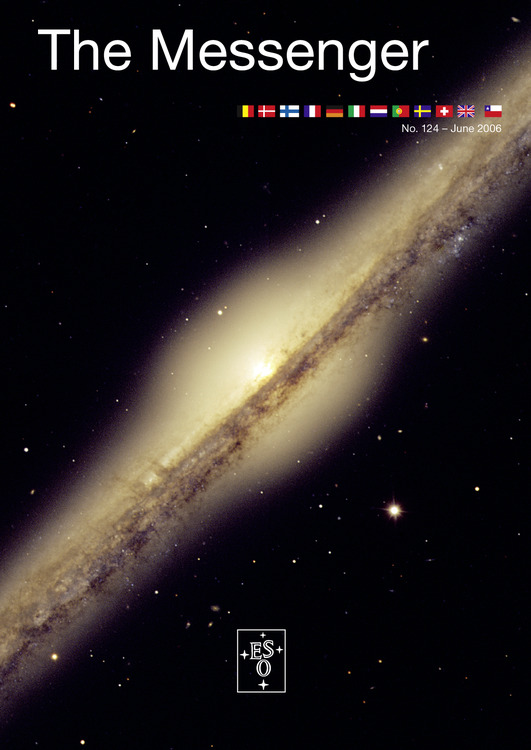
Issue 124
Messenger Issue 124

The Messenger Issue 124

Read the full PDF

Past Issues
Messenger Issue 195
2025Issue 195
Messenger Issue 194
2025Issue 194
Messenger Issue 193
2024Issue 193
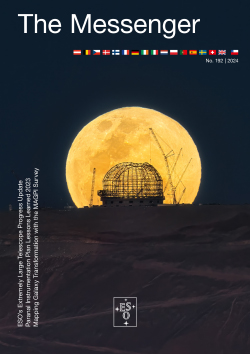
Messenger Issue 192
2024Issue 192
Messenger Issue 191
2023Issue 191
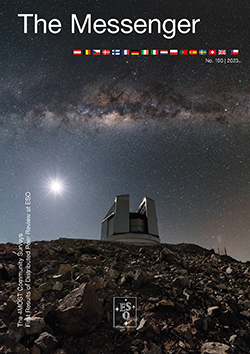
Messenger Issue 190
2023Issue 190
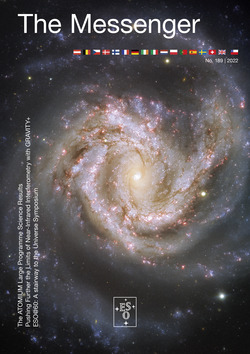
Messenger Issue 189
2022Issue 189
Messenger Issue 188
2022Issue 188
Messenger Issue 187
2022Issue 187
Messenger Issue 186
2022Issue 186
Messenger Issue 185
2021Issue 185
Messenger Issue 184
2021Issue 184
Messenger Issue 183
2021Issue 183
Messenger Issue 182
2021Issue 182
Messenger Issue 181
2020Issue 181
Messenger Issue 180
2020Issue 180
Messenger Issue 179
2020Issue 179
Messenger Issue 178
2019Issue 178
Messenger Issue 177
2019Issue 177
Messenger Issue 176
2019Issue 176
Table of Content No. 124 | 2006
Telescopes and Instrumentation
Käufl, H. U., Esteves, R.l et al.
CRIRES: Commissioning of the MACAO Adaptive Optics Module and General Status Report
More...
ADS BibCode: 2006Msngr.124....2K
Authors:
Käufl, H. U.; Esteves, R.l; Fedrigo, E.; Gojak, D.; Lizon, J.-L.; Marchetti, E.; Oberti, S.; Paufique, J.; Pozna, E.; Tordo, S.
Abstract:
The installation and commissioning of CRIRES, the Cryogenic Infrared Echelle Spectrograph, marks the completion of the original plan for the first generation of VLT instrumentation. Here we report on the commissioning of the curvature sensing adaptive optics part (MACAO) of CRIRES in April 2006. This activity also brings the quasi-series production of the MACAO systems to an end. All four UTs are now equipped with one MACAO system each to feed interferometry while UT1 and UT4 have one additional dedicated system each integrated into instruments. A summary of the overall status of CRIRES is given as well.

Bacon, R., Bauer, S. et al.
Probing Unexplored Territories with MUSE: a Second-Generation Instrument for the VLT
More...
ADS BibCode: 2006Msngr.124....5B
Authors:
Bacon, R.; Bauer, S.; Böhm, P.; Boudon, D.; Brau-Nogue, S.; Caillier, P.; Capoani, L.; Carollo, C. M.; Champavert, N.; Contini, T.; Daguise, E.; Dalle, D.; Delabre, B.; Devriendt, J.; Dreizler, S.; Dubois, J.-P.; Dupieux, M.; Dupin, J.-P.; Emsellem, E.; Ferruit, P.; Franx, M.; Gallou, G.; Gerssen, J.; Guiderdoni, B.; Hahn, T.; Hofmann, D.; Jarno, A.; Kelz, A.; Koehler, C.; Kollatschny, W.; Kosmalski, J.; Laurent, F.; Lilly, S.J.; Lizon, J.-L.; Loupias, M.; Lynn, S.; Manescau, A.; McDermid, R. M.; Monstein, C.; Nicklas, H.; Perès, L.; Pasquini, L.; Pécontal, E.; Pécontal-Rousset, A.; Pello, R.; Petit, C.; Picat, J.-P.; Popow, E.; Quirrenbach, A.; Reiss, R.; Renault, E.; Roth, M.; Schaye, J.; Soucail, G.; Steinmetz, M.; Ströbele, S.; Stuik, R.; Weilbacher, P.; Wozniak, H.; de Zeeuw, T.
Abstract:
The Multi Unit Spectroscopic Explorer (MUSE) is a second-generation VLT panoramic integral-field spectrograph presently under preliminary design study. MUSE has a field of 1 × 1 arcmin2 sampled at 0.2 × 0.2 arcsec2 and is assisted by the VLT ground layer adaptive optics ESO facility using four laser guide stars. The simultaneous spectral range is 0.465-0.93 μm, at a resolution of R ~ 3000. MUSE couples the discovery potential of a large imaging device to the measuring capabilities of a high-quality spectrograph, while taking advantage of the increased spatial resolution provided by adaptive optics. MUSE has also a high spatial resolution mode with 7.5 × 7.5 arcsec2 field of view sampled at 25 milli-arcsec. In this mode MUSE should be able to obtain diffraction-limited data cubes in the 0.6-0.93 μm wavelength range.

Marconi, Gianni, Bagnulo, Stefano et al.
New, Efficient High-Resolution Red VPH Grisms in VIMOS
More...
ADS BibCode: 2006Msngr.124...11M
Authors:
Marconi, Gianni; Bagnulo, Stefano; Lizon, Jean-Louis; Buzzoni, Bernard; Dekker, Hans; D'Odorico, Sandro; Izzo, Carlo; Wolff, Burkhard F.
Abstract:
VIMOS is the visible (360 to 1000 nm) wide-field imager and multi-object spectrograph mounted on the Nasmyth focus B of Melipal (UT3) (Le Fèvre et al. 2003). The instrument is comprised of four identical arms each with a field of view of 7' × 8' with a 0.205' pixel size and a gap between each quadrant of ~ 2'. Each arm is equipped with six grisms providing a spectral resolution range from ~ 200-2500 and with an EEV 44-82, thinned, anti-reflection coated, 4k × 2k pixel CCD. VIMOS operates in three different modes: Imaging (IMG), Multi-Object Spectroscopy (MOS), and with Integral Field Unit (IFU). For a summary of the instrument capability and performance, see http://www.eso.org/instruments/vimos/.

Güsten, Rolf, Nyman, Lars-Ake et al.
The Atacama Pathfinder EXperiment
More...
ADS BibCode: 2006Msngr.124...12G
Authors:
Güsten, Rolf; Nyman, Lars-Ake; Menten, Karl; Cesarsky, Catherine; Booth, Roy S.; Schilke, Peter F.
Abstract:
APEX, the Atacama Pathfinder Experiment, is operational on Llano de Chajnantor, on what is considered one of the world’s best sites for submillimetre astronomy. With its large primary reflector of 12 m diameter, carefully adjusted to a surface smoothness of only 17‑18 μm r.m.s, APEX will allow observations up to 200 μm, through all atmospheric submm windows accessible from the ground. Scientific opportunities to explore the ‘cold universe’ are discussed, and first scientific results are presented.

Wilson, T.
ALMA News
More...
ADS BibCode: 2006Msngr.124...18W
Authors:
Wilson, T.
Abstract:
ESO has selected Dr. Paola Andreani as the ARC Manager for ESO. Dr. Andreani will begin work at ESO Garching on 1 June 2006. Dr. Andreani is presently an Associate Astronomer at the Astronomical Observatory of Trieste, a part of INAF. Dr. Andreani is also a Co-I of Herschel/PACS and the local Project Manager of Herschel/SPIRE. She has been a working group manager of the Italian Herschel community, participating in the Herschel GTO process. Dr. Andreani is a well known researcher in the field of extragalactic astronomy, and has carried out significant work on the Sunyaev-Zeldovich effect using the SEST.

Moorwood, A.
The 2006 SPIE Symposium on Astronomical Telescopes and Instrumentation ? Observing the Universe from Ground and Space
More...
ADS BibCode: 2006Msngr.124...19M
Authors:
Moorwood, A.
Abstract:
The most recent of these biennial SPIE (The International Society for Optical Engineering) Symposia was held from 24-31 May in the Orlando World Center Marriott Resort & Convention Center in Florida, USA. Over the last decade, these meetings have grown to become the main forum for presenting and discussing all aspects of ground-based, airborne and space telescopes and their instrumentation, including associated advances in technology, software, operations and even astronomical results. As a consequence the meetings are large and well attended by people at all levels in the process of initiating, approving, implementing and operating astronomical projects and facilities. This year there were ~ 1700 registered participants who presented ~ 1600 papers and posters in the following 12 parallel conferences which formed the heart of the meeting.

Reports from Observers
Zijlstra, A., Lagadec, E. et al.
The Compact Discs of Post-AGB stars
More...
ADS BibCode: 2006Msngr.124...21Z
Authors:
Zijlstra, A.; Lagadec, E.; Matsuura, M.; Chesneau, O.; Etoka, S.
Abstract:
Many post-AGB stars are predicted to show compact discs less than ~ 100 AU in size. The VLT is uniquely able to trace these size scales, using adaptive optics (NACO) and optical interferometry (VLTI). We here report on observations of four such objects, showing direct detections of these structures.

Wilkinson, Mark I., Kleyna, Jan T. et al.
Probing the Dark Matter Content of Local Group Dwarf Spheroidal Galaxies with FLAMES
More...
ADS BibCode: 2006Msngr.124...25W
Authors:
Wilkinson, Mark I.; Kleyna, Jan T.; Gilmore, Gerard F.; Evans, N. Wyn; Koch, Andreas; Grebel, Eva K.; Wyse, Rosemary F. G.; Harbeck, Daniel R.
Abstract:
We present preliminary kinematic results from our VLT programme of spectroscopic observations in the Carina dwarf spheroidal galaxy using the FLAMES multi-object spectrograph. These new data suggest that the dark matter halo of this galaxy has a uniform density core. The implications for our understanding of the nature of the dark matter are discussed. Z% Aaronson M. 1983, ApJ 266, L11 Belokurov V. et al. 2006, ApJL, submitted, astro-ph/0604355 Goerdt T. et al. 2006, MNNRAS 368, 1073 Harbeck D. et al. 2001, AJ 122, 3092 Kleyna J. T. et al. 2001, ApJ 564, L115 Kleyna J. T. et al. 2003, ApJ 588, L21 Koch A. et al. 2006a, The Messenger 123, 38 Koch A. et al. 2006b, AJ 131, 895 Majewski S. R. et al. 2005, AJ 130, 2677 Martin N. et al. 2006, MNRAS 367, L69 Mateo M. et al. 1993, AJ 105, 510 Mateo M. 1997, ASP Conf. Ser. 116, 259 Mateo M. et al. 1998, AJ 116, 2315 Monelli M. et al. 2003, AJ 126, 218 Munoz R. R. et al. 2005, ApJ 631, L137 Shetrone M. D. et al. 2001, ApJ 548, 592 Tolstoy E. et al. 2006, The Messenger 123, 33 Wilkinson M. I. et al. 2002, MNRAS 330, 778 Wilkinson M. I. et al. 2004, MNRAS 611, L21 Wilkinson M. I. et al. 2006, in proceedings of XXIst IAP meeting, EDP sciences, astro-ph/0602186 Willman B. et al. 2005, ApJ 626, L85 Wyse R. F. G. et al. 2006, ApJ 639, L13 Zucker D. B. et al. 2006, ApJ 643, L103

ESO
A Three-Planet Extrasolar System
More...
ADS BibCode: 2006Msngr.124...29.
Authors:
ESO
Abstract:
Using the ultra-precise HARPS spectro-graph on ESO’s 3.6-m telescope at La Silla, a team of astronomers1 has discovered that a nearby star is host to three Neptune-mass planets. The in-nermost planet is most probably rocky, while the outermost is the first known Neptune-mass planet to reside in the habitable zone. This unique system is likely further enriched by an asteroid belt.

Proust, Dominique, Quintana, Hernán et al.
The Shapley Supercluster: the Largest Matter Concentration in the Local Universe
More...
ADS BibCode: 2006Msngr.124...30P
Authors:
Proust, Dominique; Quintana, Hernán; Carrasco, Eleazar R.; Reisenegger, Andreas; Slezak, Eric; Muriel, Hernán; Dünner, Rolando; Sodré, Laerte, Jr.; Drinkwater, Michael J.; Parker, Quentin A.; Ragone, Cinthia J.
Abstract:
Since the 1980s, we have known that the Local Group of galaxies is moving at a velocity of 366 ± 125 km/s in the direction of Centaurus. In this region, the well-known Shapley supercluster of galaxies (SSC) consists of many clusters and groups of galaxies in the redshift range 0.04 < z < 0.055. An international collaboration has highlighted this greatest matter concentration in the local Universe, less than 500 million light years from us. The SSC may be able to account for half of the sought for ‘Great Attractor’.

Courbin, F., Letawe, G. et al.
The Host Galaxies of the Brightest Quasars: Gas-Rich Galaxies, Mergers, and Young Stars
More...
ADS BibCode: 2006Msngr.124...32C
Authors:
Courbin, F.; Letawe, G.; Meylan, G.; Magain, P.; Jablonka, P.; Jahnke, K.; Wisotzki, L.; Letawe, Y.; North, P.
Abstract:
Because they are faint and hidden in the glare of a much brighter unresolved source, quasar host galaxies still challenge the most powerful telescopes, instrumentation and processing techniques. Determining their basic morphological parameters and their integrated colours is feasible, but difficult, from imaging alone. However, detailed information on their stellar and gas contents and on their dynamics is achievable with deep spectroscopy.

Other Astronomical News
West, R. M.
André B. Muller (25.9.1918-1.4.2006)
More...
ADS BibCode: 2006Msngr.124...37W
Authors:
West, R. M.
Abstract:
With great sadness, we have learned about the death of André Muller on 1 April, at the age of 87. Living in retirement in his native Holland since 1983, he was one of ESOs true pioneers, an outstanding representative of the select group of European astronomers who succeeded in steering ESO through the difficult initial phases. André was close-ly associated with the entire process, from the first site monitoring programmes in South Africa to the subsequent search in Chile, the decision in favour of the La Silla site, as well as the management of ESOs early activities in Chile, includ-ing the construction of the headquarters and observatory and the installation of the first generation of ESO telescopes. Few persons, if any, have been so inti-mately connected to the setting-up of ESOs facilities and it would be impossible to list in detail all of the services André performed for the organisation with such great expertise and zeal during his long career.

Madsen, C.
Finnish Parliamentary Committee at ESO Headquarters
More...
ADS BibCode: 2006Msngr.124...38M
Authors:
Madsen, C.
Abstract:
Finnish Parliamentary Committee at ESO Headquarters

Richtler, T., Larsen, S. S.
Report on the ESO-FONDAP Conference on Globular Clusters - Guides to Galaxies (held in Concepción, Chile, 6-10 March 2006)
More...
ADS BibCode: 2006Msngr.124...39R
Authors:
Richtler, T.; Larsen, S. S.
Abstract:
The role of ESO in the development of astronomy in Chile is difficult to overstate. However, the Chilean government is also well aware of the significance of science for the development of the country and has created large programmes for Chilean science to grow and maintain a sci-entific productivity competitive with that of countries with a longer scientific tradition. One of these programmes is called FONDAP (Fondo de Investigación Avanzado en Areas Prioritarias) and there is no question that astronomy is a priority field in Chile. The astronomy FONDAP pro-gramme (www.cenastro.cl) unites groups from Santiago (Universidad de Chile, Universidad Católica) and Concepción (Universidad de Concepción). One of the FONDAP goals is to support schools and conferences. Since globular clusters play an important role in the research of the Concepción group, we had the feeling that a small workshop of two or three days on globular cluster research would be due. But the reaction from the community was overwhelming and within a short time we had to drop the idea of an intimate workshop and instead had to face the challenge of a full-scale international conference, which would stretch our organisational and infrastructural capabilities to the limit. As so often, ESO was very generous and so a joint ESO-FONDAP conference on Globular Clus-ters in Concepción became reality.

Lundgren, A., Reveret, V.
Fellows at ESO
More...
ADS BibCode: 2006Msngr.124...41L
Authors:
Lundgren, A.; Reveret, V.
Abstract:
Andreas Lundgren; Vincent Reveret

Madsen, C.
Walloon Space Days
More...
ADS BibCode: 2006Msngr.124...42M
Authors:
Madsen, C.
Abstract:
On 28-29 March, the Cluster Wallonie Espace, mainly a partnership of companies in the Walloon ‘Space Valley’, or-ganised the first so-called ‘W Space Days’ at the Colonster Castle, located on the premises of the University of Liège. The primary aim of these days is to encourage meetings between professionals in the sector and to identify new scientific and technological opportunities. They should also help to raise awareness of the activities of the space sector amongst the general public and young people in particular. Indeed the event successfully brought together scientists, industrialists, funding agencies and policymakers. On the first day, some 210 representatives of research centres, industries and organisations from 13 countries in Europe participated in the professional event, while the next day was a ‘public day’. The first morning’s programme comprised a series of talks, including ELT presentations by Roberto Gilmozzi and Philippe Dierickx.

Pierce-Price, D.
Schoolchildren Worldwide Compete to 'Catch a Star!'
More...
ADS BibCode: 2006Msngr.124...43P
Authors:
Pierce-Price, D.
Abstract:
“Catch a Star!”, an international competition for school students organised by ESO’s Educational Office and the Euro-pean Association for Astronomy Edu-cation, has had its fourth successful year.

Uttenthaler, S.
A Solar Eclipse Expedition to Turkey
More...
ADS BibCode: 2006Msngr.124...44U
Authors:
Uttenthaler, S.
Abstract:
On 29 March 2006, a total solar eclipse occurred over South America, Africa, Turkey, Russia and Kazakhstan. It was the first one close to central Europe after the eclipse of 11 August 1999, and was calculated to have a maximum duration of totality of 4min 7sec. A group of eleven persons from ESO, accompanied by three from MPE and several amateur astronomers from the Augsburg area (altogether 20 participants) travelled to the Antalya region of Turkey to observe the eclipse. The Turkish Riviera could be rated as a good, but not excellent ob-serving site, with a probability of seeing the eclipse of 48% for Antalya.

Announcements
ESO
Towards the European Extremely Large Telescope
More...
ADS BibCode: 2006Msngr.124...45.
Authors:
ESO
Abstract:
European astronomical research is at a critical juncture with the European Ex-tremely Large Telescope (E-ELT) project currently being defined by the ESO ELT Project Office with a large involvement of the community through, in particular, topical working groups, OPTICON and the ELT Design Study, and with a de-cision to proceed designing the facility to be taken end 2006/early 2007. This meet-ing will offer the European astronomi- cal community at large the opportunity to provide precious feedback to the goals and means of that ambitious long-term programme. It will successively address the E-ELT Science case, its basic ref-erence design and instrumentation con-cepts.

ESO
2007 ESO Instrument Calibration Workshop
More...
ADS BibCode: 2006Msngr.124Q..45.
Authors:
ESO
Abstract:
The ESO La Silla Paranal Observatory (LPO) is currently operating 19 optical, NIR, and MIR instruments (9 VLT, 2 VLTI, 8 La Silla). To monitor and calibrate both the performance of each of these instru-ments and the quality of the data they deliver, ESO executes dedicated calibration plans. These systematic and regular measurements further aid in the calibration of data from science programmes, at least to specified levels of accuracy.

ESO
ESO Fellowship Programme 2006/2007
More...
ADS BibCode: 2006Msngr.124...46.
Authors:
ESO
Abstract:
ESO awards several postdoctoral fellow-ships each year. The goal of these fel-lowships is to offer young scientists op-portunities and facilities to enhance their research programmes at one of the world’s foremost observatories.

ESO
Personnel Movements
More...
ADS BibCode: 2006Msngr.124Q..47.
Authors:
ESO

ESO
List of Proceedings from the ESO Astrophysics Symposia
More...
ADS BibCode: 2006Msngr.124R..47.
Authors:
ESO
Abstract:
List of Proceedings from the ESO Astrophysics Symposia

Our use of Cookies

We use cookies that are essential for accessing our websites and using our services. We also use cookies to analyse, measure and improve our websites’ performance, to enable content sharing via social media and to display media content hosted on third-party platforms.

You can manage your cookie preferences and find out more by visiting 'Cookie Settings and Policy'.

ESO Cookies Policy


The European Organisation for Astronomical Research in the Southern Hemisphere (ESO) is the pre-eminent intergovernmental science and technology organisation in astronomy. It carries out an ambitious programme focused on the design, construction and operation of powerful ground-based observing facilities for astronomy.

This Cookies Policy is intended to provide clarity by outlining the cookies used on the ESO public websites, their functions, the options you have for controlling them, and the ways you can contact us for additional details.

What are cookies?

Cookies are small pieces of data stored on your device by websites you visit. They serve various purposes, such as remembering login credentials and preferences and enhance your browsing experience.

Categories of cookies we use

Essential cookies (always active): These cookies are strictly necessary for the proper functioning of our website. Without these cookies, the website cannot operate correctly, and certain services, such as logging in or accessing secure areas, may not be available; because they are essential for the website’s operation, they cannot be disabled.

Cookie ID/Name
Description/Purpose
Provider (1st party or 3rd party)
Browser session cookie or Stored cookie?
Duration
csrftoken
XSRF protection token. We use this cookie to protect against cross-site request forgery attacks.
1st party
Stored
1 year
user_privacy
Your privacy choices. We use this cookie to save your privacy preferences.
1st party
Stored
6 months
_grecaptcha
We use reCAPTCHA to protect our forms against spam and abuse. reCAPTCHA sets a necessary cookie when executed for the purpose of providing its risk analysis. We use www.recaptcha.net instead of www.google.com in order to avoid unnecessary cookies from Google.
3rd party
Stored
6 months

Analytics cookies: These cookies collect information about how visitors interact with our website, such as which pages are visited most often and how users navigate the site. This data helps us improve website performance, optimize content, and enhance the user experience; these cookies are only placed if you provide your consent. We use the following analytics cookies.

Matomo Cookies:

This website uses Matomo (formerly Piwik), an open source software which enables the statistical analysis of website visits. Matomo uses cookies (text files) which are saved on your computer and which allow us to analyze how you use our website. The website user information generated by the cookies will only be saved on the servers of our IT Department. We use this information to analyze www.eso.org visits and to prepare reports on website activities. These data will not be disclosed to third parties.

On behalf of ESO, Matomo will use this information for the purpose of evaluating your use of the website, compiling reports on website activity and providing other services relating to website activity and internet usage.

ON | OFF

Matomo cookies settings:

Cookie ID/Name
Description/Purpose
Provider (1st party or 3rd party)
Browser session cookie or Stored cookie?
Duration
Settings
_pk_id
Stores a unique visitor ID.
1st party
Stored
13 months
_pk_ses
Session cookie temporarily stores data for the visit.
1st party
Stored
30 minutes
_pk_ref
Stores attribution information (the referrer that brought the visitor to the website).
1st party
Stored
6 months
_pk_testcookie
Temporary cookie to check if a visitor’s browser supports cookies (set in Internet Explorer only).
1st party
Stored
Temporary cookie that expires almost immediately after being set.

Additional Third-party cookies on ESO websites: some of our pages display content from external providers, e.g. YouTube.

Such third-party services are outside of ESO control and may, at any time, change their terms of service, use of cookies, etc.

YouTube: Some videos on the ESO website are embedded from ESO’s official YouTube channel. We have enabled YouTube’s privacy-enhanced mode, meaning that no cookies are set unless the user actively clicks on the video to play it. Additionally, in this mode, YouTube does not store any personally identifiable cookie data for embedded video playbacks. For more details, please refer to YouTube’s embedding videos information page.

Cookies can also be classified based on the following elements.

Regarding the domain, there are:

As for their duration, cookies can be:

How to manage cookies

Cookie settings: You can modify your cookie choices for the ESO webpages at any time by clicking on the link Cookie settings at the bottom of any page.

In your browser: If you wish to delete cookies or instruct your browser to delete or block cookies by default, please visit the help pages of your browser:

Please be aware that if you delete or decline cookies, certain functionalities of our website may be not be available and your browsing experience may be affected.

You can set most browsers to prevent any cookies being placed on your device, but you may then have to manually adjust some preferences every time you visit a site/page. And some services and functionalities may not work properly at all (e.g. profile logging-in, shop check out).

Updates to the ESO Cookies Policy

The ESO Cookies Policy may be subject to future updates, which will be made available on this page.

Additional information

For any queries related to cookies, please contact: pdprATesoDOTorg.

As ESO public webpages are managed by our Department of Communication, your questions will be dealt with the support of the said Department.