European
Southern
Observatory

The Messenger
The Messenger is ESO’s journal for science and technology. It serves as a link between ESO and its broad astronomical community by providing information about scientific, technical, and other developments. It also delivers relevant news about astronomy and astrophysics to a broader public, including policy-makers, government officials, journalists, teachers, and amateur astronomers, as well as to interested scientists from other fields.

The Messenger is published twice per year and is available for free download as a PDF here and via the digital publishing platform Scribd.

Subscribe
If you wish to receive the new issue directly into your inbox, sign up here:
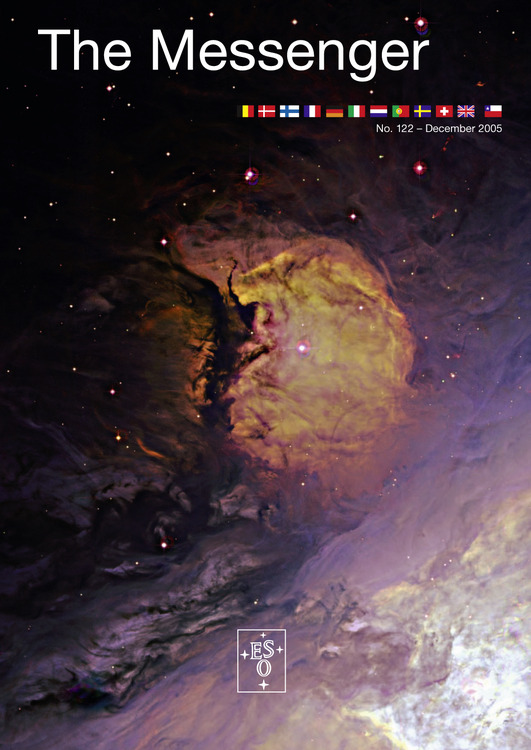
Issue 122
Messenger Issue 122

The Messenger Issue 122

Read the full PDF

Past Issues
Messenger Issue 195
2025Issue 195
Messenger Issue 194
2025Issue 194
Messenger Issue 193
2024Issue 193
Messenger Issue 192
2024Issue 192
Messenger Issue 191
2023Issue 191
Messenger Issue 190
2023Issue 190
Messenger Issue 189
2022Issue 189
Messenger Issue 188
2022Issue 188
Messenger Issue 187
2022Issue 187
Messenger Issue 186
2022Issue 186
Messenger Issue 185
2021Issue 185
Messenger Issue 184
2021Issue 184
Messenger Issue 183
2021Issue 183
Messenger Issue 182
2021Issue 182
Messenger Issue 181
2020Issue 181
Messenger Issue 180
2020Issue 180
Messenger Issue 179
2020Issue 179
Messenger Issue 178
2019Issue 178
Messenger Issue 177
2019Issue 177
Messenger Issue 176
2019Issue 176
Table of Content No. 122 | 2005
Telescopes and Instrumentation
Sharples, R., Bender, R. et al.
Surveying the High-Redshift Universe with KMOS
More...
ADS BibCode: 2005Msngr.122....2S
Authors:
Sharples, R.; Bender, R.; Bennett, R.; Burch, K.; Carter, P.; Casali, M.; Clark, P.l; Content, R.; Davies, R.; Davies, R.; Dubbeldam, M.; Finger, G.; Genzel, R.; Haefner, R.; Hess, A.; Kissler-Patig, M.; Laidlaw, K.; Lehnert, M.; Lewis, I.; Moorwood, A.; Muschielok, B.; Foester Schreiber, N.; Pirard, J.; Ramsay Howat, S.; Rees, P.; Richter, J.; Robertson, D.; Robson, I.; Saglia, R.; Tecza, M.; Thatte, N.; Todd, S.; Wegner, M.
Abstract:
KMOS is a near-infrared multi-object integral-field spectrometer which has been selected by ESO as one of a suite of second-generation instruments to be constructed for the VLT. The instrument will be built by a consortium of UK and German institutes working in partnership with ESO and is currently in the preliminary design phase. KMOS will be capable of obtaining simultaneous spatially resolved spectroscopy at a sampling of 0.2 arcseconds for up to 24 targets distributed over a field of view of 7.2 arcminutes diameter.

D'Odorico, S.
Instrument Concepts for the OWL Telescope
More...
ADS BibCode: 2005Msngr.122....6D
Authors:
D'Odorico, S.
Abstract:
During the past year ESO has coordinated a number of instrument concept studies as a complement to the OWL Observatory Design Study. Eight teams of scientists and engineers from different institutes in Europe and ESO have identified a variety of science programmes at the frontier of astrophysics and developed concepts of instruments at OWL which would be able to carry them out. This exercise has provided a first view of the unique astronomical observations at Blue to IR wavelengths which will become possible with a future European Extremely Large Telescope.

Almudena Prieto, M., Maciejewski, W. et al.
The centre of the active galaxy NGC 1097.
More...
ADS BibCode: 2005Msngr.122....9A
Authors:
Almudena Prieto, M.; Maciejewski, W.; Reunanen, J.
Abstract:
Near-infrared images of the active galaxy NGC 1097 have been obtained by a team of astronomers1 using NACO on the VLT. Located at a distance of about 45 million light years in the southern constellation Fornax, NGC 1097 is a relatively bright, barred spiral galaxy seen face-on. It is a very moderate example of an Active Galactic Nucleus (AGN), whose emission is thought to arise from matter (gas and stars) falling into a central black hole. NGC 1097 possesses a comparatively faint nucleus only, indicating that the infall rate is small.

Pasquini, L., Cristiani, S. et al.
CODEX: Measuring the Expansion of the Universe (and beyond)
More...
ADS BibCode: 2005Msngr.122...10P
Authors:
Pasquini, L.; Cristiani, S.; Dekker, H.; Haehnelt, M.; Molaro, P.; Pepe, F.; Avila, G.; Delabre, B.; D'Odorico, S.; Liske, J.; Shaver, P.; Bonifacio, P.; Borgani, S.; D'Odorico, V.; Vanzella, E.; Bouchy, F.; Dessauges-Lavadsky, M.; Lovis, C.; Mayor, M.; Queloz, D.; Udry, S.; Murphy, M.; Viel, M.; Grazian, A.; Levshakov, S.; Moscardini, L.; Wiklind, T.; Zucker, S.
Abstract:
CODEX, a high-resolution, super-stable spectrograph to be fed by OWL, the most powerful telescope ever conceived, will for the first time provide the possibility of directly measuring the change of the expansion rate of the Universe with time ... and much more. The concept of this instrument has been studied in a collaboration launched by ESO in July 2004 together with INAF-Osservatorio Astronomico di Trieste, the Institute of Astronomy, Cambridge University, and the Observatoire de Geneve.

ESO
Afterglows of Elusive Short Gamma-Ray Bursts
More...
ADS BibCode: 2005Msngr.122...14.
Authors:
ESO
Abstract:
An international team of astronomers1 has for the first time observed the visible light from a short gamma-ray burst (GRB). Using the 1.5-m Danish telescope at La Silla (Chile), they showed that these short, intense bursts of gamma-ray emission most likely originate from the violent collision of two merging neutron stars. The same team has also used the VLT to constrain the birthplace of the first ever short burst whose position could be pinpointed with high precision. The results were published in the October 6 issue of the journal Nature.

Wilson, T.
ALMA News
More...
ADS BibCode: 2005Msngr.122...15W
Authors:
Wilson, T.
Abstract:
An independent international Cost Review of the ALMA project was held in Garmisch- Partenkirchen on October 13–16. The general response of the Cost Review Committee was positive. The three ALMA Project Managers (Tony Beasley, Joint ALMA Office; Adrian Russell, North America; Hans Rykaczewski, Europe) wrote that “The response from the committee is pretty much as good as it could be ...” Massimo Tarenghi, the ALMA Director, added “This excellent outcome reflects the very hard work of many people in the ALMA project, and the conscientious way in which the review was carried out.” More details of the review will follow when the final report becomes available.

ESO
ALMA Antenna Contract Signed
More...
ADS BibCode: 2005Msngr.122...17.
Authors:
ESO
Abstract:
On December 6, ESO signed a contract with the consortium led by Alcatel Alenia Space and composed also of European Industrial Engineering (Italy) and MT Aerospace (Germany), to supply 25 antennas for the Atacama Large Millimeter Array (ALMA) project, along with an option for another seven antennas. The contract, worth 147 million euros, covers the design, manufacture, transport and on-site integration of the antennas. It is the largest contract ever signed in ground-based astronomy in Europe.

Argandona, G., Mirabel, F.
Inauguration of the APEX Telescope
More...
ADS BibCode: 2005Msngr.122...18A
Authors:
Argandona, G.; Mirabel, F.
Abstract:
The serene Andean village of San Pedro de Atacama, in northern Chile, was the epicentre of the two-day official inauguration of APEX, the 12-metre telescope working at the Llano of Chajnantor.

Kuntschner, H., Kuemmel, M. et al.
Towards an Automatic Reduction of FORS2-MXU Spectroscopy
More...
ADS BibCode: 2005Msngr.122...19K
Authors:
Kuntschner, H.; Kuemmel, M.; Larsen, S.; Walsh, J.
Abstract:
A brief report is presented of a feasibility study for an automatic, science quality spectral extraction of FORS2-MXU spectra using the aXe package developed for slitless spectroscopy. We briefly describe the aXe data reduction concept, which is usually applied to HST-ACS data, and demonstrate the applicability of this concept by reducing a subset of the Great Observatories Origins Survey (GOODS) FORS2 spectroscopic survey.

Padovani, P., Quinn, P.
The Virtual Observatory in Europe and at ESO
More...
ADS BibCode: 2005Msngr.122...22P
Authors:
Padovani, P.; Quinn, P.
Abstract:
Virtual Observatories are moving from a 'research and development' to an 'operational' phase. We report on the EURO-VO, a project to build an operational Virtual Observatory in Europe, and on the new Virtual Observatory Systems department at ESO.

Reports from Observers
Vanzella, E., Cristiani, S. et al.
GOODS' Look at Galaxies in the Young Universe
More...
ADS BibCode: 2005Msngr.122...25V
Authors:
Vanzella, E.; Cristiani, S.; Dickinson, M.; Kuntschner, H.; Rettura, A.; Moustakas, L. A.; Nonino, M.; Popesso, P.; Rosati, P.; Stern, D.; Cesarsky, C.; Ferguson, H. C.; Foxbury, R. A. E.; Giavalisco, M.; Haase, J.; Renzini, A.; The Goods Team
Abstract:
The Great Observatories Origin Deep Survey is using the most advanced observing facilities, ESO/VLT, HST, Spitzer, Chandra, XMM/Newton, etc. to discover infant galaxies at epochs when the Universe was only 900 million years old. The FORS2 spectroscopic survey has confirmed 33 galaxies in the redshift interval 5 < z < 6.2, producing one of the largest spectroscopic samples in that redshift range to date.

Tacconi, Linda J., Dasyra, Kalliopi et al.
The Dynamics and Evolution of Luminous Galaxy Mergers: ISAAC Spectroscopy of ULIRGs
More...
ADS BibCode: 2005Msngr.122...28T
Authors:
Tacconi, Linda J.; Dasyra, Kalliopi; Davies, Richard; Genzel, Reinhard; Lutz, Dieter; Burkert, Andreas; Naab, Thorsten; Sturm, Eckhard; Veilleux, Sylvain; Baker, Andrew J.; Sanders, David B.
Abstract:
Local ultraluminous galaxy mergers provide us with a quantitative observational means to track an important process for galaxy formation and evolution at high redshift. This article presents first results from a near-infrared spectroscopic study of a moderately large sample of local Universe mergers that we have undertaken at the VLT with ISAAC. This study is providing compelling observational evidence that mergers of near-equal-mass, gas-rich galaxies can evolve into intermediate-mass elliptical galaxies after passing through an ultraluminous infrared phase.

ESO
Supernova in NGC 1559
More...
ADS BibCode: 2005Msngr.122...31.
Authors:
ESO

Nissen, Poul E., Asplund, Martin et al.
Lithium Isotopic Abundances in Metal-Poor Stars: A Problem for Standard Big Bang Nucleosynthesis?
More...
ADS BibCode: 2005Msngr.122...32N
Authors:
Nissen, Poul E.; Asplund, Martin; Lambert, David L.; Primas, Francesca; Smith, Verne V.
Abstract:
Spectra obtained with VLT/UVES suggest the existence of the Li isotope in several metal-poor stars at a level that challenges ideas about its synthesis. The Li abundance is, on the other hand, a factor of three lower than predicted by standard Big Bang nucleosynthesis theory. Both problems may be explained if decaying supersymmetric particles affect the synthesis of light elements in the Big Bang.

Evans, C., Smartt, S. et al.
The VLT-FLAMES Survey of Massive Stars
More...
ADS BibCode: 2005Msngr.122...36E
Authors:
Evans, C.; Smartt, S.; Lennon, D.; Dufton, P.; Hunter, I.; Mokiem, R.; de Koter, A.; Irwin, M.
Abstract:
We have observed an unprecedented sample of 800 massive stars in open cluster fields in the Magellanic Clouds and Milky Way, primarily with the multi-fibre FLAMES instrument. The survey addresses the role of environment, via stellar rotation and mass-loss, on the evolution of the most massive stars, which are the dominating influence on the evolution of young, star-forming galaxies.

Doellinger, M. P., Pasquini, L. et al.
Why are G and K Giants Radial Velocity Variables?
More...
ADS BibCode: 2005Msngr.122...39D
Authors:
Doellinger, M. P.; Pasquini, L.; Hatzes, A. P.; Setiawan, J.; da Silva, L.; Renan de Medeiros, J.; von der Luehe, O.; Girardi, L.; di Mauro, M. P.; Weiss, A.; Roth, M.
Abstract:
During the past year ESO has coordinated a number of instrument concept studies as a complement to the OWL Observatory Design Study. Eight teams of scientists and engineers from different institutes in Europe and ESO have identified a variety of science programmes at the frontier of astrophysics and developed concepts of instruments at OWL which would be able to carry them out. This exercise has provided a first view of the unique astronomical observations at Blue to IR wavelengths which will become possible with a future European Extremely Large Telescope.

Other Astronomical News
Lagrange, A.-M.
ASTRONET: Towards a Strategic Plan for European Astronomy
More...
ADS BibCode: 2005Msngr.122...42L
Authors:
Lagrange, A.-M.
Abstract:
Establishing a comprehensive long-term plan for the development of European astronomy – optical and radio, ground and space – has been discussed for many years, but still waits to be done. Also, European astronomy would benefit much from better-coordinated actions among countries. A consortium of European funding agencies is now launching ASTRONET, a four-year ERANET initiative to achieve these goals.

Fosbury, R. A. E.
The Current and Future ST-ECF
More...
ADS BibCode: 2005Msngr.122...44F
Authors:
Fosbury, R. A. E.
Abstract:
After 15 years in orbit, the Hubble Space Telescope is facing an uncertain future although there is a real possibility of a fifth servicing mission within the next two to three years. ESA and ESO have jointly been pondering the future of the ST-ECF at the ESO headquarters in Garching and this article outlines their conclusions.

ESO
PPARC Council at ESO
More...
ADS BibCode: 2005Msngr.122...45.
Authors:
ESO

Boffin, H.
Open House at ESO Garching
More...
ADS BibCode: 2005Msngr.122...46B
Authors:
Boffin, H.
Abstract:
On October 22, ESO in Garching opened its doors to the public, as part of the traditional all-campus Open House. The event was successful again this year, clearly generating a lot of public interest, with 2000–2500 visitors passing through our building within a seven-hour period. For ESO, the Open House is an important element of our continued dialogue with the local community, playing a key role in maintaining awareness about astronomy in general and about our organisation in particular.

Pierce-Price, D., Boffin, H. et al.
Science on Stage 2005
More...
ADS BibCode: 2005Msngr.122...47P
Authors:
Pierce-Price, D.; Boffin, H.; Madsen, C.
Abstract:
“Science on Stage”, the European Science Teaching Festival, is a major educational outreach programme for science teachers. It aims to identify and foster innovation within formal science education by means of exchange of best practice, workshops and seminars involving educators from all over Europe.

Argandona, G., Mirabel, F.
Danish Minister visits ESO Chile
More...
ADS BibCode: 2005Msngr.122...47A
Authors:
Argandona, G.; Mirabel, F.
Abstract:
On October 21, the Danish Minister for Education, Mr. Bertel Haarder, paid a visit to ESO in Santiago, accompanied by a small entourage including the Danish Ambassador to Chile, Anita Hugau.

Madsen, C.
ESO at Cer 2005
More...
ADS BibCode: 2005Msngr.122...48M
Authors:
Madsen, C.
Abstract:
On November 14–15, the Brussels Exhibition Centre (Heysel) was the home of a major international conference on science communication with the title “Communicating European Research” (CER 2005).

Walsh, J., Kissler-Patig, M.
Report on the Conference on Science Perspectives for 3D Spectroscopy
More...
ADS BibCode: 2005Msngr.122...49W
Authors:
Walsh, J.; Kissler-Patig, M.
Abstract:
About four years ago when discussions were taking place to plan the proposal to the European Commission for a Research Training Network (RTN) on 3D spectroscopy, we decided to make an international conference one of the closing highpoints of the network. At that time there were only a few 3D instruments routinely taking data on large telescopes (such as Integral on the WHT and Oasis on the CFHT) and some of us thought that a full-scale international conference on science with 3D spectroscopy might be rather difficult to fill. However, as it transpired, we had problems containing the conference in four and a half days. The RTN, called Euro3D, shared the hosting of the conference with ESO and it was held at ESO Headquarters in Garching from October 10–14, 2005.

ESO
Report on the Science Day in Honour of Alvio Renzini
More...
ADS BibCode: 2005Msngr.122...52.
Authors:
ESO
Abstract:
The scientific legacy of Alvio Renzini was celebrated with a one-day workshop in Garching on October 19. Alvio retired as the VLT Programme Scientist in June this year and this conference was a way to look back at his many scientific achievements and his influence on ESO and the VLT project.

Announcements
ESO
NEON Observing Schools
More...
ADS BibCode: 2005Msngr.122R..54.
Authors:
ESO
Abstract:
The purpose of these summer schools is to provide the opportunity for young researchers to gain practical experience in observational techniques, data reduction and analysis and the use of virtual observatory tools. Students will carry out small research projects, centred on selected astrophysical topics, in small groups under the supervision of experienced astronomers. These practical exercises will be complemented by lectures on general observational techniques and archival research for both ground and space based astronomy.

ESO
Conference on Globular Clusters - Guide to Galaxies
More...
ADS BibCode: 2005Msngr.122Q..54.
Authors:
ESO
Abstract:
The Universidad de Concepción, the Centro de Astrofísica FONDAP (Chile), the Cerro Tololo Interamerican Observatory and ESO are organising a conference on “Globular Clusters – Guides to Galaxies”, which will take place on March 6–10, 2006.

ESO
List of Proceedings from the ESO Astrophysics Symposia
More...
ADS BibCode: 2005Msngr.122R..55.
Authors:
ESO
Abstract:
List of Proceedings from the ESO Astrophysics Symposia

ESO
Personnel Movements
More...
ADS BibCode: 2005Msngr.122Q..55.
Authors:
ESO

Our use of Cookies

We use cookies that are essential for accessing our websites and using our services. We also use cookies to analyse, measure and improve our websites’ performance, to enable content sharing via social media and to display media content hosted on third-party platforms.

You can manage your cookie preferences and find out more by visiting 'Cookie Settings and Policy'.

ESO Cookies Policy


The European Organisation for Astronomical Research in the Southern Hemisphere (ESO) is the pre-eminent intergovernmental science and technology organisation in astronomy. It carries out an ambitious programme focused on the design, construction and operation of powerful ground-based observing facilities for astronomy.

This Cookies Policy is intended to provide clarity by outlining the cookies used on the ESO public websites, their functions, the options you have for controlling them, and the ways you can contact us for additional details.

What are cookies?

Cookies are small pieces of data stored on your device by websites you visit. They serve various purposes, such as remembering login credentials and preferences and enhance your browsing experience.

Categories of cookies we use

Essential cookies (always active): These cookies are strictly necessary for the proper functioning of our website. Without these cookies, the website cannot operate correctly, and certain services, such as logging in or accessing secure areas, may not be available; because they are essential for the website’s operation, they cannot be disabled.

Cookie ID/Name
Description/Purpose
Provider (1st party or 3rd party)
Browser session cookie or Stored cookie?
Duration
csrftoken
XSRF protection token. We use this cookie to protect against cross-site request forgery attacks.
1st party
Stored
1 year
user_privacy
Your privacy choices. We use this cookie to save your privacy preferences.
1st party
Stored
6 months
_grecaptcha
We use reCAPTCHA to protect our forms against spam and abuse. reCAPTCHA sets a necessary cookie when executed for the purpose of providing its risk analysis. We use www.recaptcha.net instead of www.google.com in order to avoid unnecessary cookies from Google.
3rd party
Stored
6 months

Analytics cookies: These cookies collect information about how visitors interact with our website, such as which pages are visited most often and how users navigate the site. This data helps us improve website performance, optimize content, and enhance the user experience; these cookies are only placed if you provide your consent. We use the following analytics cookies.

Matomo Cookies:

This website uses Matomo (formerly Piwik), an open source software which enables the statistical analysis of website visits. Matomo uses cookies (text files) which are saved on your computer and which allow us to analyze how you use our website. The website user information generated by the cookies will only be saved on the servers of our IT Department. We use this information to analyze www.eso.org visits and to prepare reports on website activities. These data will not be disclosed to third parties.

On behalf of ESO, Matomo will use this information for the purpose of evaluating your use of the website, compiling reports on website activity and providing other services relating to website activity and internet usage.

ON | OFF

Matomo cookies settings:

Cookie ID/Name
Description/Purpose
Provider (1st party or 3rd party)
Browser session cookie or Stored cookie?
Duration
Settings
_pk_id
Stores a unique visitor ID.
1st party
Stored
13 months
_pk_ses
Session cookie temporarily stores data for the visit.
1st party
Stored
30 minutes
_pk_ref
Stores attribution information (the referrer that brought the visitor to the website).
1st party
Stored
6 months
_pk_testcookie
Temporary cookie to check if a visitor’s browser supports cookies (set in Internet Explorer only).
1st party
Stored
Temporary cookie that expires almost immediately after being set.

Additional Third-party cookies on ESO websites: some of our pages display content from external providers, e.g. YouTube.

Such third-party services are outside of ESO control and may, at any time, change their terms of service, use of cookies, etc.

YouTube: Some videos on the ESO website are embedded from ESO’s official YouTube channel. We have enabled YouTube’s privacy-enhanced mode, meaning that no cookies are set unless the user actively clicks on the video to play it. Additionally, in this mode, YouTube does not store any personally identifiable cookie data for embedded video playbacks. For more details, please refer to YouTube’s embedding videos information page.

Cookies can also be classified based on the following elements.

Regarding the domain, there are:

As for their duration, cookies can be:

How to manage cookies

Cookie settings: You can modify your cookie choices for the ESO webpages at any time by clicking on the link Cookie settings at the bottom of any page.

In your browser: If you wish to delete cookies or instruct your browser to delete or block cookies by default, please visit the help pages of your browser:

Please be aware that if you delete or decline cookies, certain functionalities of our website may be not be available and your browsing experience may be affected.

You can set most browsers to prevent any cookies being placed on your device, but you may then have to manually adjust some preferences every time you visit a site/page. And some services and functionalities may not work properly at all (e.g. profile logging-in, shop check out).

Updates to the ESO Cookies Policy

The ESO Cookies Policy may be subject to future updates, which will be made available on this page.

Additional information

For any queries related to cookies, please contact: pdprATesoDOTorg.

As ESO public webpages are managed by our Department of Communication, your questions will be dealt with the support of the said Department.