European
Southern
Observatory

The Messenger
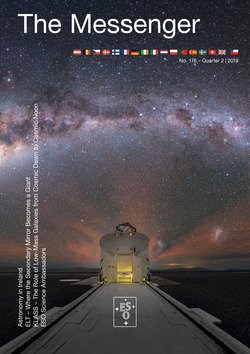
The Messenger is ESO’s journal for science and technology. It serves as a link between ESO and its broad astronomical community by providing information about scientific, technical, and other developments. It also delivers relevant news about astronomy and astrophysics to a broader public, including policy-makers, government officials, journalists, teachers, and amateur astronomers, as well as to interested scientists from other fields.

The Messenger is published twice per year and is available for free download as a PDF here and via the digital publishing platform Scribd.

Subscribe
If you wish to receive the new issue directly into your inbox, sign up here:
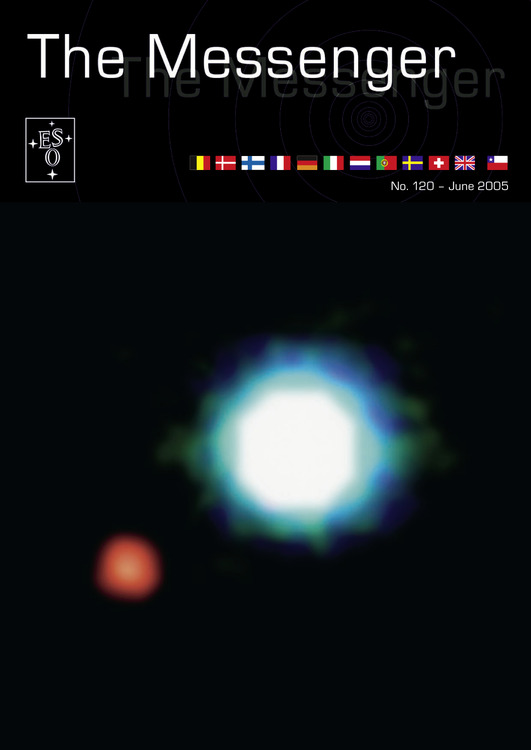
Issue 120
Messenger Issue 120

The Messenger Issue 120

Read the full PDF

Past Issues
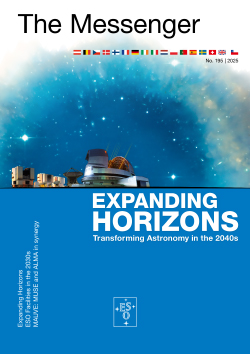
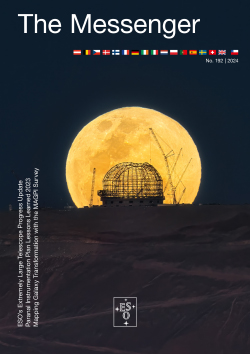
Messenger Issue 195
2025Issue 195
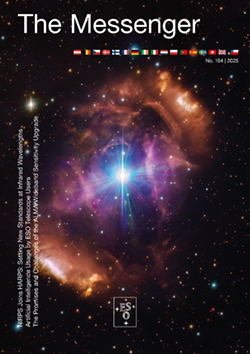
Messenger Issue 194
2025Issue 194
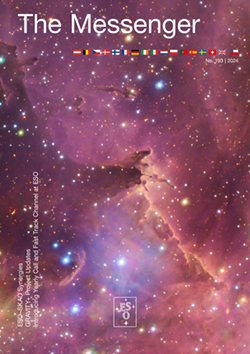
Messenger Issue 193
2024Issue 193
Messenger Issue 192
2024Issue 192
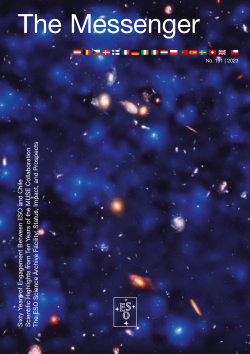
Messenger Issue 191
2023Issue 191
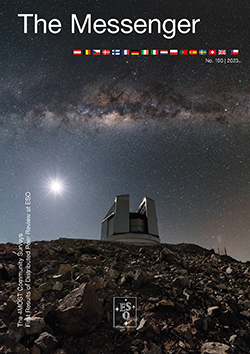
Messenger Issue 190
2023Issue 190
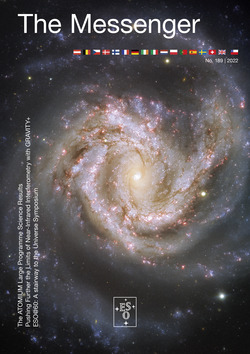
Messenger Issue 189
2022Issue 189
Messenger Issue 188
2022Issue 188
Messenger Issue 187
2022Issue 187
Messenger Issue 186
2022Issue 186
Messenger Issue 185
2021Issue 185
Messenger Issue 184
2021Issue 184
Messenger Issue 183
2021Issue 183
Messenger Issue 182
2021Issue 182
Messenger Issue 181
2020Issue 181
Messenger Issue 180
2020Issue 180
Messenger Issue 179
2020Issue 179
Messenger Issue 178
2019Issue 178
Messenger Issue 177
2019Issue 177
Messenger Issue 176
2019Issue 176
Table of Content No. 120 | 2005
Telescopes and Instrumentation
Dekker, H., D'Odorico, S.
Progress Report on X-shooter, the first second-generation VLT instrument
More...
ADS BibCode: 2005Msngr.120....2D
Authors:
Dekker, H.; D'Odorico, S.
Abstract:
X-shooter is the first of the approved second-generation VLT instruments to have completed the Preliminary Design Phase. Here we give an update of developments in the project since its official launch in December 2003.

Koehler, B., The AT Assembly and Commissioning Team
VLTI First Fringes with Two Auxiliary Telescopes at Paranal
More...
ADS BibCode: 2005Msngr.120....5K
Authors:
Koehler, B.; The AT Assembly and Commissioning Team
Abstract:
The Very Large Telescope Interferometer (VLTI) at Paranal Observatory had another extension of its already impressive capabilities by combining interferometrically the light from two relocatable 1.8-m Auxiliary Telescopes in February 2005. This achievement heralds an era of new scientific discoveries. Both Auxiliary Telescopes will be offered from October 1, 2005 to the community of astronomers for routine observations, together with the MIDI instrument. By the end of 2006, Paranal will be home to four operational ATs that may be placed at 30 different positions and thus be combined in a very large number of ways (baselines). This will enable the VLTI to operate with enormous flexibility and, in particular, to obtain extremely sharp images of celestial objects.

Monnet, G.
The OPTICON FP6 Programme and ESO
More...
ADS BibCode: 2005Msngr.120....7M
Authors:
Monnet, G.
Abstract:
The OPTICON FP6 programme which started at the beginning of 2004 is already playing a large role in coordinating optical and near-IR European astronomy. ESO, a full participant to this endeavour, is reaping very significant benefits for its community, in particular through the development activities aimed at validating enabling technologies for next-generation instrumentation of 8-10 m class telescopes and through a number of 'structuring' network activities.

Capaccioli, M., Mancini, D. et al.
The VLT Survey Telescope: A Status Report
More...
ADS BibCode: 2005Msngr.120...10C
Authors:
Capaccioli, M.; Mancini, D.; Sedmak, G.
Abstract:
The VLT Survey Telescope (VST) is now a few months from its completion. this paper briefly reviews the project, accounts for its current status, anticipates the calendar of future milestones up to first light, and lists the scientific programmes for the observing time guaranteed to the OAC by ESO for procurement of the telescope.

Cappellarao, E.
OmegaCAM: The VST Camera
More...
ADS BibCode: 2005Msngr.120...13C
Authors:
Cappellarao, E.
Abstract:
OmegaCAM is the large-format CCD pixels imaging camera that has been designed to exploit the square degree field of view of the VST while sampling the excellent seeing of Paranal (Kuijken et al. 2002, The Messenger 110, 15). The instrument is built by a consortium which comprises institutes in the Netherlands, Germany and Italy, and is headed by PI Konrad Kuijken (Groningen and Leiden University) with co-PI’s Ralf Bender (Munich USM/MPE) and Enrico Cappellaro (INAF Naples), and project management by Bernhard Muschielok and Reinhold Häfner (USM). The Optical Detector Team at ESO has designed and built the detector system.

Wilson, T.
ALMA News
More...
ADS BibCode: 2005Msngr.120...15W
Authors:
Wilson, T.
Abstract:
SCIENCE ADVISORY COMMITTEE REPORT The European ALMA Science Advisory Committee (ESAC) met on 23 February 2005 at ESO in Garching. On the two following days, the ALMA Science Advisory Committee (ASAC) met. In both meetings the discussions were mostly concerned with a request by the ALMA Board to consider the impact of ‘rebaselining’ proposals on the science that can be done with ALMA. Much of the need for rebaselining is caused by the large increases in commodity prices, such as those of steel and oil. These have led to large cost increases for ALMA. A number of possible options for savings were proposed.

Hook, R., Moller, P. et al.
The SAMPO Porject
More...
ADS BibCode: 2005Msngr.120...17H
Authors:
Hook, R.; Moller, P.; Ignatius, J.; Vasko, K.; Peron, M.; Quinn, P.
Abstract:
As an in-kind contribution to its joining fee, the Republic of Finland is funding a three-year project to assess future data reduction and analysis software needs for the ESO community. The SAMPO project, named after a mysterious artifact and source of power in the Finnish Kalevala legends, will gather requirements, assess technologies and perform detailed pilot software projects to help prepare ESO for the software challenges of data handling in the next decade.

Reports from Observers
Pont, F., Bouchy, F. et al.
Transiting Extra-solar Planets, follow the FLAMES ...
More...
ADS BibCode: 2005Msngr.120...19P
Authors:
Pont, F.; Bouchy, F.; Queloz, D.; Melo, C.; Santos, N.; Udry, S.; Mayor, M.; Moutou, C.
Abstract:
The past year witnessed a blossoming in the field of transiting exoplanets. Until 2003, only one transiting exoplanet was known, the famous hd 209568, first detected by radial-velocity surveys. Then in quick succession, six transiting planets were discovered among the candidates identified by photometric transit surveys. Five of these transiting exoplanets were characterized by our team with FLAMES on the VLT.

Pepe, F., Mayor, M. et al.
On the Track of Very Low-mass Planets with HARPS
More...
ADS BibCode: 2005Msngr.120...22P
Authors:
Pepe, F.; Mayor, M.; Queloz, D.; Benz, W.; Bertaux, J.-L.; Bouchy, F.; Lovis, C.; Mordasini, C.; Santos, N.; Sivan, J.-P.; Udry, S.
Abstract:
In only one and a half years of operation HARPS has discovered eight new extra-solar planet candidates. Many more discoveries are expected with the increase of the duration of the survey. What makes HARPS unique compared with other instruments is its unprecedented precision and its ability to discover planets with very low mass. In fact, all the planets discovered with HARPS lie in the low-mass tail of the planetary companion mass distribution. This distribution, which is known to be highly sensitive in its low mass end to the detection threshold, can be explored with HARPS in a comprehensive way. The exploration of the very low-mass end of giant planets may bring new constraints on planet formation and evolution scenarios.

ESO
Confirmation of the First Image of an Extra-Solar Planet
More...
ADS BibCode: 2005Msngr.120...25.
Authors:
ESO
Abstract:
A team of astronomers has confirmed the discovery of a giant planet, approximately five times the mass of Jupiter, that is gravitationally bound to a young brown dwarf, putting an end to a year-long discussion on the nature of this object. Last year, the team reported a faint red object in the close vicinity of a young brown dwarf (see ESO PR 23/04). The red object, now called 2M1207b, is more than 100 times fainter than the brown dwarf, 2M1207A. The spectrum of 2M1207b contains a strong signature of water molecules, confirming that it must be cold. Based on the infrared colours and the spectral data, evolutionary model calculations led to the conclusion that 2M1207b is a 5-Jupiter-mass planet. Its mass can also be estimated from a different method, which focuses on the strength of its gravitational field; this technique suggests that the mass might be even less than 5 Jupiter masses.

Gillessen, S., Davies, R. et al.
First Sceince with SINFONI
More...
ADS BibCode: 2005Msngr.120...26G
Authors:
Gillessen, S.; Davies, R.; Kissler-Patig, M.; Lehnert, M.; van der Werf, P.; Nowak, N.; Eisenhauer, F.; Abuter, R.; Horrobin, M.; Gilbert, A.; Genzel, R.; Bender, R.; Saglia, R.; Lemoine-Busserolle, M.; Reunanen, J.; Kjaer, K.; Messineo, M.; Nuernberger, D.; Dumas, C.
Abstract:
Since the beginning of 2005 another success story has gone into regular operation at the ESO facilities on Paranal. On UT4 (Yepun) an adaptive optics assisted near infrared integral field spectrometer makes an astronomer's dream come true: obtaining a diffraction-limited image of which each pixel contains a full spectrum. In fact, such data are best thought of as a cube rather than a flat image. SINFONI is the name of the new instrument and a whole symphony of exciting science results has been obtained already.

Boehringer, H., Mullis, C. et al.
Galaxy Cluster Archaeology
More...
ADS BibCode: 2005Msngr.120...33B
Authors:
Boehringer, H.; Mullis, C.; Rosati, P.; Lamer, G.; Fassbender, R.; Schwope, A.; Schuecker, P.
Abstract:
With the discovery of an X-ray luminous cluster of galaxies at z = 1.4 we have extended the horizon for studies of well-evolved galaxy clusters to a look-back time of 9 gyrs. This recordbreaking cluster was detected as an extended X-ray source in an archival XMM-newton observation during the pilot study phase of a search for distant clusters. This result, combined with additional newly-identified candidates from our programme, demonstrates the potential of the XMM-Newton archive to provide a substantial sample of very distant clusters for detailed cosmic evolution studies.

Habart, E., Walmsley, M. et al.
The Horsehead Nebula: A Beautiful Case
More...
ADS BibCode: 2005Msngr.120...37H
Authors:
Habart, E.; Walmsley, M.; Abergel, A.
Abstract:
The Horsehead Nebula has been a great source of speculation and inspiration for the last century. We give a brief discussion of why that is as well as summarizing our recent observations using SofI on the NTT.

Scarpa, R., Falomo, R. et al.
Resolving the Host Galaxies of Quasars at z = 2.5 with VLT + NACO.
More...
ADS BibCode: 2005Msngr.120...40S
Authors:
Scarpa, R.; Falomo, R.; Kotilainen, J. K.; Treves, A.
Abstract:
Based on the most widely accepted model for structure formation in the Universe, the massive galaxies we see today are the result of the merging of smaller structures. Looking far enough, and therefore far back in time, one should then be able to see galaxies getting smaller and smaller. To explore this issue we focus on quasars host galaxies and trace their properties up to redshift z = 2.5 (about 8 billion years in the past). Observations indicate that up to z ~ 2.5 quasar hosts are massive galaxies that are fully formed even at these early epochs. This is in partial disagreement with the hierarchical merging scenario, for the formation of massive spheroids.

Cowley, C. R., Castelli, F. et al.
A New Isotopic Abundance Anomaly in Chemically Peculiar Stars
More...
ADS BibCode: 2005Msngr.120...42C
Authors:
Cowley, C. R.; Castelli, F.; Hubrig, S.
Abstract:
The discovery of a new isotopic anomaly in young, chemically-peculiar stars draws attention to extraordinary chemical separation processes that must take place in the atmospheres of these stars. No other natural processes are known that can do this so efficiently.

Other Astronomical News
Kissler-Patig, M., Kaufer, A. et al.
ESO Studentships: PhD opportunities in Garching and Santiago
More...
ADS BibCode: 2005Msngr.120...44K
Authors:
Kissler-Patig, M.; Kaufer, A.; Leibundgut, B.; Mirabel, F.
Abstract:
ESO offers a number of opportunities for graduate students to spend part of their research studies in the observatory environment. The primary aim is to give young researcher the opportunity to discover ESO during their PhD studies and participate in an exciting research environment. Further, this represents one of many opportunities for students to be immerged in an international environment and to work at one of the centres of European and worldwide astronomy. Last but not least, it allows researchers/ supervisors of ESO’s community to foster stronger links with their ESO colleagues.

Madsen, C.
Towards a Europe of Knowledge and Innovation?
More...
ADS BibCode: 2005Msngr.120...46M
Authors:
Madsen, C.
Abstract:
THE EUROPEAN SOCIETIES ARE undergoing fast changes these years. The need to manage the European integration process as well as to develop adequate solutions in the face of globalization and the pressure on the ‘European way of life’ led the Heads of states and governments of the EU to set for themselves the goal of developing the most dynamic knowledge-based economy in the world within a 10-year period. Both the goals and the policies to reach them are known as the Lisbon Agenda and the Lisbon Process, respectively, reminding us that it was in the city of Lisbon – in the year 2000 – that this development was started. Now, at half-time, the process has been reviewed and the governments have acknowledged the need to focus on the most essential policy areas that must be developed to achieve success.

Richichi, A., Glindemann, A.
Report on the workshop on "The Power of Optical/IR Interferometry: Recent Scientific Results and Second-Generation VLTI Instrumentation"
More...
ADS BibCode: 2005Msngr.120...48R
Authors:
Richichi, A.; Glindemann, A.
Abstract:
This workshop was held in Garching from April 4 through April 8, 2005, with 2.5 days dedicated to science from interferometers, and 2.5 days dedicated to concepts of second-generation instrumentation for the VLTI. With about 170 registered participants from a large number of countries and institutions, it can be safely stated that the workshop was a huge success. This massive participation forced the organizers to abandon the idea of holding the workshop inside the ESO headquarters, and accept the generous offer of a vast meeting room at the MPE, made by Prof. R. Genzel. Similarly overwhelming was the number of contributions. The number of requests for just the scientific part of the workshop could have easily filled a full week-long schedule with interesting oral presentations, and difficult selections were necessary.

ESO
Dutch Minister of Science Visits ESO Facilities in Chile
More...
ADS BibCode: 2005Msngr.120...51.
Authors:
ESO
Abstract:
Mrs. Maria van der Hoeven, the Dutch Minister of Education, Culture and Science, who travelled to the Republic of Chile, arrived at the ESO Paranal Observatory on Friday afternoon, May 13, 2005. The Minister was accompanied, among others, by the Dutch Ambassador to Chile, Mr. Hinkinus Nijenhuis, and Mr. Cornelis van Bochove, the Dutch Director of Science.

ESO
ESO Receives Computerworld Honors Program 21st Century Achievement Award in Science Category
More...
ADS BibCode: 2005Msngr.120...52.
Authors:
ESO
Abstract:
In a ceremony held in Washington, D.C. (USA) on June 6, 2005, ESO, the European Organisation for Astronomical Research in the Southern Hemisphere, received the coveted 21st Century Achievement Award from the Computerworld Honors Program for its visionary use of information technology in the Science category. Sybase, a main database server vendor and member of the Chairmen’s Committee, nominated ESO’s Data Flow System in recognition of its contributions to the global information technology revolution and its positive impact on society.

ESO
Fellows at ESO
More...
ADS BibCode: 2005Msngr.120...53.
Authors:
ESO
Abstract:
MARTIN VANNIER; MARTIN ZWANN

Janssen, E.
ESO at the European Research and Innovation Salon in Paris
More...
ADS BibCode: 2005Msngr.120...53J
Authors:
Janssen, E.
Abstract:
From June 3–5, 2005, ESO took part in the European Research and Innovation Salon, which was held at Paris Expo (France). The event, organized under the auspices of the French Government and the European Commission, was the first of its kind in Europe and was mostly aimed at the general public. This first event had over 24 000 visitors, including high-ranking officials, a great success given the numerous events that took place in Paris the same weekend.

Announcements
ESO
ESO Conference on Groups of Galaxies in the nearby Universe
More...
ADS BibCode: 2005Msngr.120R..54.
Authors:
ESO
Abstract:
Comparative studies of galaxy groups and group members, and detailed studies of individual groups, promise an understanding of the evolution of the groups themselves as well as their stellar systems. Historically, the former approach was pursued for nearby groups, while the latter was restricted to the Local Group. The recent advance of technology allows both approaches to be combined. The next generation of extremely large telescopes and space missions will make it possible to study nearby groups at the same level of detail as is currently achievable for the Local Group. We will hold a conference aiming to summarize the considerable progress that has been made since the last meetings dedicated to galaxy groups, and to formulate the new problems that can be tackled both with the new instrumentation available to the community, and with the ever advancing theoretical work.

ESO
ESO/MPA Workshop on Carbon-Rich Ultra Metal-Poor Stars in the Galactic Halo
More...
ADS BibCode: 2005Msngr.120Q..54.
Authors:
ESO
Abstract:
The main goal of the workshop is to thoroughly discuss, review and understand in depth all aspects related to the many carbon-rich stars found in the last decade among the oldest and most metal-poor objects of the Galactic Halo, i.e. their origin, nature, main characteristics, and implications for the chemical evolution of the (early) Galaxy.

Argandona, G., Mirabel, F.
High Honour for Daniel Hofstadt.
More...
ADS BibCode: 2005Msngr.120...55A
Authors:
Argandona, G.; Mirabel, F.
Abstract:
Daniel Hofstadt, former ESO representative in Chile, was honoured last May 12 by the Chilean government, in a ceremony held at the Chilean Ministry of Foreign Affairs, with the presence of ESO Director General, Dr. Catherine Cesarsky.

Madsen, C.
Richard West retires
More...
ADS BibCode: 2005Msngr.120...56M
Authors:
Madsen, C.
Abstract:
It is hard to believe, but after 35 years of service, Richard West has retired from ESO. Born 1941 in Copenhagen, Richard did his baccalaureate in 1959. In 1964, he obtained his degree (Mag. scient. et cand. mag.) in astronomy and astrophysics at Copenhagen University, followed by a period as Assistant Professor (Amanuensis) at Copenhagen University Observatory. In 1970, he joined ESO as Assistant Astronomer to the ESO Director General, Adriaan Blaauw.

ESO
Personnel Movements
More...
ADS BibCode: 2005Msngr.120R..57.
Authors:
ESO

ESO
Fizeau Exchange Visitors Programme, Optical Interferometry in Europe
More...
ADS BibCode: 2005Msngr.120Q..57.
Authors:
ESO

ESO
ESO Fellowship Programme 2005/2006
More...
ADS BibCode: 2005Msngr.120...58.
Authors:
ESO
Abstract:
The European Organisation for Astronomical Research in the Southern Hemisphere awards each year several postdoctoral fellowships to provide young scientists with opportunities and facilities to enhance their research programmes. The goal is to bring young astronomers into close contact with the instruments, activities, and people at one of the world’s foremost observatories. For more information about ESO’s astronomical research activities please consult http://www.eso.org/science/

ESO
Applications are invited for the position of ALMA Project Planner/Scheduler
More...
ADS BibCode: 2005Msngr.120...59.
Authors:
ESO
Abstract:
The Atacama Large Millimeter Array (ALMA) is an international astronomy facility. ALMA is an equal partnership between Europe and North America, in cooperation with the Republic of Chile, and is funded in North America by the U.S. National Science Foundation (NSF) in cooperation with the National Research Council of Canada (NRC), and in Europe by the European Organisation for Astronomical Research in the Southern Hemisphere (ESO) and Spain. ALMA construction and operations are led on behalf of North America by the National Radio Astronomy Observatory (NRAO), which is managed by Associated Universities, Inc. (AUI), and on behalf of Europe by ESO.

Our use of Cookies

We use cookies that are essential for accessing our websites and using our services. We also use cookies to analyse, measure and improve our websites’ performance, to enable content sharing via social media and to display media content hosted on third-party platforms.

You can manage your cookie preferences and find out more by visiting 'Cookie Settings and Policy'.

ESO Cookies Policy


The European Organisation for Astronomical Research in the Southern Hemisphere (ESO) is the pre-eminent intergovernmental science and technology organisation in astronomy. It carries out an ambitious programme focused on the design, construction and operation of powerful ground-based observing facilities for astronomy.

This Cookies Policy is intended to provide clarity by outlining the cookies used on the ESO public websites, their functions, the options you have for controlling them, and the ways you can contact us for additional details.

What are cookies?

Cookies are small pieces of data stored on your device by websites you visit. They serve various purposes, such as remembering login credentials and preferences and enhance your browsing experience.

Categories of cookies we use

Essential cookies (always active): These cookies are strictly necessary for the proper functioning of our website. Without these cookies, the website cannot operate correctly, and certain services, such as logging in or accessing secure areas, may not be available; because they are essential for the website’s operation, they cannot be disabled.

Cookie ID/Name
Description/Purpose
Provider (1st party or 3rd party)
Browser session cookie or Stored cookie?
Duration
csrftoken
XSRF protection token. We use this cookie to protect against cross-site request forgery attacks.
1st party
Stored
1 year
user_privacy
Your privacy choices. We use this cookie to save your privacy preferences.
1st party
Stored
6 months
_grecaptcha
We use reCAPTCHA to protect our forms against spam and abuse. reCAPTCHA sets a necessary cookie when executed for the purpose of providing its risk analysis. We use www.recaptcha.net instead of www.google.com in order to avoid unnecessary cookies from Google.
3rd party
Stored
6 months

Analytics cookies: These cookies collect information about how visitors interact with our website, such as which pages are visited most often and how users navigate the site. This data helps us improve website performance, optimize content, and enhance the user experience; these cookies are only placed if you provide your consent. We use the following analytics cookies.

Matomo Cookies:

This website uses Matomo (formerly Piwik), an open source software which enables the statistical analysis of website visits. Matomo uses cookies (text files) which are saved on your computer and which allow us to analyze how you use our website. The website user information generated by the cookies will only be saved on the servers of our IT Department. We use this information to analyze www.eso.org visits and to prepare reports on website activities. These data will not be disclosed to third parties.

On behalf of ESO, Matomo will use this information for the purpose of evaluating your use of the website, compiling reports on website activity and providing other services relating to website activity and internet usage.

ON | OFF

Matomo cookies settings:

Cookie ID/Name
Description/Purpose
Provider (1st party or 3rd party)
Browser session cookie or Stored cookie?
Duration
Settings
_pk_id
Stores a unique visitor ID.
1st party
Stored
13 months
_pk_ses
Session cookie temporarily stores data for the visit.
1st party
Stored
30 minutes
_pk_ref
Stores attribution information (the referrer that brought the visitor to the website).
1st party
Stored
6 months
_pk_testcookie
Temporary cookie to check if a visitor’s browser supports cookies (set in Internet Explorer only).
1st party
Stored
Temporary cookie that expires almost immediately after being set.

Additional Third-party cookies on ESO websites: some of our pages display content from external providers, e.g. YouTube.

Such third-party services are outside of ESO control and may, at any time, change their terms of service, use of cookies, etc.

YouTube: Some videos on the ESO website are embedded from ESO’s official YouTube channel. We have enabled YouTube’s privacy-enhanced mode, meaning that no cookies are set unless the user actively clicks on the video to play it. Additionally, in this mode, YouTube does not store any personally identifiable cookie data for embedded video playbacks. For more details, please refer to YouTube’s embedding videos information page.

Cookies can also be classified based on the following elements.

Regarding the domain, there are:

As for their duration, cookies can be:

How to manage cookies

Cookie settings: You can modify your cookie choices for the ESO webpages at any time by clicking on the link Cookie settings at the bottom of any page.

In your browser: If you wish to delete cookies or instruct your browser to delete or block cookies by default, please visit the help pages of your browser:

Please be aware that if you delete or decline cookies, certain functionalities of our website may be not be available and your browsing experience may be affected.

You can set most browsers to prevent any cookies being placed on your device, but you may then have to manually adjust some preferences every time you visit a site/page. And some services and functionalities may not work properly at all (e.g. profile logging-in, shop check out).

Updates to the ESO Cookies Policy

The ESO Cookies Policy may be subject to future updates, which will be made available on this page.

Additional information

For any queries related to cookies, please contact: pdprATesoDOTorg.

As ESO public webpages are managed by our Department of Communication, your questions will be dealt with the support of the said Department.