European
Southern
Observatory

The Messenger
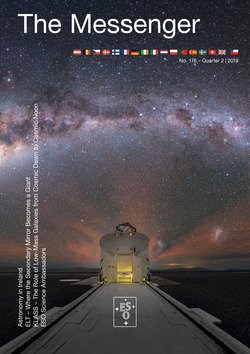
The Messenger is ESO’s journal for science and technology. It serves as a link between ESO and its broad astronomical community by providing information about scientific, technical, and other developments. It also delivers relevant news about astronomy and astrophysics to a broader public, including policy-makers, government officials, journalists, teachers, and amateur astronomers, as well as to interested scientists from other fields.

The Messenger is published twice per year and is available for free download as a PDF here and via the digital publishing platform Scribd.

Subscribe
If you wish to receive the new issue directly into your inbox, sign up here:
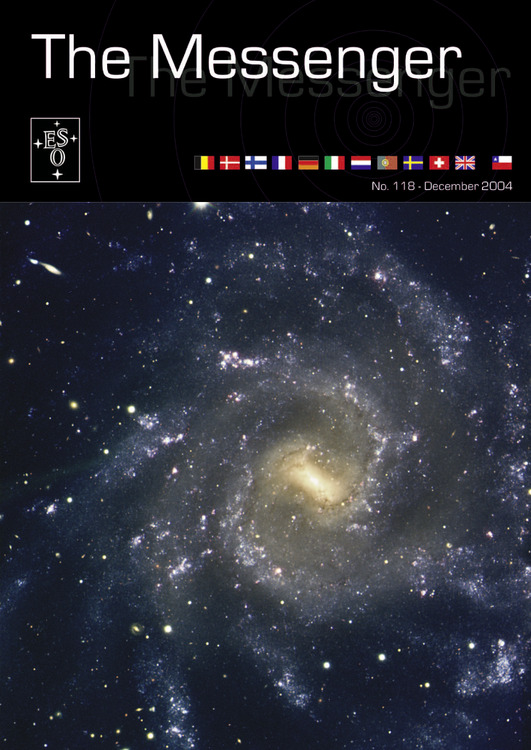
Issue 118
Messenger Issue 118

The Messenger Issue 118

Read the full PDF

Past Issues
Messenger Issue 195
2025Issue 195
Messenger Issue 194
2025Issue 194
Messenger Issue 193
2024Issue 193
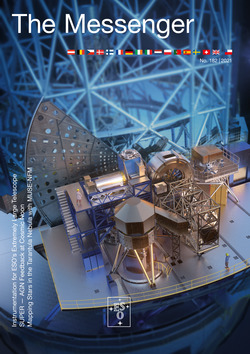
Messenger Issue 192
2024Issue 192
Messenger Issue 191
2023Issue 191
Messenger Issue 190
2023Issue 190
Messenger Issue 189
2022Issue 189
Messenger Issue 188
2022Issue 188
Messenger Issue 187
2022Issue 187
Messenger Issue 186
2022Issue 186
Messenger Issue 185
2021Issue 185
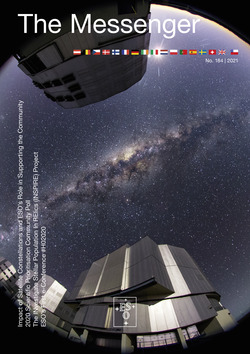
Messenger Issue 184
2021Issue 184
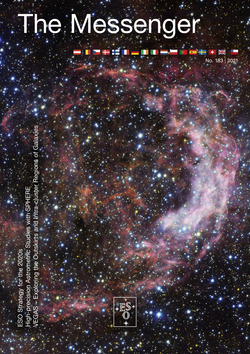
Messenger Issue 183
2021Issue 183
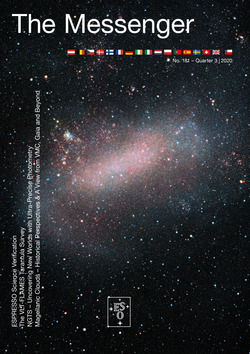
Messenger Issue 182
2021Issue 182
Messenger Issue 181
2020Issue 181
Messenger Issue 180
2020Issue 180
Messenger Issue 179
2020Issue 179
Messenger Issue 178
2019Issue 178
Messenger Issue 177
2019Issue 177
Messenger Issue 176
2019Issue 176
Table of Content No. 118 | 2004
Telescopes and Instrumentation
Silva, D. R., Peron, M.
VLT Science Products Produced by Pipelines: A Status Report
More...
ADS BibCode: 2004Msngr.118....2S
Authors:
Silva, D. R.; Peron, M.
Abstract:
Using the Data Flow System, ESO is producing calibrated science data products for all VLT and VLTI instruments. For many users, these products can be used directly for scientific analysis without further processing. In the end, the scientific usefulness of these products depends strongly on the needs of the individual investigators.

Modigliani, A., Mulas, G. et al.
The FLAMES-UVES Pipeline
More...
ADS BibCode: 2004Msngr.118....8M
Authors:
Modigliani, A.; Mulas, G.; Porceddu, I.; Wolff, B.; Damiani, F.; Banse, B. K.
Abstract:
In this paper we describe features associated with the data reduction of UVES when operated in Fibre Mode, the required calibrations, the data processing steps and the quality checks performed by the pipeline. We also summarise some results.

Patat, F.
Observing During Bright Time: Tips and Tricks
More...
ADS BibCode: 2004Msngr.118...11P
Authors:
Patat, F.
Abstract:
In this paper we present and discuss the effects of scattered moonlight on optical observations, the current status of the moonlit night sky modelling and the implications this has on the Service Mode observations and the maximisation of scientific outcome.

Alves, J., Lombardi, M.
The Sky Distribution of VLT Observations
More...
ADS BibCode: 2004Msngr.118...15A
Authors:
Alves, J.; Lombardi, M.
Abstract:
The sky is not all the same. Observers have favorite regions where most telescope time is spent while others are apparently ignored. To quantify this predilection we constructed an all-sky distribution of VLT pointings and found the existence of a well defined unpopular region, a ~20' band above and below the Galactic plane, where the VLT rarely spends any time.

Wilson, T., de Brueck, T. et al.
A Progress Report on ALMA
More...
ADS BibCode: 2004Msngr.118...16W
Authors:
Wilson, T.; de Brueck, T.; Zwaan, M.
Abstract:
The last article about ALMA in the Messenger was by the Director General, in the June 2003 issue. In the present article we give an update of activities since that time. An important event was the Community Day meeting in Garching on 24 September, which is summarized on page 68 of this issue.

Tan, G. H., Jackson, B. D. et al.
The European Receivers for ALMA
More...
ADS BibCode: 2004Msngr.118...18T
Authors:
Tan, G. H.; Jackson, B. D.; Lazareff, B.; Adema, J.; Baryshev, A. M.; Hesper, R.; Klapwijk, T. M.; Kroug, M.; Mahieu, S.; Maier, D.; Schuster, K.; Wielinga, K.; Zijlstra, T.
Abstract:
To a large extent the scientific capabilities of the Atacama Large Millimeter Array (ALMA) will depend on the receivers mounted on each of the 64 antennas. In the last year, substantial progress has been made in the design of these receivers and currently a transition towards production is underway. Two out of the four initial baseline frequency bands funded under the bi-lateral project between Europe and North America are a European responsibility. This European contribution will be for the shortest wavelength ALMA Bands designated 7 and 9, covering the frequency ranges 275 GHz to 373 GHz and 602 GHz to 720 GHz.

Reports from Observers
Lidman, C.
Observing Distant Type IA Supernovae with the ESO VLT
More...
ADS BibCode: 2004Msngr.118...24L
Authors:
Lidman, C.
Abstract:
The discovery of the accelerating universe through observations of distant Type Ia supernovae (SNe Ia) was one of the most exciting scientific discoveries of the past decade. The acceleration is apparently driven by a mysterious 'dark' energy which overcomes the gravitational pull of matter. One of the best ways of constraining the nature of the dark energy is to build a larger, better-observed sample of distant SNe Ia over a wide range of redshifts. The Supernova Cosmology Project (SCP) has been using ESO and other telescopes to do just that and, in this article, we give an overview of the data we have collected thus far and we present some preliminary results.

Della Valle, M., Malesani, D. et al.
Supernovae shed light on gamma-ray bursts
More...
ADS BibCode: 2004Msngr.118...31D
Authors:
Della Valle, M.; Malesani, D.; Chincarini, G.; Stella, L.; Tagliaferri, G.; Antonelli, L. A.; Campana, S.; Covino, S.; Fiore, F.; Gehrels, N.; Hurley, K.; Pellizza, L.J.; Zerbi, F. M.; Angelini, L.; Burderi, L.; Burrows, D.; Capalbi, M.; Caraveo, P.; Costa, E.; Cusumano, G.; Filliatre, P.; Fugazza, D.; Gilmozzi, R.; Giommi, P.; Goldoni, P.; Israel, G. L.; Mason, E.; Mason, K.; Melandr, A.; Mereghetti, S.; Mirabel, I. Felix; Molinari, E.; Moretti, A.; Nousek, J.; O'Brien, P.; Osborne, J.; Perna, R.; Perri, M.; Piro, L.; Puchnarewicz, E.; Vietri, M.; The MISTICI Collaboration
Abstract:
We have believed for decades that supernovae were the most magnificent and energetic phenomena occurring in the Universe after the Big Bang. Today we know that this is only a part of the story. Astronomers have discovered that comparable amounts of energy (or even more) are released, in a few seconds, by gamma-ray bursts. Recently it was determined that these two classes of events have a deep connection. In this article we report the observations of supernovae associated with gamma-ray bursts carried out at ESO by our group. We also briefly review the status of the supernova/gamma-ray burst connection and highlight the open questions.

Vreeswijk, P., Moller, P. et al.
GRB Afterglows: illuminating the star-forming universe
More...
ADS BibCode: 2004Msngr.118...35V
Authors:
Vreeswijk, P.; Moller, P.; Ledoux, C.; Ellison, C.; Masetti, N.; Fynbo, J.; Jakobsson, P.; Hjorth, J.
Abstract:
Gamma-Ray Burst (GRB) afterglows are distant powerhouses that can be extremely bright. Therefore, they can be used as a tool to study intervening matter along the line of sight, in exactly the same way that quasars have been used for decades, with two important differences: First, GRB afterglows fade away, thereby in time opening up their lines of sight for deep searches for the counterparts of the absorption systems. Secondly, a subclass of GRBs is related to the deaths of massive stars, and hence their afterglows provide sightlines directly into the very cores of star-forming regions, illuminating the line of sight all the way down to their immediate surroundings.

Bergeron, J., Petitjean, P. et al.
The large programme 'Cosmic Evolution of the IGM'
More...
ADS BibCode: 2004Msngr.118...40B
Authors:
Bergeron, J.; Petitjean, P.; Aracil, B.; Pichon, C.; Scannapieco, E.; Srianand, R.; Boisse, P.; Carswell, R. F.; Chand, H.; Cristiani, S.; Ferrara, A.; Haehnelt, M.; Hughes, A.; Kim, T.-S.; Ledoux, C.; Richter, P.; Viel, M.
Abstract:
Metal enrichment, clustering properties and main heating process of the intergalactic medium can be probed by analyzing the numerous Lyman 'forest' lines in the spectra of distant quasars and their associated, absorption metal lines. Constraints can then be placed on the scenarii of structure formation, the origin of metals and how they have been expelled in the intergalactic medium, and the spectral shape of the metagalactic UV flux.

Vanzella, E., Cristiani, S. et al.
VLT/FORS2 Spectroscopy in the GOODS-South Field
More...
ADS BibCode: 2004Msngr.118...45V
Authors:
Vanzella, E.; Cristiani, S.; Dickinson, M.; Kuntschner, H.; Moustakas, L. A.; Nonino, M.; Rosati, P.; Stern, D.; Cesarsky, C.; Ettori, S.; Ferguson, H. C.; Fosbury, R. A. E.; Giavalisco, M.; Haase, J.; Renzini, A.; Rettura, A.; Serra, P.; The Goods Team
Abstract:
The FORS2 instrument at the ESO VLT has been used to obtain spectra of a large sample of faint galaxies in the Chandra Deep Field South in the framework of the Great Observatories Origins Deep Survey (GOODS). A total of 303 objects with magnitude z850 ² 25.5 has been observed, providing 234 redshift determinations. The reduced spectra and the derived redshifts are released to the community (http://www.eso.org/science/goods/). They constitute an essential contribution to reach the scientific goals of GOODS, providing the time coordinate needed to delineate the evolution of galaxy masses, morphologies, and star formation, calibrating the photometric redshifts that can be derived from the imaging data at 0.36-8 mm and enabling detailed studies of the physical diagnostics for galaxies in the GOODS field.

Cimatti, A., Daddi, E. et al.
Unveiling Old Massive Spheroidal Galaxies in the Young Universe
More...
ADS BibCode: 2004Msngr.118...51C
Authors:
Cimatti, A.; Daddi, E.; Renzini, A.; Cassata, P.; Vanzella, E.; Pozzetti, L.; Cristiani, S.; Fontana, A.; Rodighiero, G.; Mignoli, M.; Zamorani, G.
Abstract:
Very deep VLT spectroscopy has unveiled the existence of old and massive spheroidal galaxies when the Universe was still young, thus showing that massive galaxies formed earlier and faster than has been expected from current theories of galaxy formation.

Cayrel, R., Spite, M.
The First Stars: What We Know and Do Not Know
More...
ADS BibCode: 2004Msngr.118...55C
Authors:
Cayrel, R.; Spite, M.
Abstract:
The H and K survey of Beers, Preston & Shectman has been the mine of extremely metal-poor stars during the last decade of the XXth century. The VLT-UVES combination has allowed us to study the chemical composition of the brightest members of this population, fossil component of events which have occured either during the formation of the galaxy, or earlier in smaller systems having eventually merged into our beautiful milky way. We report here what has been derived from a VLT large programme devoted to these objects, as well as on other questions relevant to the first stars.

Nordström, B., Mayor, M. et al.
A Livelier Picture of the Solar Neighbourhood
More...
ADS BibCode: 2004Msngr.118...61N
Authors:
Nordström, B.; Mayor, M.; Andersen, J.; Holmberg, J.; Jørgensen, B. R.; Pont, F.; Olsen, E. H.; Udry, S.; Mowlavi, N.
Abstract:
The formation and evolution of galaxies is one of the great outstanding problems of modern astrophysics. A new radial-velocity survey of over 14,000 nearby, long-lived stars now documents the history of the Solar Neighbourhood in unprecedented detail - and severely challenges models for the evolution of galactic disks.

Other Astronomical News
Randich, S., Pasquini, L.
Report on the ESO-Arectri Workshop 'Chemical Abundances and Mixing in Stars in the Milky Way and its Satellites'
More...
ADS BibCode: 2004Msngr.118...66R
Authors:
Randich, S.; Pasquini, L.
Abstract:
Between 13 and 17 September 2004, an ESO-Arcetri workshop took place in Castiglione della Pescaia, a middle age village in the south of Toscana, on the beautiful coast of Maremma. Thanks to the advent of 8 m class telescopes and efficient high resolution spectrographs, detailed chemical composition can now be obtained for stars of different masses and evolutionary stages, both in our Galaxy and in its neighborhood satellites, and the VLT with FLAMES and UVES is providing a wealth of high quality data. Chemical abundance ratios and patterns represent key fossil records that can reveal the complex chemical history of the stellar aggregate out of which stars formed; if correctly interpreted, measured abundances will allow us to derive the star formation history and evolution of the host galaxies. As a crucial step, however, we must first ensure that the abundances presently observed in the stellar atmospheres are the pristine ones. We must therefore first understand stellar mixing, a phenomenon present in most stars which may affect not only the surface abundances of the fragile elements, such as lithium and beryllium, but also the most commonly studied heavier elements.

Wilson, T. L., van Dishoeck, E. F.
ALMA Community Day
More...
ADS BibCode: 2004Msngr.118...67W
Authors:
Wilson, T. L.; van Dishoeck, E. F.
Abstract:
ALMA Community Day

Dennefeld, M.
The NEON School Enters a New Era
More...
ADS BibCode: 2004Msngr.118...68D
Authors:
Dennefeld, M.
Abstract:
THE NEON SCHOOL, a school on astronomical observations organised by a collaboration of observatories (Asiago, Calar Alto, ESO, La Palma and OHP) is well known by PhD students in astronomy all over Europe. It runs tutorial observations directly at the telescope for students in small groups, under the supervision of an experienced astronomer. This way, the participants can execute a real scientific program with all the steps needed in professional life: preparation of the program with selection of targets and feasibility estimates; set-up of the instrument and calibrations; running of the observations, in general both imaging/photometry and spectroscopy; data reductions; and, finally, the presentation of the results at the end of the school.

Boffin, H., West, R.
The “Venus Transit Experience”
More...
ADS BibCode: 2004Msngr.118...69B
Authors:
Boffin, H.; West, R.
Abstract:
On November 5-7, 2004, an unusual conference took place at the French Ministry of Research in Paris. Entitled the “Venus Transit Experience”, this meeting was organised by the VT-2004 International Steering Committee (ISC) and the local arrangements were ably taken care of by the staff of the IMCCE and the Observatoire de Paris, with Jean-Eudes Arlot and William Thuillot at the helm. It brought together more than 150 persons connected to the VT-2004 programme. The aim was to sum up the vast experience gained through this unique public education programme and, in particular, to perform an evaluation of its many components. On the first day, more than 50 students from the Paris areas who participated actively in this programme were also present.

Alloin, D., Lidman, C.
Report on the 2004 IAOC Conference 'The Cool Universe: Exploring Cosmic Dawn'
More...
ADS BibCode: 2004Msngr.118...69A
Authors:
Alloin, D.; Lidman, C.
Abstract:
In preparation for ALMA, the International Astronomical Observatories in Chile (IAOC) organised a conference on the topic of the cool universe. The conference was hosted by the Universidad Tecnica Federico Santa Maria (UTFSM) in the beautiful Chilean port city of Valparaiso from 4 to 8 October 2004 and was jointly supported by ESO, CTIO, LCO, Gemini, NRAO and NAOJ.

ESO
Personnel Movements
More...
ADS BibCode: 2004Msngr.118...70.
Authors:
ESO

Madsen, C., D'Odorico, S.
ESO Presentation in Copenhagen
More...
ADS BibCode: 2004Msngr.118...71M
Authors:
Madsen, C.; D'Odorico, S.
Abstract:
On November 8, ESO continued its series of presentations in memberstates with an event in Copenhagen. So far events have been organised in Belgium, Finland, Portugal, Sweden, Switzerland and the United Kingdom. The purpose of these presentations is to raise the awareness of ESO amongst decision-makers, academia and the media. Over time, the scope and specific focus of the national events have varied, considering the particular circumstances and the wishes of the national hosts, and accordingly, the presentation in Denmark was primarily oriented towards industry. The meeting was initiated by the Royal Danish Consulate General in Munich in conjunction with the Confederation of Danish Industries and the Ministry for Science, Technology and Innovation. Leading up to the meeting, several articles about ESO had appeared in the Danish press and the 2nd TV Channel featured a report on the ESO projects also in connection with the event.

Our use of Cookies

We use cookies that are essential for accessing our websites and using our services. We also use cookies to analyse, measure and improve our websites’ performance, to enable content sharing via social media and to display media content hosted on third-party platforms.

You can manage your cookie preferences and find out more by visiting 'Cookie Settings and Policy'.

ESO Cookies Policy


The European Organisation for Astronomical Research in the Southern Hemisphere (ESO) is the pre-eminent intergovernmental science and technology organisation in astronomy. It carries out an ambitious programme focused on the design, construction and operation of powerful ground-based observing facilities for astronomy.

This Cookies Policy is intended to provide clarity by outlining the cookies used on the ESO public websites, their functions, the options you have for controlling them, and the ways you can contact us for additional details.

What are cookies?

Cookies are small pieces of data stored on your device by websites you visit. They serve various purposes, such as remembering login credentials and preferences and enhance your browsing experience.

Categories of cookies we use

Essential cookies (always active): These cookies are strictly necessary for the proper functioning of our website. Without these cookies, the website cannot operate correctly, and certain services, such as logging in or accessing secure areas, may not be available; because they are essential for the website’s operation, they cannot be disabled.

Cookie ID/Name
Description/Purpose
Provider (1st party or 3rd party)
Browser session cookie or Stored cookie?
Duration
csrftoken
XSRF protection token. We use this cookie to protect against cross-site request forgery attacks.
1st party
Stored
1 year
user_privacy
Your privacy choices. We use this cookie to save your privacy preferences.
1st party
Stored
6 months
_grecaptcha
We use reCAPTCHA to protect our forms against spam and abuse. reCAPTCHA sets a necessary cookie when executed for the purpose of providing its risk analysis. We use www.recaptcha.net instead of www.google.com in order to avoid unnecessary cookies from Google.
3rd party
Stored
6 months

Analytics cookies: These cookies collect information about how visitors interact with our website, such as which pages are visited most often and how users navigate the site. This data helps us improve website performance, optimize content, and enhance the user experience; these cookies are only placed if you provide your consent. We use the following analytics cookies.

Matomo Cookies:

This website uses Matomo (formerly Piwik), an open source software which enables the statistical analysis of website visits. Matomo uses cookies (text files) which are saved on your computer and which allow us to analyze how you use our website. The website user information generated by the cookies will only be saved on the servers of our IT Department. We use this information to analyze www.eso.org visits and to prepare reports on website activities. These data will not be disclosed to third parties.

On behalf of ESO, Matomo will use this information for the purpose of evaluating your use of the website, compiling reports on website activity and providing other services relating to website activity and internet usage.

ON | OFF

Matomo cookies settings:

Cookie ID/Name
Description/Purpose
Provider (1st party or 3rd party)
Browser session cookie or Stored cookie?
Duration
Settings
_pk_id
Stores a unique visitor ID.
1st party
Stored
13 months
_pk_ses
Session cookie temporarily stores data for the visit.
1st party
Stored
30 minutes
_pk_ref
Stores attribution information (the referrer that brought the visitor to the website).
1st party
Stored
6 months
_pk_testcookie
Temporary cookie to check if a visitor’s browser supports cookies (set in Internet Explorer only).
1st party
Stored
Temporary cookie that expires almost immediately after being set.

Additional Third-party cookies on ESO websites: some of our pages display content from external providers, e.g. YouTube.

Such third-party services are outside of ESO control and may, at any time, change their terms of service, use of cookies, etc.

YouTube: Some videos on the ESO website are embedded from ESO’s official YouTube channel. We have enabled YouTube’s privacy-enhanced mode, meaning that no cookies are set unless the user actively clicks on the video to play it. Additionally, in this mode, YouTube does not store any personally identifiable cookie data for embedded video playbacks. For more details, please refer to YouTube’s embedding videos information page.

Cookies can also be classified based on the following elements.

Regarding the domain, there are:

As for their duration, cookies can be:

How to manage cookies

Cookie settings: You can modify your cookie choices for the ESO webpages at any time by clicking on the link Cookie settings at the bottom of any page.

In your browser: If you wish to delete cookies or instruct your browser to delete or block cookies by default, please visit the help pages of your browser:

Please be aware that if you delete or decline cookies, certain functionalities of our website may be not be available and your browsing experience may be affected.

You can set most browsers to prevent any cookies being placed on your device, but you may then have to manually adjust some preferences every time you visit a site/page. And some services and functionalities may not work properly at all (e.g. profile logging-in, shop check out).

Updates to the ESO Cookies Policy

The ESO Cookies Policy may be subject to future updates, which will be made available on this page.

Additional information

For any queries related to cookies, please contact: pdprATesoDOTorg.

As ESO public webpages are managed by our Department of Communication, your questions will be dealt with the support of the said Department.