European
Southern
Observatory

The Messenger
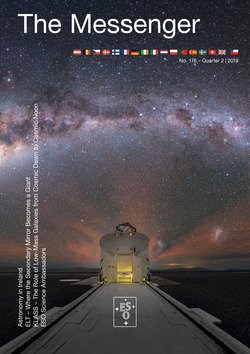
The Messenger is ESO’s journal for science and technology. It serves as a link between ESO and its broad astronomical community by providing information about scientific, technical, and other developments. It also delivers relevant news about astronomy and astrophysics to a broader public, including policy-makers, government officials, journalists, teachers, and amateur astronomers, as well as to interested scientists from other fields.

The Messenger is published twice per year and is available for free download as a PDF here and via the digital publishing platform Scribd.

Subscribe
If you wish to receive the new issue directly into your inbox, sign up here:
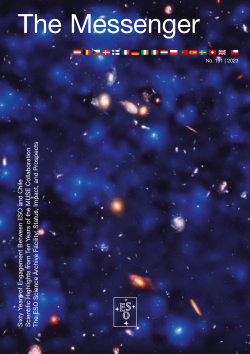
Issue 111
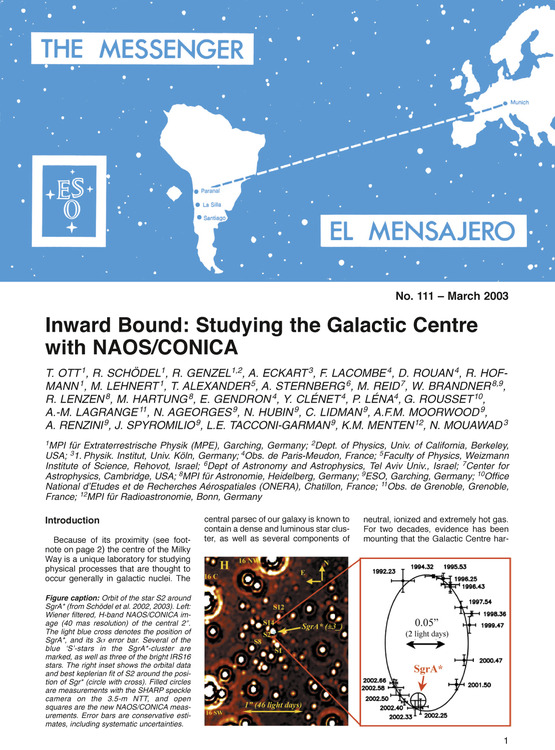
Messenger Issue 111

The Messenger Issue 111

Read the full PDF

Past Issues
Messenger Issue 195
2025Issue 195
Messenger Issue 194
2025Issue 194
Messenger Issue 193
2024Issue 193
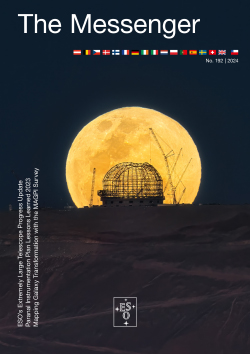
Messenger Issue 192
2024Issue 192
Messenger Issue 191
2023Issue 191
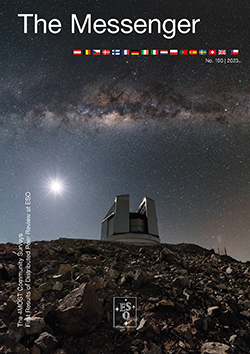
Messenger Issue 190
2023Issue 190
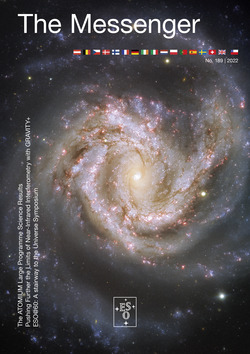
Messenger Issue 189
2022Issue 189
Messenger Issue 188
2022Issue 188
Messenger Issue 187
2022Issue 187
Messenger Issue 186
2022Issue 186
Messenger Issue 185
2021Issue 185
Messenger Issue 184
2021Issue 184
Messenger Issue 183
2021Issue 183
Messenger Issue 182
2021Issue 182
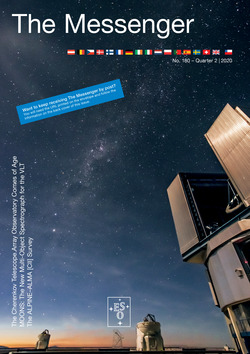
Messenger Issue 181
2020Issue 181
Messenger Issue 180
2020Issue 180
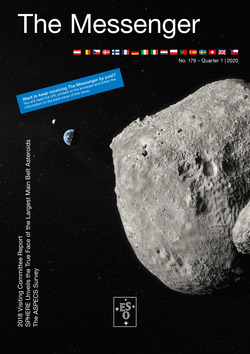
Messenger Issue 179
2020Issue 179
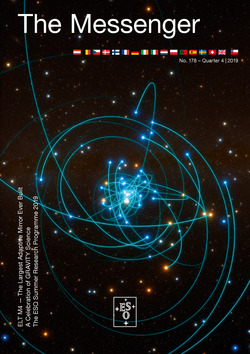
Messenger Issue 178
2019Issue 178
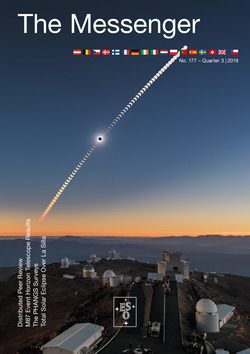
Messenger Issue 177
2019Issue 177
Messenger Issue 176
2019Issue 176
Table of Content No. 111 | 2003
Reports from Observers
Ott, T., Schödel, R. et al.
Inward bound: studying the Galactic Centre with NAOS/CONICA
More...
ADS BibCode: 2003Msngr.111....1O
Authors:
Ott, T.; Schödel, R.; Genzel, R.; Eckart, A.; Lacombe, F.; Rouan, D.; Hofmann, R.; Lehnert, M.; Alexander, T.; Sternberg, A.; Reid, M.; Brandner, W.; Lenzen, R.; Hartung, M.; Gendron, E.; Clénet, Y.; Léna, P.; Rousset, G.; Lagrange, A.-M.; Ageorges, N.; Hubin, N.; Lidman, C.; Moorwood, A.F.M.; Renzini, A.; Spyromilo, J.; Tacconi-Garman, L.E.; Menten, K.M.; Mouawad, N.
Abstract:
We report on the first results obtained using adaptive optics measurements of the Galactic Centre done with NAOS/CONICA.

Stolte, A., Brandner, W. et al.
NAOS-CONICA performance in a crowded field - the Arches cluster
More...
ADS BibCode: 2003Msngr.111....9S
Authors:
Stolte, A.; Brandner, W.; Grebel, E. K.; Figer, Don F.; Eisenhauer, F.; Lenzen, R.; Harayama, Y.
Abstract:
NAOS-CONICA is a near-infrared imaging camera and spectrograph (CONICA) attached to an adaptive optics (AO) system (NAOS) for wavefront corrections (Lenzen et al. 1998, Rousset et al. 2000). The AO system is designed to deliver diffraction-limited observations at an 8-metre-class telescope. NAOS is equipped with two Shack-Hartmann wavefront sensors operating at visual and NIR wavelengths, respectively. Most existing AO systems feed near-infrared (NIR) cameras, but operate at visual wavelengths. In addition to the fact that the spectral energy distribution of bright stars peaks at optical wavelengths, visual detectors offer higher sensitivity and lower read-out noise than NIR detectors, thus allowing one to use fainter targets for wavefront sensing. The restriction to visual reference sources, however, excludes deeply embedded objects located in regions with active star formation or high foreground extinction such as the Galactic Centre. With wavefront sensors operating both at visual and NIR wavelengths, NAOS combines the advantages of visual, faint reference targets with the option to penetrate highly obscured regions containing bright infrared sources. NAOS-CONICA was commissioned on Yepun (UT4) in the course of Period 69. For more detailed information on NACO performance and first light, see Brandner et al. (2002) in The Messenger 107.

Pettini, M.
Early galactic chemical evolution with UVES
More...
ADS BibCode: 2003Msngr.111...13P
Authors:
Pettini, M.
Abstract:
In November 2002 a workshop on the theme 'Early galactic chemical evolution with UVES' was held at ESO in Garching. The workshop served to highlight the major impact which UVES has had, and continues to have, on European astronomy, not only in new results and projects which the instrument has made possible, but also in the increasing dialogue between stellar and extragalactic astronomy, and between observers and theorists.

Le F
The VIRMOS-VLT Deep Survey: a progress report
More...
ADS BibCode: 2003Msngr.111...18L
Authors:
Le F
Abstract:
We describe the start of the survey with the first guaranteed night observations which have been carried out in the October - December 2002 time frame. The general survey strategy, performances, and first results are presented.

Boehnhardt, H., Barucci, A. et al.
Exploring the icy world of the Edgeworth-Kuiper Belt - an ESO Large Programme
More...
ADS BibCode: 2003Msngr.111...22B
Authors:
Boehnhardt, H.; Barucci, A.; Delsanti, A.; de Bergh, C.; Doressoundiram, A.; Romon, J.; Dotto, E.; Tozzi, G.; Lazzarin, M.; Fournisier, S.; Peixinho, N.; Hainaut, O.; Davies, J.; Rousselot, P.; Barrera, L.; Birkle, K.; Meech, K.; Ortiz, J.; Sekiguchi, T.; Watanabe, J.-I.; Thomas, N.; West, R.
Abstract:
The first object in the Edgeworth- Kuiper Belt was observed in 1930, when Clyde Tombaugh discovered Pluto at a distance of 43 AU (1AU = one astronomical unit, the mean distance between Earth and the Sun = 149.6 million km), i.e. beyond the orbit of Neptune. About 20 years later Edgeworth and Kuiper started to speculate about the existence of another asteroid belt at the edge of the planetary system. Another 30 years later this speculation became an hypothesis when Fernandez and Ip argued for the existence of an Ecliptic-oriented reservoir of icy bodies beyond Neptune as a source for short-period comets, the recruitment of which was difficult to explain by gravitational capturing of Oort Cloud comets through planets when approaching the inner solar system. The hypothesis became reality in 1992, when, during a search campaign for distant asteroids, Jewitt and Luu found 1992 QB1 (now numbered: 15760) at a distance of 41 AU from the Sun.

Cimatti, A., Daddi, E. et al.
The K20 survey: new light on galaxy formation and evolution
More...
ADS BibCode: 2003Msngr.111...29C
Authors:
Cimatti, A.; Daddi, E.; Mignoli, M.; Pozzetti, L.; Fontana, A.; Broadhurst, T.; Poli, F.; Saracco, P.; Renzini, A.; Zamorani, G.; Menci, M.; Cristiani, S.; D'Odorico, S.; Giallongo, E.; Gilmozzi, R.; di Serego Alighieri, S.; Vernet, J.
Abstract:
Despite the recent extraordinary progress in observational cosmology and the successful convergence on a single cosmological model, the history of galaxy and structure formation and evolution remains still an open question. One of the most actively debated issues is how and when the presentday most massive galaxies (e.g. elliptical galaxies and bulges with Mstars > 1011 M) built up and what type of evolution characterized their growth over the cosmic time. Addressing this question is important not only to test the different scenarios of galaxy formation, but also to understand how the general structures of the universe evolved.

Venemans, B., Miley, G. et al.
Tracing the formation and evolution of clusters and their central massive galaxies to z > 4: a progress report
More...
ADS BibCode: 2003Msngr.111...36V
Authors:
Venemans, B.; Miley, G.; Kurk, J.; R
Abstract:
Luminous distant radio galaxies are unique probes of the early Universe. About 15 years ago at Leiden some of us started a programme to find distant radio galaxies, study their properties and use them as probes of the early Universe. The project began as a result of the technique we developed during the late eighties to pinpoint distant radio galaxies, based on their ultra-steep radio spectra (spectral index

Telescopes and Instrumentation
ESO
ESO and NSF sign agreement on ALMA. Green light for world's most powerful radio observatory
More...
ADS BibCode: 2003Msngr.111...39.
Authors:
ESO
Abstract:
On February 25, 2003, the European Southern Observatory (ESO) and the US National Science Foundation (NSF) signed a historic agreement to construct and operate the world s largest and most powerful radio telescope, operating at millimetre and sub-millimetre wavelengths. The Director General of ESO, Dr. Catherine Cesarsky, and the Director of the NSF, Dr. Rita Colwell, acted for their respective organizations.

ESO
New Vistas Open with MIDI at the VLT Interferometer
More...
ADS BibCode: 2003Msngr.111...40.
Authors:
ESO
Abstract:
Following several weeks of around-theclock work, a team of astronomers and engineers from Germany, the Netherlands, France and ESO has successfully performed the first observations with the MIDInfrared interferometric instrument (MIDI), a new, extremely powerful instrument just installed in the underground laboratory of the VLT Interferometer (VLTI) at the Paranal Observatory (Chile).

Doublier, V.
TIMMI2 at the 3.6-m, or The return of MIR
More...
ADS BibCode: 2003Msngr.111...41D
Authors:
Doublier, V.
Abstract:
In October 2002, after only 12 weeks of forced retirement, TIMMI2 (Thermal Infrared Multimode Instrument) underwent a major upgrade and was successfully remounted at the Cassegrain focus of the 3.6-m telescope at La Silla. TIMMI2 had a difficult start to 2000, when the tragic and untimely death of PI Hans-Georg Reimann overshadowed the success of the project. The instrument was first commissioned in late 2000, with TNT control software and the Wallace acquisition system. However, after almost two years of continuous operation, it became apparent that an upgrade of the control and acquisition system could improve the reliability of the instrument and reduce the operational load for the staff.

Other Astronomical News
Alloin, D., Pierre, M. et al.
International Workshop on Structure Evolution and Cosmology: New synergy between ground-based observations, space observations and theory
More...
ADS BibCode: 2003Msngr.111...42A
Authors:
Alloin, D.; Pierre, M.; Refregier, A.
Abstract:
An international Workshop, Structure Evolution and Cosmology: New Synergy between Ground-based Observations, Space Observations and Theory , was organized jointly by the European Southern Observatory (ESO/ Chile), the Centre National d Etudes Spatiales (CNES/France) and the Commissariat pour l Energie (CEA/ France), at ESO/Santiago from October 28 to 31, 2002.

Alloin, D., Gieren, W.
International Workshop on Stellar Candles for the Extragalactic Distance Scale
More...
ADS BibCode: 2003Msngr.111...43A
Authors:
Alloin, D.; Gieren, W.
Abstract:
An international Workshop, STELLAR CANDLES for the EXTRAGALACTIC DISTANCE SCALE , was organized jointly by the European Southern Observatory and the Astronomy Group at the University of Concepci

Leibundgut, B.
Fellows at ESO
More...
ADS BibCode: 2003Msngr.111...44L
Authors:
Leibundgut, B.
Abstract:
Since the beginning ESO has provided opportunities for young scientists to interact with the environment of an observatory. Many European astronomers spent some years as post-doctoral Fellows at ESO. The Fellowship programme has been very successful; with only very few exceptions, all former ESO Fellows are now working as astronomers in the community. In addition to developing their scientific careers the Fellows are also asked to contribute to the work of the observatories. In Chile all Fellows are involved in operational activities at Paranal and La Silla, while in Garching they participate in instrument and software development, PR activities, ALMA related studies and surveys. With this issue of The Messenger we start short presentations of Fellows currently at ESO. They describe in their own words what research they pursue and how they are involved in ESO activities. We will continue to present some of the young faces at ESO in the coming issues.

ESO
URANUS, Rings and Moons
More...
ADS BibCode: 2003Msngr.111...45.
Authors:
ESO
Abstract:
A near-infrared view of the giant planet Uranus with its rings and some of its moons, obtained at a wavelength of 2.2

Announcements
ESO
ESO Workshop on High-Resolution Infrared Spectroscopy in Astronomy
More...
ADS BibCode: 2003Msngr.111Q..46.
Authors:
ESO
Abstract:
Infrared spectroscopy at a resolution of a few km/s offers a unique tool to study rotational-vibrational transitions of many abundant molecules as well as important atomic lines in a multitude of interesting astrophysical environments. Applications include the possible direct detection of exosolar planets, measurements of the abundances and magnetic fields of stars, studies of ISM chemistry and the kinematics of stars and gas in galactic centres.

ESO
ESO Workshop on Large Programmes and Public Surveys
More...
ADS BibCode: 2003Msngr.111R..46.
Authors:
ESO
Abstract:
An evaluation of the scientific success of the first completed Large Programmes at the VLT and public surveys should take place before the survey telescopes VST and VISTA start operating. To assess the scientific return of the Large Programmes ESO is organizing a three-day workshop in Garching.

ESO
Personnel Movements
More...
ADS BibCode: 2003Msngr.111Q..47.
Authors:
ESO

ESO
First Announcement - ESO Workshop on Science with Adaptive Optics
More...
ADS BibCode: 2003Msngr.111R..47.
Authors:
ESO
Abstract:
Over the past ten years, the concept of adaptive optics has matured from early experimental stages to a standard observing tool now available at many large optical and near-infrared telescope facilities. Indeed, adaptive optics has become an integral part of all present and future large telescope initiatives, and will be essential in exploiting the full potential of the large optical interferometers currently under construction. Adaptive optics has been identified as one of the key technologies for astronomy in the 21st century.

ESO
ESO Studentship Programme
More...
ADS BibCode: 2003Msngr.111Q..48.
Authors:
ESO
Abstract:
The European Southern Observatory research student programme aims at providing opportunities and facilities to enhance the Ph.D. programmes of ESO member-state universities. Its goal is to bring young scientists into close contact with the instruments, activities, and people at one of the world s foremost observatories. For more information about ESO s astronomical research activities please consult http://www.eso.org/science/

ESO
Acronyms Used at ESO Confused?
More...
ADS BibCode: 2003Msngr.111R..48.
Authors:
ESO

ESO
ESO Workshop Proceedings Still Available
More...
ADS BibCode: 2003Msngr.111Q..52.
Authors:
ESO
Abstract:
ESO Workshop Proceedings Still Available

Messenger Index
ESO
Subject Index 2002 (Nos. 107 - 110)
More...
ADS BibCode: 2003Msngr.111...49.
Authors:
ESO

ESO
Author Index 2002 (Nos. 107 - 110)
More...
ADS BibCode: 2003Msngr.111...50.
Authors:
ESO

Our use of Cookies

We use cookies that are essential for accessing our websites and using our services. We also use cookies to analyse, measure and improve our websites’ performance, to enable content sharing via social media and to display media content hosted on third-party platforms.

You can manage your cookie preferences and find out more by visiting 'Cookie Settings and Policy'.

ESO Cookies Policy


The European Organisation for Astronomical Research in the Southern Hemisphere (ESO) is the pre-eminent intergovernmental science and technology organisation in astronomy. It carries out an ambitious programme focused on the design, construction and operation of powerful ground-based observing facilities for astronomy.

This Cookies Policy is intended to provide clarity by outlining the cookies used on the ESO public websites, their functions, the options you have for controlling them, and the ways you can contact us for additional details.

What are cookies?

Cookies are small pieces of data stored on your device by websites you visit. They serve various purposes, such as remembering login credentials and preferences and enhance your browsing experience.

Categories of cookies we use

Essential cookies (always active): These cookies are strictly necessary for the proper functioning of our website. Without these cookies, the website cannot operate correctly, and certain services, such as logging in or accessing secure areas, may not be available; because they are essential for the website’s operation, they cannot be disabled.

Cookie ID/Name
Description/Purpose
Provider (1st party or 3rd party)
Browser session cookie or Stored cookie?
Duration
csrftoken
XSRF protection token. We use this cookie to protect against cross-site request forgery attacks.
1st party
Stored
1 year
user_privacy
Your privacy choices. We use this cookie to save your privacy preferences.
1st party
Stored
6 months
_grecaptcha
We use reCAPTCHA to protect our forms against spam and abuse. reCAPTCHA sets a necessary cookie when executed for the purpose of providing its risk analysis. We use www.recaptcha.net instead of www.google.com in order to avoid unnecessary cookies from Google.
3rd party
Stored
6 months

Analytics cookies: These cookies collect information about how visitors interact with our website, such as which pages are visited most often and how users navigate the site. This data helps us improve website performance, optimize content, and enhance the user experience; these cookies are only placed if you provide your consent. We use the following analytics cookies.

Matomo Cookies:

This website uses Matomo (formerly Piwik), an open source software which enables the statistical analysis of website visits. Matomo uses cookies (text files) which are saved on your computer and which allow us to analyze how you use our website. The website user information generated by the cookies will only be saved on the servers of our IT Department. We use this information to analyze www.eso.org visits and to prepare reports on website activities. These data will not be disclosed to third parties.

On behalf of ESO, Matomo will use this information for the purpose of evaluating your use of the website, compiling reports on website activity and providing other services relating to website activity and internet usage.

ON | OFF

Matomo cookies settings:

Cookie ID/Name
Description/Purpose
Provider (1st party or 3rd party)
Browser session cookie or Stored cookie?
Duration
Settings
_pk_id
Stores a unique visitor ID.
1st party
Stored
13 months
_pk_ses
Session cookie temporarily stores data for the visit.
1st party
Stored
30 minutes
_pk_ref
Stores attribution information (the referrer that brought the visitor to the website).
1st party
Stored
6 months
_pk_testcookie
Temporary cookie to check if a visitor’s browser supports cookies (set in Internet Explorer only).
1st party
Stored
Temporary cookie that expires almost immediately after being set.

Additional Third-party cookies on ESO websites: some of our pages display content from external providers, e.g. YouTube.

Such third-party services are outside of ESO control and may, at any time, change their terms of service, use of cookies, etc.

YouTube: Some videos on the ESO website are embedded from ESO’s official YouTube channel. We have enabled YouTube’s privacy-enhanced mode, meaning that no cookies are set unless the user actively clicks on the video to play it. Additionally, in this mode, YouTube does not store any personally identifiable cookie data for embedded video playbacks. For more details, please refer to YouTube’s embedding videos information page.

Cookies can also be classified based on the following elements.

Regarding the domain, there are:

As for their duration, cookies can be:

How to manage cookies

Cookie settings: You can modify your cookie choices for the ESO webpages at any time by clicking on the link Cookie settings at the bottom of any page.

In your browser: If you wish to delete cookies or instruct your browser to delete or block cookies by default, please visit the help pages of your browser:

Please be aware that if you delete or decline cookies, certain functionalities of our website may be not be available and your browsing experience may be affected.

You can set most browsers to prevent any cookies being placed on your device, but you may then have to manually adjust some preferences every time you visit a site/page. And some services and functionalities may not work properly at all (e.g. profile logging-in, shop check out).

Updates to the ESO Cookies Policy

The ESO Cookies Policy may be subject to future updates, which will be made available on this page.

Additional information

For any queries related to cookies, please contact: pdprATesoDOTorg.

As ESO public webpages are managed by our Department of Communication, your questions will be dealt with the support of the said Department.