European
Southern
Observatory

The Messenger
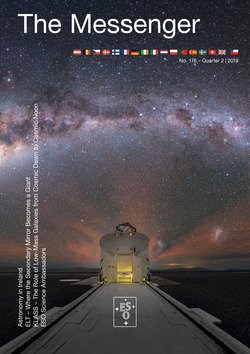
The Messenger is ESO’s journal for science and technology. It serves as a link between ESO and its broad astronomical community by providing information about scientific, technical, and other developments. It also delivers relevant news about astronomy and astrophysics to a broader public, including policy-makers, government officials, journalists, teachers, and amateur astronomers, as well as to interested scientists from other fields.

The Messenger is published twice per year and is available for free download as a PDF here and via the digital publishing platform Scribd.

Subscribe
If you wish to receive the new issue directly into your inbox, sign up here:
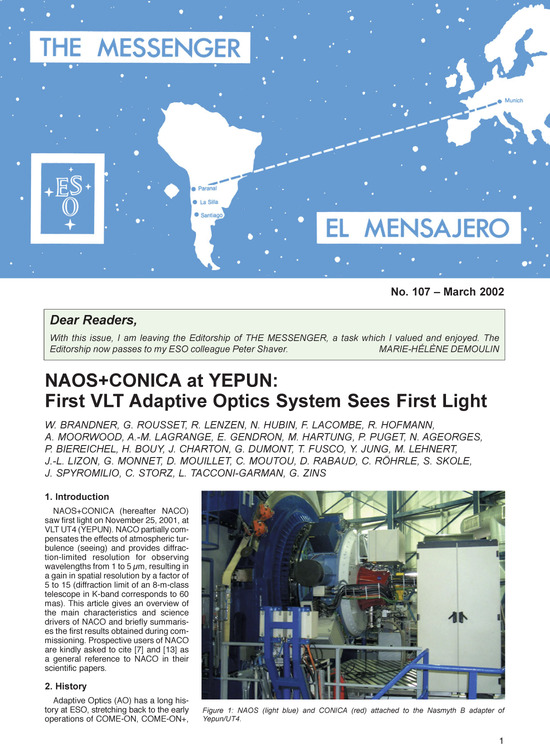
Issue 107
Messenger Issue 107

The Messenger Issue 107

Read the full PDF

Past Issues
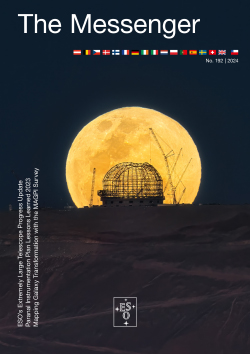
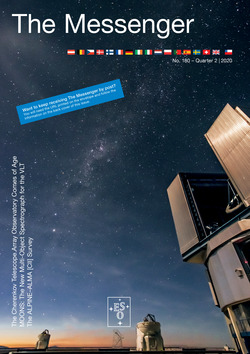
Messenger Issue 195
2025Issue 195
Messenger Issue 194
2025Issue 194
Messenger Issue 193
2024Issue 193
Messenger Issue 192
2024Issue 192
Messenger Issue 191
2023Issue 191
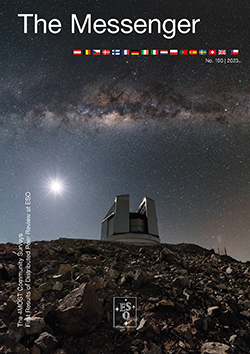
Messenger Issue 190
2023Issue 190
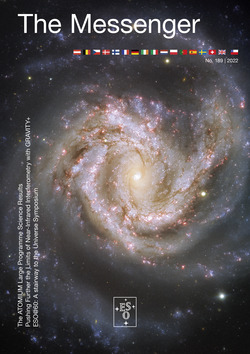
Messenger Issue 189
2022Issue 189
Messenger Issue 188
2022Issue 188
Messenger Issue 187
2022Issue 187
Messenger Issue 186
2022Issue 186
Messenger Issue 185
2021Issue 185
Messenger Issue 184
2021Issue 184
Messenger Issue 183
2021Issue 183
Messenger Issue 182
2021Issue 182
Messenger Issue 181
2020Issue 181
Messenger Issue 180
2020Issue 180
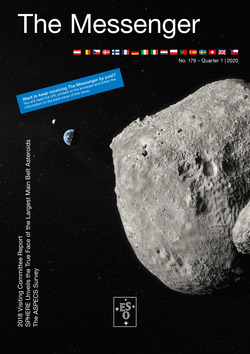
Messenger Issue 179
2020Issue 179
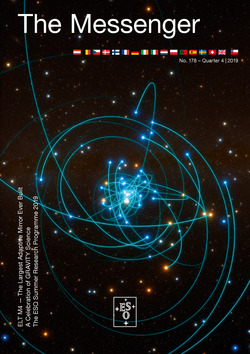
Messenger Issue 178
2019Issue 178
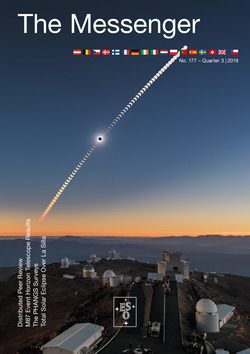
Messenger Issue 177
2019Issue 177
Messenger Issue 176
2019Issue 176
Table of Content No. 107 | 2002
Telescopes and Instrumentation
Brandner, W., Rousset, G. et al.
NAOS+CONICA at YEPUN: first VLT adaptive optics system sees first light
More...
ADS BibCode: 2002Msngr.107....1B
Authors:
Brandner, W.; Rousset, G.; Lenzen, R.; Hubin, N.; Lacombe, F.; Hofmann, R.; Moorwood, A.; Lagrange, A.-M.; Gendron, E.; Hartung, M.; Puget, P.; Ageorges, N.; Biereichel, P.; Bouy, H.; Charton, J.; Dumont, G.; Fusco, T.; Jung, Y.; Lehnert, M.; Lizon, J.-L.; Monnet, G.; Mouillet, D.; Moutou, C.; Rabaud, D.; Röhrle, C.; Skole, S.; Spyromilio, J.; Storz, C.; Tacconi-Garman, L.; Zins, G.
Abstract:
NAOS+CONICA (hereafter NACO) saw first light on November 25, 2001, at VLT UT4 (YEPUN). NACO partially compensates the effects of atmospheric turbulence (seeing) and provides diffraction- limited resolution for observing wavelengths from 1 to 5 μm, resulting in a gain in spatial resolution by a factor of 5 to 15 (diffraction limit of an 8-m-class telescope in K-band corresponds to 60 mas). This article gives an overview of the main characteristics and science drivers of NACO and briefly summarises the first results obtained during commissioning. Prospective users of NACO are kindly asked to cite [7] and [13] as a general reference to NACO in their scientific papers.

Kurz, R., Guilloteau, S. et al.
The Atacama Large Millimetre Array
More...
ADS BibCode: 2002Msngr.107....7K
Authors:
Kurz, R.; Guilloteau, S.; Shaver, P.
Abstract:
This article is based on the Executive Summary of the European proposal for ALMA, which was prepared with input from many persons, including J. Baars, R. Bachiller, A. Benz, A. Blain, D. Bockelée-Morvan, R. Booth, C. Carilli, F. Combes, J. Conway, P. Cox, J. Crovisier, A. Dutrey, E. Falgarone, T. Forveille, M. Guélin, S. Guilloteau, C. Henkel, R. Kurz, E. Lellouch, J. Lequeux, J-F. Lestrade, R. Lucas, K. Menten, R. Pallavicini, J. Richer, P. Shaver, L. Tacconi, E. van Dishoeck, M. Walmsley, T. Wiklind.

Germany, L.
News from the 2p2 Team
More...
ADS BibCode: 2002Msngr.107...13G
Authors:
Germany, L.
Abstract:
News from the 2p2 Team

Chilean Astronomy
Bronfman, L.
A panorama of Chilean astronomy
More...
ADS BibCode: 2002Msngr.107...14B
Authors:
Bronfman, L.
Abstract:
Chile is becoming the astronomical capital of the world. The Atacama desert encompasses the best locations on Earth to build astronomical observatories. Paranal, Las Campanas, Tololo, Pachón, and La Silla are well-known places that contain top-quality optical astronomical facilities open to Chilean astronomers. In the last few years a new generation of astronomical facilities, the mega-telescopes, have been constructed in those sites: VLT, Magellan, and Gemini. In addition, there will be near San Pedro de Atacama at a height of 5000 m, the most powerful radio synthesis telescope of the world: the Atacama Large Millimetre Array (ALMA). This telescope will open up a new, unexplored, window of the electromagnetic spectrum for astrophysical studies. It will operate in an spectral range where clouds of cold gas which are the placental material of mostly every object we know in the universe, have their characteristic spectral signatures.

Reisenegger, A., Quintana, H. et al.
Dynamics and mass of the Shapley Supercluster, the largest bound structure in the local Universe
More...
ADS BibCode: 2002Msngr.107...18R
Authors:
Reisenegger, A.; Quintana, H.; Proust, D.; Slezak, E.
Abstract:
The Shapley Supercluster is the largest bound structure identified in the local Universe (z < 0.1). In this article, we discuss the role of superclusters as present day 'turning points' in the growth of structure in the Universe. We review observations of the Shapley Supercluster and their interpretation, particularly with regard to its dynamics and the determination of its mass, much of which has been done by our group, centred at Pontificia Universidad Catolica de Chile. Finally, we describe our recent application of a spherical collapse model to the supercluster, and discuss possibilities of future progress.

Reports from Observers
Baade, D., Rivinius, T. et al.
To Be or not to Be and a 50-cm post-mortem eulogy
More...
ADS BibCode: 2002Msngr.107...24B
Authors:
Baade, D.; Rivinius, T.; Štefl, S.
Abstract:
Be stars were discovered as early as 1866 by the famous Jesuit astronomer Angelo Secchi. Not only was γ Cas the first known Be star but the first star ever to be seen displaying emission lines. About half-way between then and today, the work by Otto Struve and others led to the picture that Be stars differ from supergiant B-type stars, which also feature emission lines, in that they are much less evolved, rotate extremely rapidly (up to 450 km/s at the equator), and their emission lines arise from a circumstellar disk.

Courbin, F., Letawe, G. et al.
Spectroscopy of quasar host galaxies at the VLT: stellar populations and dynamics down to the central kiloparsec
More...
ADS BibCode: 2002Msngr.107...28C
Authors:
Courbin, F.; Letawe, G.; Magain, P.; Wisotzki, L.; Jablonka, P.; Alloin, D.; Jahnke, K.; Kuhlbrodt, B.; Meylan, G.; Minniti, D.
Abstract:
1. Scientific Context 2. VLT Spectroscopic Observations 3. Spectra Decomposition and Stellar Population 4. Dynamics of the Host 5. Towards 2D Spectroscopy and High Spatial Resolution: GIRAFFE, SINFONI and FALCON

Sollerman, J., Flyckt, V.
The Crab pulsar and its environment
More...
ADS BibCode: 2002Msngr.107...32S
Authors:
Sollerman, J.; Flyckt, V.
Abstract:
We present new data of the Crab pulsar and its environment. Images taken in the infrared with ISAAC allow us to measure the pulsar spectrum and to reveal the red knot close to the pulsar. Complementary optical data from VLT and HST are presented. The full article, with full resolution nice color images, is presented in Messenger, 107, 32

Vanzi, L., Mannucci, F. et al.
SOFI discovers a dust enshrouded supernova
More...
ADS BibCode: 2002Msngr.107...35V
Authors:
Vanzi, L.; Mannucci, F.; Maiolino, R.; della Valle, M.
Abstract:
1. An IR Search for SN 2. First Success with SOFI – SN2001db 3. Extinction 4. The IR SN Rate

Rupprecht, G.
A deep look at an active galaxy
More...
ADS BibCode: 2002Msngr.107...38R
Authors:
Rupprecht, G.
Abstract:
A Deep Look at an Active Galaxy

ESO
Coming Home at Paranal. Unique “Residencia” Opens at the VLT Observatory
More...
ADS BibCode: 2002Msngr.107...39.
Authors:
ESO
Abstract:
The Paranal Residencia at the ESO VLT Observatory is now ready and the staff and visitors have moved into their new home.

Other Astronomical Announcements
ESO
VLT Science Verification Policy and Procedures
More...
ADS BibCode: 2002Msngr.107...41.
Authors:
ESO
Abstract:
1. Science Verification Observations 2. Goals of Science Verification 3. Science Verification Programmes and Data Policy 4. Selection Criteria for SV Programmes 5. The SV Team

Paresce, F.
Release of Scientific Data from VLTI Commissioning
More...
ADS BibCode: 2002Msngr.107...41P
Authors:
Paresce, F.

ESO
“ESO Studentship Programme
More...
ADS BibCode: 2002Msngr.107...42.
Authors:
ESO

Alloin, D.
News from Santiago
More...
ADS BibCode: 2002Msngr.107...42A
Authors:
Alloin, D.
Abstract:
The spectacular fringes obtained at VLTI, as well as the intensive ALMA preparatory work in Chile, have suddenly brought the “world of interferometry” to full attention of the astronomical community in Chile.

Bacher, A.
“Life in the Universe” Winners on La Silla and Paranal
More...
ADS BibCode: 2002Msngr.107...43B
Authors:
Bacher, A.
Abstract:
“Please fasten you seat-belts, we are descending to Santiago de Chile!” On board of the airplane are the winners of the “Life in the Universe” contest, Mihaly Kristof, Katalin Lovei, Adam Orban, Andras Sik and Tamas Simon. All are excited and for one it is the first flight in his life. What a chance!

Dennefeld, M.
The Third NEON Observing School
More...
ADS BibCode: 2002Msngr.107...43D
Authors:
Dennefeld, M.

Bacher, A., Christensen, L.L.
In the Footsteps of Scientists – ESA/ESO Astronomy Exercise Series
More...
ADS BibCode: 2002Msngr.107...44B
Authors:
Bacher, A.; Christensen, L.L.

ESO
List of Scientific Preprints
More...
ADS BibCode: 2002Msngr.107Q..45.
Authors:
ESO

ESO
Personnel Movements
More...
ADS BibCode: 2002Msngr.107...45.
Authors:
ESO

Messenger Index
ESO
Subject Index 2001 (Nos. 103–106)
More...
ADS BibCode: 2002Msngr.107...46.
Authors:
ESO

ESO
Author Index 2001 (Nos. 103–106)
More...
ADS BibCode: 2002Msngr.107...47.
Authors:
ESO

Our use of Cookies

We use cookies that are essential for accessing our websites and using our services. We also use cookies to analyse, measure and improve our websites’ performance, to enable content sharing via social media and to display media content hosted on third-party platforms.

You can manage your cookie preferences and find out more by visiting 'Cookie Settings and Policy'.

ESO Cookies Policy


The European Organisation for Astronomical Research in the Southern Hemisphere (ESO) is the pre-eminent intergovernmental science and technology organisation in astronomy. It carries out an ambitious programme focused on the design, construction and operation of powerful ground-based observing facilities for astronomy.

This Cookies Policy is intended to provide clarity by outlining the cookies used on the ESO public websites, their functions, the options you have for controlling them, and the ways you can contact us for additional details.

What are cookies?

Cookies are small pieces of data stored on your device by websites you visit. They serve various purposes, such as remembering login credentials and preferences and enhance your browsing experience.

Categories of cookies we use

Essential cookies (always active): These cookies are strictly necessary for the proper functioning of our website. Without these cookies, the website cannot operate correctly, and certain services, such as logging in or accessing secure areas, may not be available; because they are essential for the website’s operation, they cannot be disabled.

Cookie ID/Name
Description/Purpose
Provider (1st party or 3rd party)
Browser session cookie or Stored cookie?
Duration
csrftoken
XSRF protection token. We use this cookie to protect against cross-site request forgery attacks.
1st party
Stored
1 year
user_privacy
Your privacy choices. We use this cookie to save your privacy preferences.
1st party
Stored
6 months
_grecaptcha
We use reCAPTCHA to protect our forms against spam and abuse. reCAPTCHA sets a necessary cookie when executed for the purpose of providing its risk analysis. We use www.recaptcha.net instead of www.google.com in order to avoid unnecessary cookies from Google.
3rd party
Stored
6 months

Analytics cookies: These cookies collect information about how visitors interact with our website, such as which pages are visited most often and how users navigate the site. This data helps us improve website performance, optimize content, and enhance the user experience; these cookies are only placed if you provide your consent. We use the following analytics cookies.

Matomo Cookies:

This website uses Matomo (formerly Piwik), an open source software which enables the statistical analysis of website visits. Matomo uses cookies (text files) which are saved on your computer and which allow us to analyze how you use our website. The website user information generated by the cookies will only be saved on the servers of our IT Department. We use this information to analyze www.eso.org visits and to prepare reports on website activities. These data will not be disclosed to third parties.

On behalf of ESO, Matomo will use this information for the purpose of evaluating your use of the website, compiling reports on website activity and providing other services relating to website activity and internet usage.

ON | OFF

Matomo cookies settings:

Cookie ID/Name
Description/Purpose
Provider (1st party or 3rd party)
Browser session cookie or Stored cookie?
Duration
Settings
_pk_id
Stores a unique visitor ID.
1st party
Stored
13 months
_pk_ses
Session cookie temporarily stores data for the visit.
1st party
Stored
30 minutes
_pk_ref
Stores attribution information (the referrer that brought the visitor to the website).
1st party
Stored
6 months
_pk_testcookie
Temporary cookie to check if a visitor’s browser supports cookies (set in Internet Explorer only).
1st party
Stored
Temporary cookie that expires almost immediately after being set.

Additional Third-party cookies on ESO websites: some of our pages display content from external providers, e.g. YouTube.

Such third-party services are outside of ESO control and may, at any time, change their terms of service, use of cookies, etc.

YouTube: Some videos on the ESO website are embedded from ESO’s official YouTube channel. We have enabled YouTube’s privacy-enhanced mode, meaning that no cookies are set unless the user actively clicks on the video to play it. Additionally, in this mode, YouTube does not store any personally identifiable cookie data for embedded video playbacks. For more details, please refer to YouTube’s embedding videos information page.

Cookies can also be classified based on the following elements.

Regarding the domain, there are:

As for their duration, cookies can be:

How to manage cookies

Cookie settings: You can modify your cookie choices for the ESO webpages at any time by clicking on the link Cookie settings at the bottom of any page.

In your browser: If you wish to delete cookies or instruct your browser to delete or block cookies by default, please visit the help pages of your browser:

Please be aware that if you delete or decline cookies, certain functionalities of our website may be not be available and your browsing experience may be affected.

You can set most browsers to prevent any cookies being placed on your device, but you may then have to manually adjust some preferences every time you visit a site/page. And some services and functionalities may not work properly at all (e.g. profile logging-in, shop check out).

Updates to the ESO Cookies Policy

The ESO Cookies Policy may be subject to future updates, which will be made available on this page.

Additional information

For any queries related to cookies, please contact: pdprATesoDOTorg.

As ESO public webpages are managed by our Department of Communication, your questions will be dealt with the support of the said Department.