Press Release
"Beyond the limit": one million satellites and mirrors in space pose grave threat to the night sky
1 July 2026
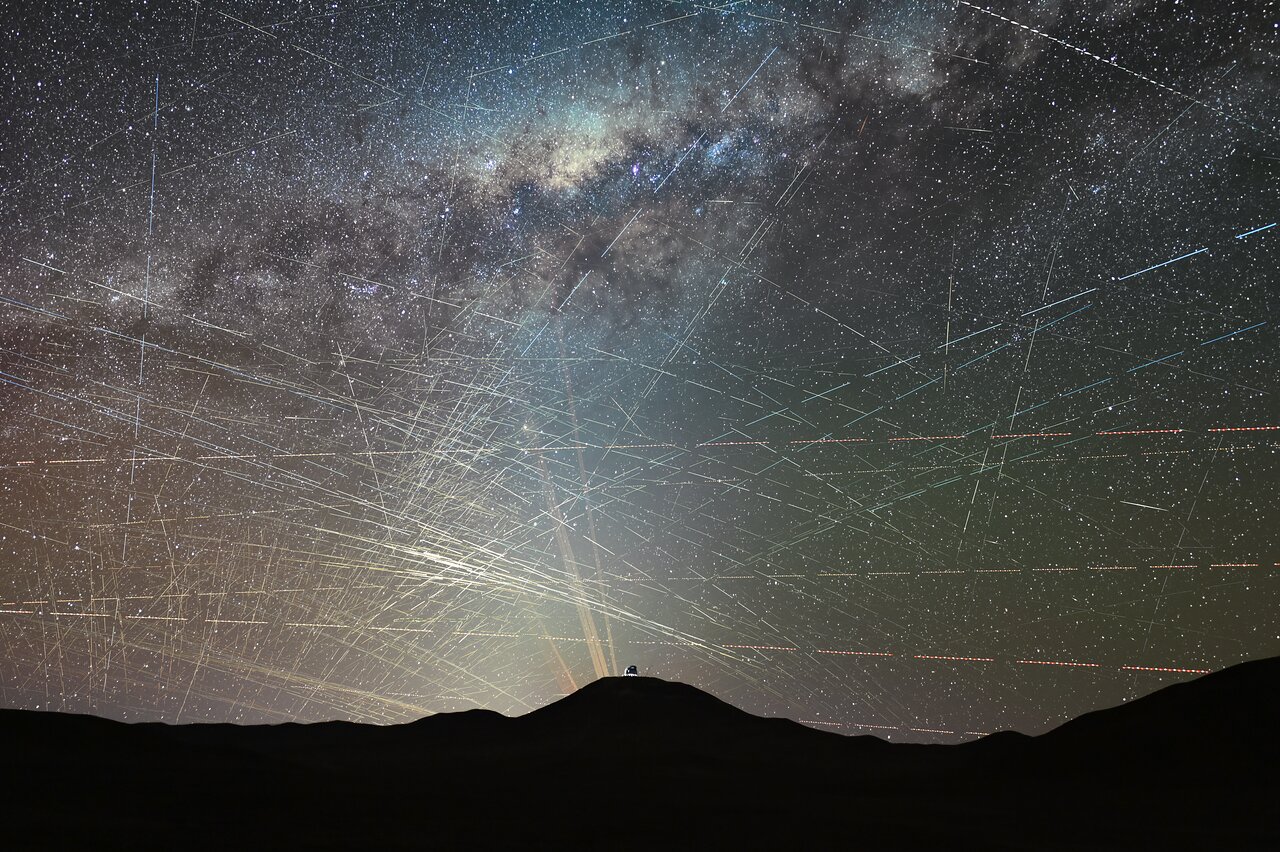
A new European Southern Observatory (ESO) study has found that current proposals to launch over 1.7 million satellites into orbit, including extremely bright ones, would have “devastating consequences for astronomy.” According to the study, no more than 100 000 faint satellites, below naked eye visibility, should orbit Earth, to safeguard our ability to observe the night sky with modern telescopes. The study is the first to compute the extent to which large and bright satellite constellations — which have also raised concerns about their impacts on health and the environment — would affect astronomical observations by making the night sky brighter.
Since 2019, the number of satellites orbiting Earth has increased rapidly, to over 14 000 today [1] — dominated by SpaceX's Starlink telecommunications satellites. Satellite proposals have also escalated, both in number and in potential impact. "Until now we have managed, but it's getting worse," stresses Olivier Hainaut, who has been involved in developing recommendations to mitigate the impact of satellite constellations on astronomy. While companies like SpaceX have taken measures to make their satellites less bright, current satellite proposals are going “beyond the limit” of what astronomy can withstand, he says. Hainaut, an astronomer at ESO for over 30 years, is the author of the peer-reviewed study on the impacts of satellite constellations accepted for publication in Astronomy & Astrophysics.
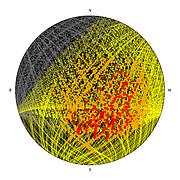
SpaceX plans to send one million more satellites into orbit, for space-based data centres, which would significantly alter the appearance of the sky. The new study shows that, for a large fraction of each night, hundreds of satellites would be visible and, at certain times, up to several thousand, similar to the number of stars seen with the naked eye in good conditions. Other planned satellite constellations such as E-Space's Cinnamon and China’s CTC-1 and 2 would add hundreds of thousands more satellites into orbit, compounding the problem.
Reflect Orbital, a US start-up, aims to launch a constellation of very large mirror-like satellites to provide sunlight at night, with reflected beams that span at least five kilometres on Earth's surface. They intend to start with a prototype satellite in orbit this year and plan to increase their satellite population to 50 000 by 2035. These satellites would be the brightest ever in orbit, with damaging consequences for dark skies on Earth. Hainaut's calculations show that the full constellation would fill the night sky with hundreds of very brightly visible satellites. Seen from within a reflected beam, the satellite delivering sunlight would appear four times brighter than the full Moon. Even if no satellite points its beam directly at an observer, each would be as bright as the planet Venus, the ‘morning star’. From a light-polluted city, like Munich, Germany, these hundreds of satellites would be the only ‘stars’ visible in the night sky.
These proposals, combined with others considered in the study, would dramatically brighten the night sky, hindering humankind’s ability to observe faint cosmic targets, including far-away galaxies, some Earth-like planets around other stars, and even asteroids potentially dangerous to Earth.
Bright trails and brighter skies
Hainaut explains that "satellites, illuminated by the Sun, are much brighter than distant galaxies. When a satellite crosses what we observe, it makes a bright streak on our image, zapping whatever is behind it."
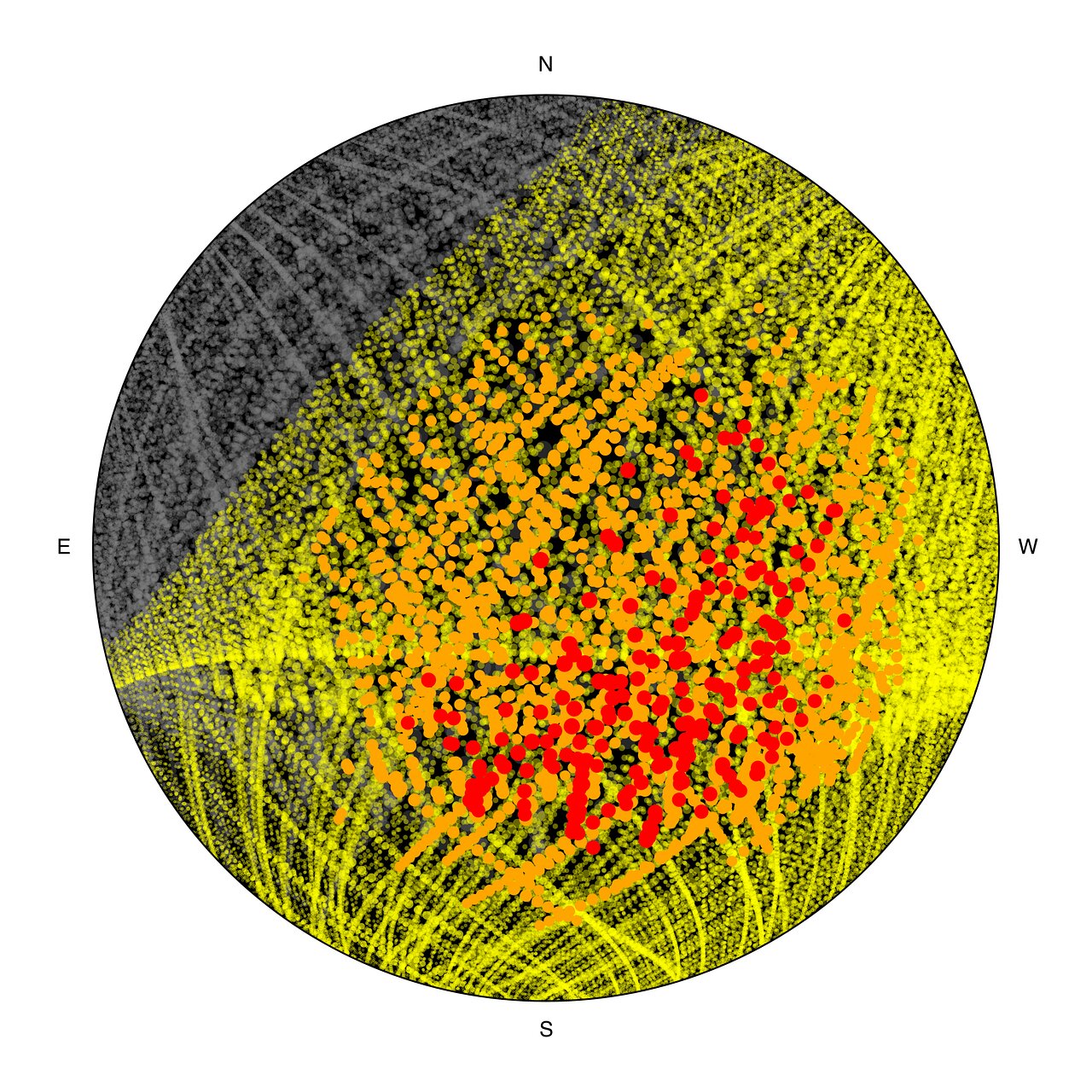
To compute the impact of this and other effects of satellite constellations on astronomical observations, Hainaut simulated the positions, motion and brightness of all present and planned satellite constellations.
For the SpaceX satellite mega-constellation, he found that dozens of trails would appear in each image taken two hours into the night with ESO’s Very Large Telescope (VLT) at Paranal Observatory in Chile, representing field-of-view losses of up to 28% [2]. This assumes that the satellites would be faint enough not to be seen with the naked eye in good conditions. If they are just a little brighter, some instruments would be even more affected: for instance, a camera like that of the US National Science Foundation’s Vera C. Rubin Observatory could have most of its images rendered unusable for several hours each night [3].
Hainaut's simulations assumed that no Reflect Orbital satellite would point its beam directly at or near an observatory. Even so, the trail from a single mirror-satellite could spoil an observation with a camera like that of Rubin Observatory. With the full fleet of Reflect Orbital satellites in orbit, every image from such a camera would be lost when the satellites are illuminated by the Sun.
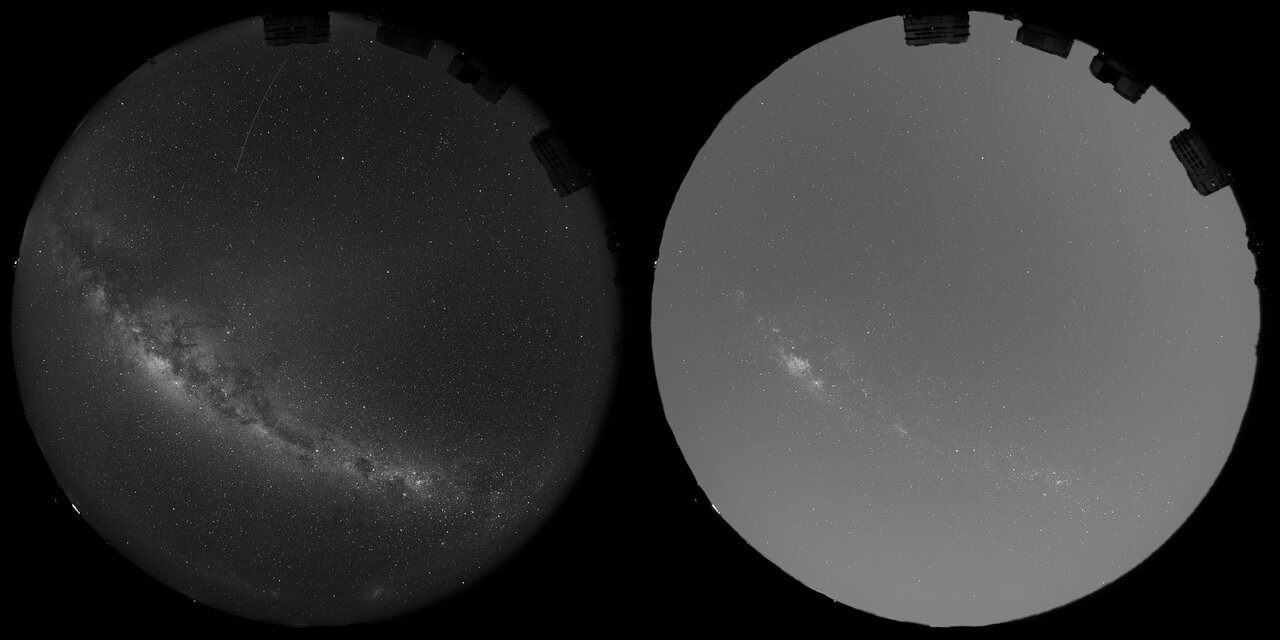
However, it's not just the criss-crossing paths of satellites that limit what we can observe: their light can pollute the entire sky. Satellites too faint to be seen directly produce a veil of ‘diffuse’ light, while light from brighter satellites is ‘scattered’ in all directions as it passes through the atmosphere. Both contributions increase the overall brightness of the night sky. This study is the first to consider the impacts on astronomy due to the contribution of satellite constellations to background sky brightness, revealing the full extent of satellite light pollution.
Very bright constellations like Reflect Orbital would have a particularly significant effect on background sky brightness. With the full 50 000 Reflect Orbital satellites, the sky would be up to three to four times brighter overall.
Limiting satellites to safeguard the night sky
Hainaut concludes that the proposed 1.7 million new satellites would have drastic consequences for ground-based astronomy. These impacts can only be avoided by limiting the total, of both existing and future satellites, to 100 000 satellites faint enough not to be seen with the naked eye from a dark site. “This is not a hard number, like 99 999 is good and 100 001 is bad: clearly I'd prefer 50 000,” says Hainaut. “But 100 000 causes losses at about the level of other technical losses, such as equipment failure.” However, he adds, the satellites must be fainter than visual magnitude 7 [4]; should some of them be too bright — above the minimum threshold for naked-eye visibility — the total number would need to be much lower.
SpaceX and Reflect Orbital, responsible for the most extreme new proposals, have each filed with the US Federal Communications Commission (FCC) for permission to launch. This new study served as the basis for a response to the FCC on these proposals by ESO, in collaboration with the UK’s Royal Astronomical Society and the International Astronomical Union.
“The FCC received over 1800 comments regarding Reflect Orbital and nearly 1500 comments on the application by SpaceX,” explains ESO Institutional Affairs Officer Betty Kioko, responsible for coordinating ESO’s response to the proposals. “The ball is now in the FCC’s court, and we wait to see the determinations they make on both filings. For optical astronomy, this is an existential threat, and we hope that the regulators will share that view.”
“Astronomy generates huge value for humankind, including scientific, technical, economical, and educational, and helps us understand our place in the Universe,” says ESO Director General Xavier Barcons. “The large number of planned satellites in low-Earth orbit challenges that capacity, underscoring the need to limit future satellite launches and for astronomers, engineers, satellite operators and other stakeholders to work together to adopt strict mitigation measures.”
"Sending thousands of satellites has implications: economical, ecological, and astronomical," adds Hainaut. Light pollution from very bright satellite constellations can impact the health and functioning of life on Earth, by disrupting biological clocks and ecosystems. Large constellations also have direct impacts on air quality from the numerous launches required to send and maintain thousands of satellites, as well as from the atmospheric pollution caused as they burn up on re-entry at the end of life. "My job is astronomy, so I quantify the effects on astronomy," explains Hainaut, "I hope others will evaluate the other impacts in their field of expertise."
Hainaut concludes: “Low Earth orbit is a celestial seashore that provides immense value to modern life, from global connectivity to our clear access to the Universe. However, we must manage the footprint of mega-constellations — from the light pollution affecting astronomy to the atmospheric effects of satellite re-entry — to ensure this resource remains pristine and accessible for future generations.”
[Edit: On Thursday 9 July, the FCC granted Reflect Orbital permission to deploy its demonstration satellite.]
Notes
[1] The number of satellites currently in orbit rises to 32 000 if dead satellites and debris are included.
[2] The instrument considered for the simulation is FORS2, the VLT workhorse, which is representative of traditional cameras on large telescopes.
[3] In cameras like the one on Rubin Observatory, with high-density, complex electronics, a satellite trail bright enough to saturate the detector causes not only a broad streak on an astronomical image, but also a series of ghost trails that multiply the losses and can potentially contaminate an entire image.
[4] A satellite below visual magnitude 7 ensures it does not saturate the detector of cameras like that of the Rubin Observatory. It also means, coincidentally, that satellites would be too faint to be viewed to the naked eye, even under pristine dark skies.
More information
This research was presented in a paper by Olivier Hainaut (European Southern Observatory, Germany) to appear in Astronomy & Astrophysics.
The European Southern Observatory (ESO) enables scientists worldwide to discover the secrets of the Universe for the benefit of all. We design, build and operate world-class observatories on the ground — which astronomers use to tackle exciting questions and spread the fascination of astronomy — and promote international collaboration for astronomy. Established as an intergovernmental organisation in 1962, today ESO is supported by 16 Member States (Austria, Belgium, Czechia, Denmark, France, Finland, Germany, Ireland, Italy, the Netherlands, Poland, Portugal, Spain, Sweden, Switzerland and the United Kingdom), along with the host state of Chile and with Australia as a Strategic Partner. ESO’s headquarters and its visitor centre and planetarium, the ESO Supernova, are located close to Munich in Germany, while the Chilean Atacama Desert, a marvellous place with unique conditions to observe the sky, hosts our telescopes. ESO operates three observing sites: La Silla, Paranal and Chajnantor. At Paranal, ESO operates the Very Large Telescope and its Very Large Telescope Interferometer, as well as survey telescopes such as VISTA. Also at Paranal, ESO will host and operate the south array of the Cherenkov Telescope Array Observatory, the world’s largest and most sensitive gamma-ray observatory. Together with international partners, ESO operates ALMA on Chajnantor, a facility that observes the skies in the millimetre and submillimetre range. At Cerro Armazones, near Paranal, we are building “the world’s biggest eye on the sky” — ESO’s Extremely Large Telescope. From our offices in Santiago, Chile we support our operations in the country and engage with Chilean partners and society.
Links
- Research paper
- Photos of the VLT
- For journalists: subscribe to receive our releases under embargo in your language
- For scientists: got a story? Pitch your research
Contacts
Olivier Hainaut
ESO Astronomer
Garching bei München, Germany
Tel: +49 89 3200 6754
Cell: +49 151 2262 0554
Email: ohainaut@eso.org
Beatrice (Betty) Kioko
ESO Institutional Affairs Officer
Garching bei München, Germany
Tel: +49 89 3200 6278
Email: beatrice.kioko@eso.org
Bárbara Ferreira
ESO Media Manager
Garching bei München, Germany
Tel: +49 89 3200 6670
Cell: +49 151 241 664 00
Email: press@eso.org
About the Release
| Release No.: | eso2607 |
| Type: | Unspecified : Sky Phenomenon : Night Sky : Trail : Satellite |
Images
Videos
Our use of Cookies
We use cookies that are essential for accessing our websites and using our services. We also use cookies to analyse, measure and improve our websites’ performance, to enable content sharing via social media and to display media content hosted on third-party platforms.
ESO Cookies Policy
The European Organisation for Astronomical Research in the Southern Hemisphere (ESO) is the pre-eminent intergovernmental science and technology organisation in astronomy. It carries out an ambitious programme focused on the design, construction and operation of powerful ground-based observing facilities for astronomy.
This Cookies Policy is intended to provide clarity by outlining the cookies used on the ESO public websites, their functions, the options you have for controlling them, and the ways you can contact us for additional details.
What are cookies?
Cookies are small pieces of data stored on your device by websites you visit. They serve various purposes, such as remembering login credentials and preferences and enhance your browsing experience.
Categories of cookies we use
Essential cookies (always active): These cookies are strictly necessary for the proper functioning of our website. Without these cookies, the website cannot operate correctly, and certain services, such as logging in or accessing secure areas, may not be available; because they are essential for the website’s operation, they cannot be disabled.
Functional Cookies: These cookies enhance your browsing experience by enabling additional features and personalization, such as remembering your preferences and settings. While not strictly necessary for the website to function, they improve usability and convenience; these cookies are only placed if you provide your consent.
Analytics cookies: These cookies collect information about how visitors interact with our website, such as which pages are visited most often and how users navigate the site. This data helps us improve website performance, optimize content, and enhance the user experience; these cookies are only placed if you provide your consent. We use the following analytics cookies.
Matomo Cookies:
This website uses Matomo (formerly Piwik), an open source software which enables the statistical analysis of website visits. Matomo uses cookies (text files) which are saved on your computer and which allow us to analyze how you use our website. The website user information generated by the cookies will only be saved on the servers of our IT Department. We use this information to analyze www.eso.org visits and to prepare reports on website activities. These data will not be disclosed to third parties.
On behalf of ESO, Matomo will use this information for the purpose of evaluating your use of the website, compiling reports on website activity and providing other services relating to website activity and internet usage.
Matomo cookies settings:
Additional Third-party cookies on ESO websites: some of our pages display content from external providers, e.g. YouTube.
Such third-party services are outside of ESO control and may, at any time, change their terms of service, use of cookies, etc.
YouTube: Some videos on the ESO website are embedded from ESO’s official YouTube channel. We have enabled YouTube’s privacy-enhanced mode, meaning that no cookies are set unless the user actively clicks on the video to play it. Additionally, in this mode, YouTube does not store any personally identifiable cookie data for embedded video playbacks. For more details, please refer to YouTube’s embedding videos information page.
Cookies can also be classified based on the following elements.
Regarding the domain, there are:
- First-party cookies, set by the website you are currently visiting. They are stored by the same domain that you are browsing and are used to enhance your experience on that site;
- Third-party cookies, set by a domain other than the one you are currently visiting.
As for their duration, cookies can be:
- Browser-session cookies, which are deleted when the user closes the browser;
- Stored cookies, which stay on the user's device for a predetermined period of time.
How to manage cookies
Cookie settings: You can modify your cookie choices for the ESO webpages at any time by clicking on the link Cookie settings at the bottom of any page.
In your browser: If you wish to delete cookies or instruct your browser to delete or block cookies by default, please visit the help pages of your browser:
Please be aware that if you delete or decline cookies, certain functionalities of our website may be not be available and your browsing experience may be affected.
You can set most browsers to prevent any cookies being placed on your device, but you may then have to manually adjust some preferences every time you visit a site/page. And some services and functionalities may not work properly at all (e.g. profile logging-in, shop check out).
Updates to the ESO Cookies Policy
The ESO Cookies Policy may be subject to future updates, which will be made available on this page.
Additional information
For any queries related to cookies, please contact: pdprATesoDOTorg.
As ESO public webpages are managed by our Department of Communication, your questions will be dealt with the support of the said Department.