Tiedote
BlueMUSE: ESO on allekirjoittanut sopimuksen VLT:n uudesta instrumentista
30. tammikuuta 2026
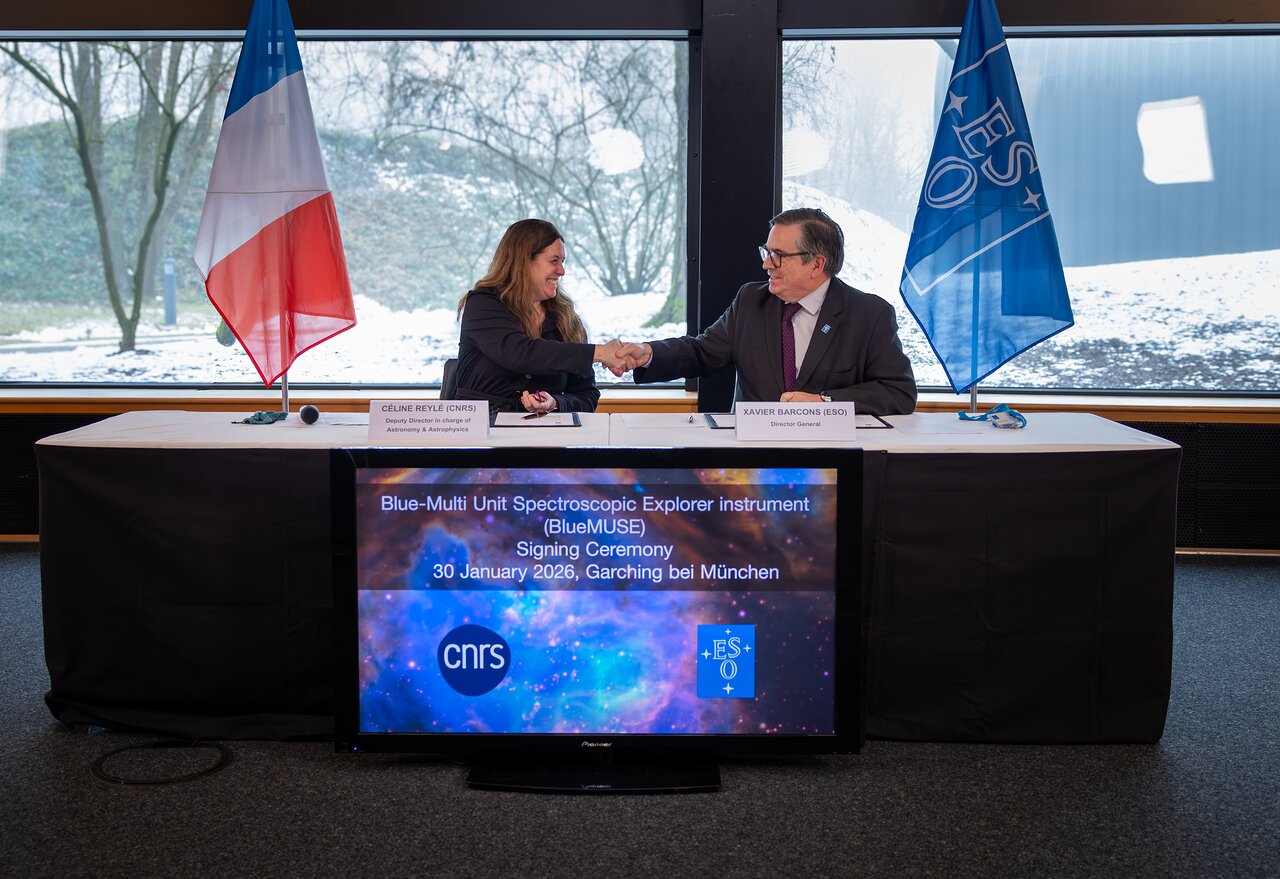
ESO on tänään allekirjoittanut sopimuksen Blue Multi Unit Spectroscopic Explorer, eli BlueMUSE-instrumentin rakentamisesta. Instrumentti asennetaan ESO:n Very Large Telescope, eli VLT-teleskooppiin. Sopimuksen allekirjoittaminen on merkittävä ensimmäinen vaihe BlueMUSE-instrumentin kehittämisessä, joka tulee antamaan tähtitieteilijöille uusia ja ainutlaatuisia tutkimusmahdollisuuksia. Laitteessa käytettävä edistynyt teknologia mahdollistaa yksityiskohtaiset havainnot galaksistamme, sekä se auttaa useiden eri kohteiden tutkimuksessa massiivisista tähdistä, sumuihin ja komeettoihin. Se mullistaa myös kaukaisen maailmankaikkeuden tutkimuksen, sillä se mahdollistaa galaksien välisessä avaruudessa olevan diffuusin aineen havaitsemisen, ja se auttaa meitä ymmärtämään, miten aine siellä liikkuu.
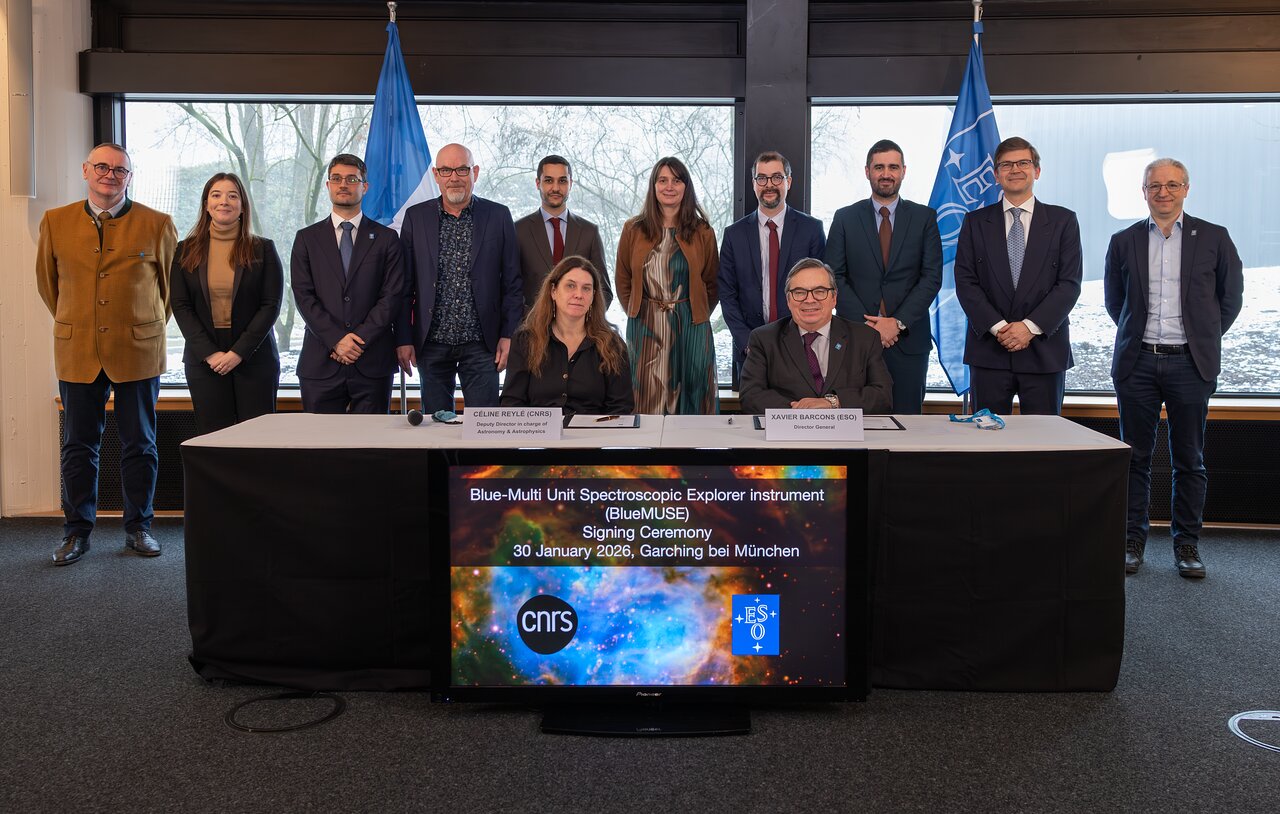
Aiemmin tänään ESO:n pääjohtaja Xavier Barcons ja Ranskan kansallisen tiedekeskuksen (CNRS) tähtitieteen ja astrofysiikan apulaisjohtaja Céline Reylé allekirjoittivat BlueMUSE-sopimuksen ESO:n päämajassa Garchingissa, Saksassa. CNRS:n Centre de Recherche Astrophysique de Lyon (CRAL – CNRS/ENS de Lyon/Claude Bernard Lyon 1 University) -instituutti johtaa laitteistokonsortiota, johon kuuluu useita instituutteja Euroopasta ja Australiasta. Tilaisuudessa mukana olivat myös Etelä-Saksan French Science and Higher Education Attaché Emmanuel Delille, BlueMUSE-hankkeen päätutkija Johan Richard ja projektipäällikkö Rémi Giroud, molemmat CRAL:sta. Mukana juhlistamassa instrumentin rakentamisen seuraavaa vaihetta oli myös muita ESO:n ja BlueMUSE-konsortion [1] arvohenkilöitä.
VLT:hen asennetun MUSE-instrumentissa käytetyn hyvin toimivaksi todetun teknologian pohjalta kehitetty BlueMUSE on integraalikenttäspektrografi (integral-field spectrograph). Se tulee ottamaan kohteista sekä 2D-kuvia (tai useista kohteista), että kohteesta tuleva valo voidaan jakaa jokaisessa pikselissä eri komponentteihin tai aallonpituuksiin, jolloin kuvasta saadaan täydellinen 3D-tietue sisältäen kohteesta valtavasti tietoa. Koska MUSE:sta on tullut yksi ESO:n tuottavimmista ja kysytyimmistä instrumenteista, tähtitieteen yhteisö on jo jonkin aikaa toivonut vastaavaa uutta instrumenttia, ja nyt siitä on tulossa totta.
Vaikka BlueMUSE muistuttaa monessa suhteessa MUSE-instrumenttia, se havaitsee lyhyempiä, eli sinisempiä aallonpituuksia. Myös laitteen spektrin resoluutio on parempi (eli se pystyy erottamaan eri aallonpituudet tarkemmin). Tämä tarkoittaa, että instrumentti täydentää erinomaisesti suuria maanpäälisiä ja avaruudessa olevia havaintolaitteita, kuten ESO:n tulevaa Extremely Large Telescope -teleskooppia ja James Webb Space Telescope -avaruusteleskooppia, jotka on optimoitu infrapuna-alueen havaintoihin.
BlueMUSEn odotetaan aloittavan toimintansa vuonna 2034, ja se tulee avaamaan uusia mahdollisuuksia tieteelle, joita MUSE ei pysty tarjoamaan. BlueMUSE tulee kartoittamaan Linnunradan ja naapurigalaksien massiivisia tähtiä laajemmin, mikä auttaa tähtien evoluutiota koskevien keskeisten kysymyksien selvittämisessä. Se pystyy myös havaitsemaan kaukaisempia himmeitä galakseja, sekä tähtipurkausgalakseja ja tutkimaan niiden äärimmäisiä tähtien muodostumisympäristöjä. BlueMUSE sopii myös erinomaisesti kaukaisen maailmankaikkeuden tutkimiseen, erityisesti galaksien välissä olevan hyvin harvan ja vaikeasti havaittavan aineen havaitsemiseen sekä ensimmäisten galaksijoukkojen syntymisen tutkimiseen.
Lisähuomiot
[1] Allekirjoitustilaisuudessa mukana olivat Karine Perraut (Ranskan ESO-neuvoston edustaja, Institut national des sciences de l’Univers (INSU), CNRS Earth & Space, Ranska), Florence Laurent (BlueMUSE-järjestelmäinsinööri, CNRS), Davor Krajnović (BlueMUSE-projektitutkija, Leibniz-Institut für Astrophysik Potsdam, Saksa) ja Alexandre Jeanneau (BlueMUSE optiikan pääinsinööri, CNRS).
ESO:sta Xavier Barconsin lisäksi tapahtumaan osallistuivat: Frédéric Derie (projektipäällikkö), Francesco Belfiore (projektitutkija), Reinhold Dorn (projekti-insinööri), Michele Cirasuolo (instrumentaatio-ohjelman johtaja), Suzanne Ramsay (instrumentaatio-ohjelman varajohtaja), Céline Péroux (ohjelmatutkija), Andrea Capardi (ohjelmakontrolleri), Enrico Marchetti (instrumenttiohjelman insinööri), Emanuela Ciattaglia (instrumenttiohjelman insinööri), Diogo Rio Fernandes (instrumenttiohjelman insinööri), Alain Delorme (sopimusten ja hankintojen vt. johtaja) ja Cyrielle Blanc (sopimus- ja hankinta-asiamies).
Lisätietoja
BlueMUSE-projektin toteutuksessa on mukana kansainvälinen konsortio, joka koostuu yhdeksästä eri maiden instituuteista, sekä EOS:sta.
Konsortioon kuuluu:
- Australia: Australian Astronomical Optics; Macquarien yliopisto
- Ranska: Centre de Recherche Astrophysique de Lyon (CRAL - CNRS/ENS de Lyon/Claude Bernard Lyon 1 University; lead); Astrophysique, Instrumentation & Modélisation (AIM – CEA/CNRS/ Université Paris Cité); Institut de Recherche sur les lois Fondamentales de l’Univers (CEA/Saclay)
- Saksa: Leibniz Institute for Astrophysics Potsdam (AIP) yhdessä Potsdamin yliopiston ja Göttingenin yliopiston kanssa
- Portugali: Institute of Astrophysics and Space Sciences
- Ruotsi: Department of Astronomy, Tukholman yliopisto
- Sveitsi: Observatoire astronomique de l’Université de Genève; Laboratory of Astrophysics, Ecole Polytechnique Fédérale de Lausanne (EPFL)
- Yhdistynyt kuningaskunta: Centre for Advanced Instrumentation and Centre for Extragalactic Astronomy, Physics Department, Durhamin yliopisto
Myös ESO osallistuu projektikehitykseen.
Linkit
Yhteystiedot
Bárbara Ferreira
ESO Media Manager
Garching bei München, Saksa
Puh.: +49 89 3200 6670
S-posti: press@eso.org
Tiedotteesta
| Tunnistus: | ann26001 |
Kuvat


Our use of Cookies
We use cookies that are essential for accessing our websites and using our services. We also use cookies to analyse, measure and improve our websites’ performance, to enable content sharing via social media and to display media content hosted on third-party platforms.
ESO Cookies Policy
The European Organisation for Astronomical Research in the Southern Hemisphere (ESO) is the pre-eminent intergovernmental science and technology organisation in astronomy. It carries out an ambitious programme focused on the design, construction and operation of powerful ground-based observing facilities for astronomy.
This Cookies Policy is intended to provide clarity by outlining the cookies used on the ESO public websites, their functions, the options you have for controlling them, and the ways you can contact us for additional details.
What are cookies?
Cookies are small pieces of data stored on your device by websites you visit. They serve various purposes, such as remembering login credentials and preferences and enhance your browsing experience.
Categories of cookies we use
Essential cookies (always active): These cookies are strictly necessary for the proper functioning of our website. Without these cookies, the website cannot operate correctly, and certain services, such as logging in or accessing secure areas, may not be available; because they are essential for the website’s operation, they cannot be disabled.
Functional Cookies: These cookies enhance your browsing experience by enabling additional features and personalization, such as remembering your preferences and settings. While not strictly necessary for the website to function, they improve usability and convenience; these cookies are only placed if you provide your consent.
Analytics cookies: These cookies collect information about how visitors interact with our website, such as which pages are visited most often and how users navigate the site. This data helps us improve website performance, optimize content, and enhance the user experience; these cookies are only placed if you provide your consent. We use the following analytics cookies.
Matomo Cookies:
This website uses Matomo (formerly Piwik), an open source software which enables the statistical analysis of website visits. Matomo uses cookies (text files) which are saved on your computer and which allow us to analyze how you use our website. The website user information generated by the cookies will only be saved on the servers of our IT Department. We use this information to analyze www.eso.org visits and to prepare reports on website activities. These data will not be disclosed to third parties.
On behalf of ESO, Matomo will use this information for the purpose of evaluating your use of the website, compiling reports on website activity and providing other services relating to website activity and internet usage.
Matomo cookies settings:
Additional Third-party cookies on ESO websites: some of our pages display content from external providers, e.g. YouTube.
Such third-party services are outside of ESO control and may, at any time, change their terms of service, use of cookies, etc.
YouTube: Some videos on the ESO website are embedded from ESO’s official YouTube channel. We have enabled YouTube’s privacy-enhanced mode, meaning that no cookies are set unless the user actively clicks on the video to play it. Additionally, in this mode, YouTube does not store any personally identifiable cookie data for embedded video playbacks. For more details, please refer to YouTube’s embedding videos information page.
Cookies can also be classified based on the following elements.
Regarding the domain, there are:
- First-party cookies, set by the website you are currently visiting. They are stored by the same domain that you are browsing and are used to enhance your experience on that site;
- Third-party cookies, set by a domain other than the one you are currently visiting.
As for their duration, cookies can be:
- Browser-session cookies, which are deleted when the user closes the browser;
- Stored cookies, which stay on the user's device for a predetermined period of time.
How to manage cookies
Cookie settings: You can modify your cookie choices for the ESO webpages at any time by clicking on the link Cookie settings at the bottom of any page.
In your browser: If you wish to delete cookies or instruct your browser to delete or block cookies by default, please visit the help pages of your browser:
Please be aware that if you delete or decline cookies, certain functionalities of our website may be not be available and your browsing experience may be affected.
You can set most browsers to prevent any cookies being placed on your device, but you may then have to manually adjust some preferences every time you visit a site/page. And some services and functionalities may not work properly at all (e.g. profile logging-in, shop check out).
Updates to the ESO Cookies Policy
The ESO Cookies Policy may be subject to future updates, which will be made available on this page.
Additional information
For any queries related to cookies, please contact: pdprATesoDOTorg.
As ESO public webpages are managed by our Department of Communication, your questions will be dealt with the support of the said Department.