Pressemeddelelse
Opdagelse af en ny 'exomåne' udfordrer navngivningen i astronomien
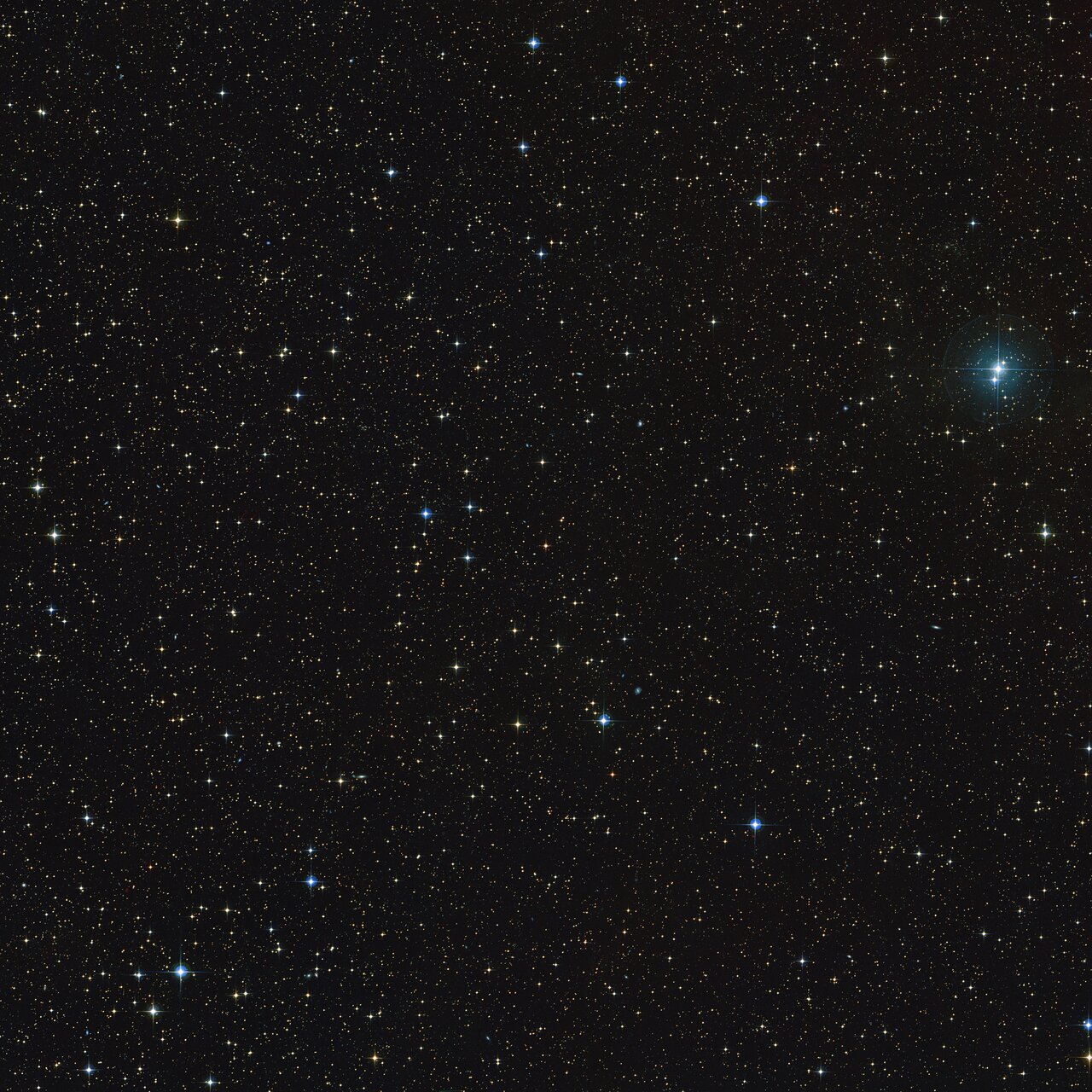
CD-35 2722, et system med en brun dværg og et månelignende objekt
22. juli 2026
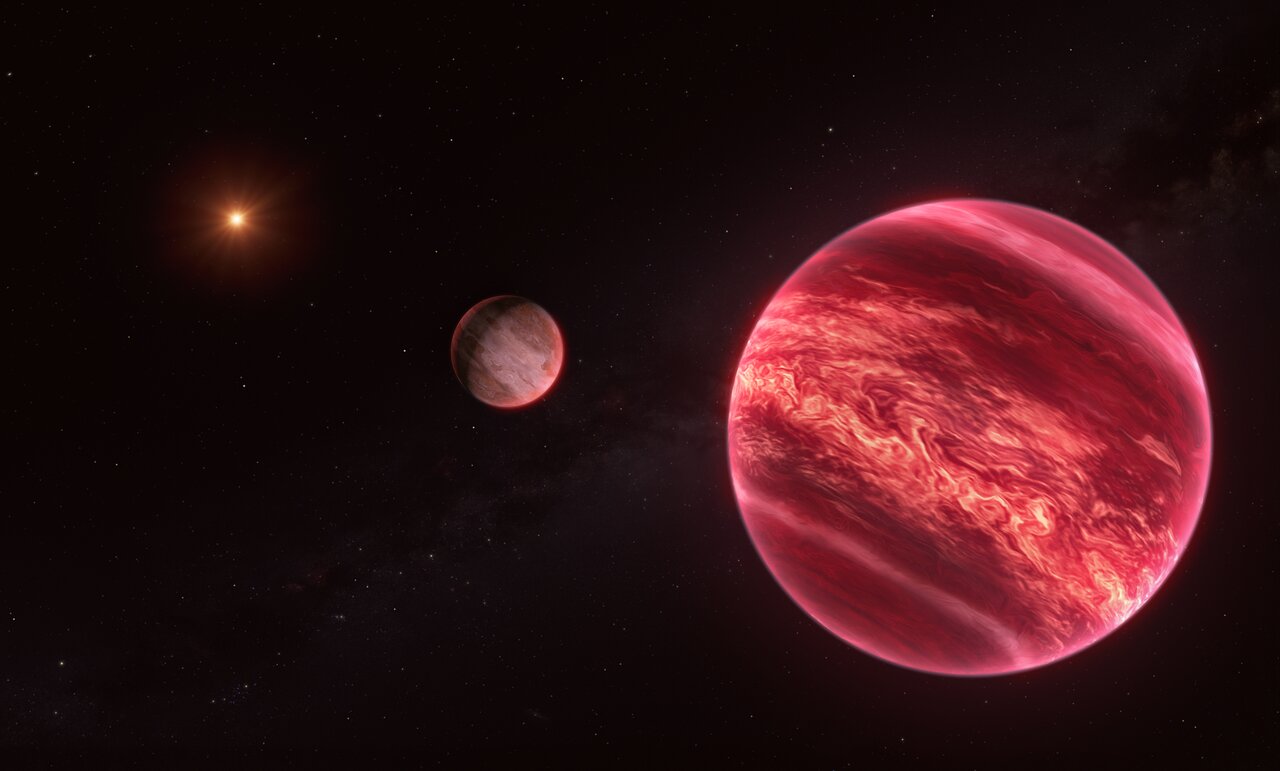
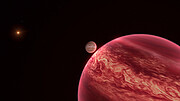
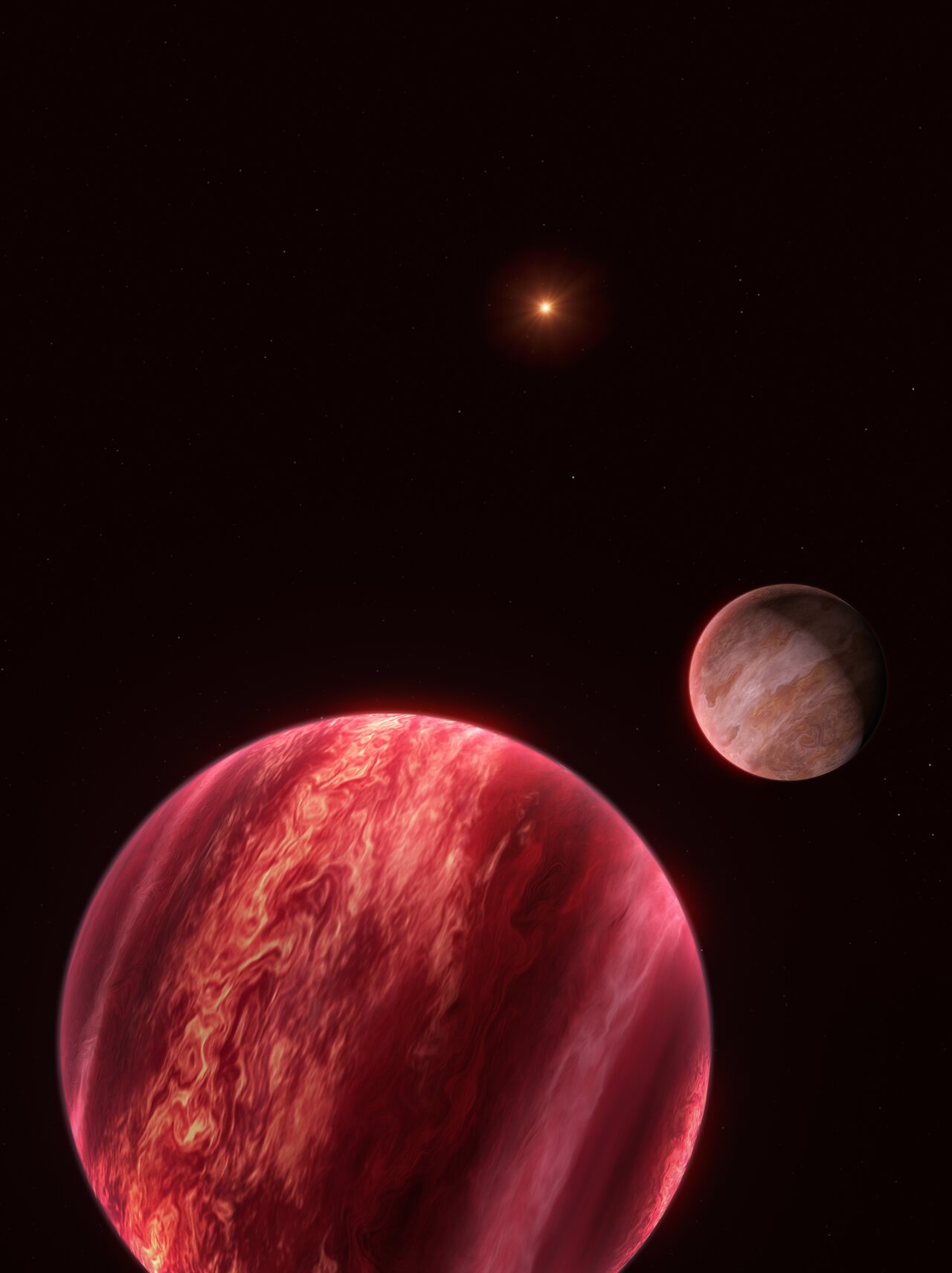
Observationer med European Southern Observatorys Very Large Telescope (ESOs VLT) har afsløret tegn på et månelignende objekt i stjernesystemet CD-35 2722. Til forskel fra månerne i vores Solsystem kredser det nyopdagede objekt ikke om en planet, og derfor er der opstået et problem med, hvad man skal kalden sådan en! I dette tilfælde kredser objektet om en brun dværg, altså en exoplanet, som selv kredser om stjernen CD-35 2722. Hvis opdagelsen bliver bekræftet, kan dette være den første 'måne', som er fundet udenfor vores Solsystem.
På grund af ferie følger oversættelsen til dansk af resten af denne pressemeddelelse snarest muligt / Ole JK
Kevin Hoy er ESO-student i Chile og hovedforfatter til en artikel, som offentliggøres i dag i tidsskriftet Nature. Han beskriver det system, som han har brugt måneder på at analysere som "super weird" sammenlignet med vores eget. Det største og tungeste objekt i dette unge stjernesystem er stjernen CD-35 2722, som vejer omkring halvdelen af Solens masse. Omkring stjernen kredser en brun dværg, som er et objekt, som er for tungt til at være en planet, men for let til at være en stjerne. Det nyopdagede objekt kredser så om denne brune dvært.
"Systemet her er noget svært at definere med de Solsystemsbaserede ord vi kender, såsom 'planet' og 'måne'," fastslår Hoy, som er tilknyttet Universidad Diego Portales og Millennium Nucleus of Young Exoplanets and their Moons (YEMS) i Chile. Det nye objekt, som forskerholdet kalder en exosatellit, er mindst så tungt som Jupiter, og den brune dværg er mere end 30 gange tungere end Jupiter. "Exosatellitten er tydeligvis tung nok til at være en planet, men den kredser jo ikke om en stjerne, men om et objekt, som så kredser om en stjerne," siger Hoy. "Når det nu er det tredje hjul i dette her system, ville vi gerne kalde det en måne, selvom det langt fra er som de små klippemåner, som vi kender i vores Solsystem."
Denne exosatellit eller 'exomåne', som er en naturlig satellit, som ikke tilhører vores Solsystem [1], er svær at sætte en etiket på, fordi situationen i det her system er så forskelligt fra vores egne. Alice Zurlo, som er leder af YEMS og medforfatter til artiklen, forklarer: "Den satellit, som vi fortæller om, er et kæmpe gaslegeme, som kredser om en meget massiv ledsager, som så igen er adskillige gange større end Jupiter."
"I Solsystemet har vi en klar afgrænsning imellem planeterne og Solen, så det er enkelt at definere sådan noget som en måne. I systemet CD-35 2722, hvor grænserne imellem stjerner, planeter og måner er mere uklare, bliver det mere kompliceret at beskrive sagerne," tilføjer Zurlo, som også er astrofysiker ved Universidad Diego Portales.
Uanset hvad man skal kalde objektet her, så har astronomerne prøvet at finde satellitter udenfor vores Solsystem i årevis, men der ikke nogen, som endnu er blevet fundet med sikkerhed. Selvom der er fundet mere end 6000 exoplaneter til dato, har man kun fundet nogle få exomåne-kandidater, og beviserne for dem er stadig mangelfulde. For blot få måneder siden rapporterede Quentin Kral om observationer med ESOs Very Large Telescope Interferometer i systemet HD 206893, som antyder en satellit, men der er ikke nogen sikker registrering endnu.
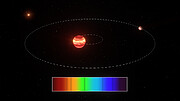
Til observationerne ved CD-35 2722 brugte Hoy, Zurlo og deres forskerhold instrumentet CRIRES+ på ESOs VLT, med den metode, som i sin tid blev brugt til at finde den første exoplanet i kredsløb om en sollignende stjerne. De brugte denne såkaldte radialhastighedsmetode til at måle små vrik i banen for den brune dværg, forårsaget af det objekt, som kredser om den, og de fandt, hvad holdet mener er stærke beviser for at denne 'måne' eksisterer. "Systemet her er, i al sin særhed, ganske unikt, og det vi har gjort er et gennembrud: den første sandsynlige opdagelse af en exosatellit," siger Zurlo.
Ud over, at det i sig selv er spændende at opdage nye slags objekter, så kan det at finde satellitter i andre planetsystemer hjælpe os til at forstå, hvor forskelligartet systemernes dannelse og udvikling kan være. Med en spejldiameter på 39 meter og nye og avancerede instrumenter, vil ESOs kommende Extremely Large Telescope (ELT) gøre det muligt for astronomerne at finde endnu mindre exomåner. Nye opdagelsesr med ELT vil få os til at genoverveje hvordan vi skal navngive planetobjekter i systemer, som er forskellige vore vores eget Solsystem.
Noter
[1] En satellit er et objekt, som kredser om et andet objekt, og det kan være naturligt (som vores egen Månen), eller kunstig (som de mange opsendte rumobjekter). En exosatellit er en satellit udenfor vores Solsystem. En exomåne anses almindeligvis for at være en naturlig satellit i kredsløb om en exoplanet eller et andet objekt udenfor Solsystemet, men der er endnu ikke nogen officielt anerkendt definition på en exomåne.
Mere information
Forskningsresultaterne her er offentliggjort i en artikel med titlen “Planetary-Mass Exosatellite Detected Around a Star’s Substellar Companion” i tidsskriftet Nature (doi:10.1038/s41586-026-10751-w).
Forskerholdet består af K. Hoy (Instituto de Estudios Astrofísicos, Facultad de Ingeniería y Ciencias, Universidad Diego Portales, Chile [Diego Portales]; European Southern Observatory, Chile [ESO Chile]; Millennium Nucleus on Young Exoplanets and their Moons, Chile [YEMS]), A. Zurlo (Diego Portales; YEMS), P. A. Peña R. (Diego Portales; Centro de Astrofísica y Tecnologías Afines, Chile [CATA]), J. Köhler (TLS Tautenburg, Tyskland), S. Desidera (INAF Osservatorio Astronomico di Padova, Italien [INAF Padova]), R. Gratton (INAF Padova), C. Lazzoni (INAF Padova; YEMS), S. Petrus (NASA Goddard Space Flight Center, USA; YEMS), F. Rodler (ESO Chile), J. Smoker (ESO Chile), V. D’Orazi (Department of Physics, University of Romer Tor Vergate, Italien; INAF Osservatorio Astronomico di Roma, Italien), I. Carleo (INAF Padova), I. Giovannini (Dipartimento di Fisica e Astronomia, Università degli Studi di Padova, Italien; Diego Portales; INAF Padova; YEMS).
Det europæiske Sydobservatorium (ESO) giver forskere Verden over mulighed for at opklare Universets hemmeligheder til glæde for os alle. Vi designer, bygger og driver jordbaserede observatorier i verdensklasse, og dem bruger astronomerne til at takle spændende spørgsmål og sprede begejstringen for astronomi, og til at fremme det internationale astronomiske samarbejde. ESO blev i 1962 stiftet som et fælles regeringsprojekt, og i dag er der 16 medlemstater (Belgien, Danmark, Finland, Frankrig, Irland, Italien, Nederlandene, Polen, Portugal, Spanien, Schweiz, Sverige, Tjekkiet, Tyskland, Det forenede Kongerige og Østrig), samt værtsnationen Chile og med Australien som strategisk partner. ESOs hovedkvarter og besøgscenter og planetarium; ESO Supernova befinder sig i Garching tæt ved München i Tyskland, og vore teleskoper befinder sig i Chiles Atacamaørken, hvor der der fantastiske muligheder for at observere himlen. ESO driver tre observatorieområder: La Silla, Paranal og Chajnantor. På Paranal driver ESO Very Large Telescope og det tilhørende Very Large Telescope Interferometer, og desuden oversigtsteleskoper som for eksempel VISTA. I Paranalområdet er ESO desuden vært og driftsansvarlig for den sydlige del af Cherenkov Telscope Array Observatory, som er Verdens største og mest følsomme gammastrålingsobservatorium. Sammen med en række internationale partnere driver ESO ALMA på Chajnantor. Det er et anlæg, som observerer himlen i millimeter- og submillimeterområdet. På Cerro Armazones nær ved Paranal bygger vi "Verdens største himmeløje" - ESOs Extremely Large Telescope. På vore kontorer i Santiago, Chile yder vi støttefunktioner i landet, og vi samarbejder med chilenske partnere og samfundet i sin helhed.
Links
- Hele forskningsartiklen
- Fotos af VLT
- Find ud af mere om ESOs Extremely Large Telescope på vores hjemmeside og press kit
- For journalister: du kan abonnere på vore pressemeddelelser under embargo og på dit eget sprog her
- For forskere: har du en god historie, så send os et tip
Kontakter
Kevin Hoy
European Southern Observatory (ESO) and Universidad Diego Portales
Santiago, Chile
E-mail: Kevin.Hoy@eso.org, kevin.hoy@mail.udp.cl
Alice Zurlo
Universidad Diego Portales
Santiago, Chile
Tel: +56 22138153
E-mail: alice.zurlo@mail.udp.cl
Bárbara Ferreira
ESO Media Manager
Garching bei München, Germany
Tel: +49 89 3200 6670
Mobil: +49 151 241 664 00
E-mail: press@eso.org
Ole J. Knudsen (Pressekontakt Danmark)
ESOs formidlingsnetværk
og Aarhus Space Centre, Aarhus Universitet
Aarhus, Danmark
Tel: +45 8715 5597
E-mail: eson-denmark@eso.org
Om pressemeddelelsen
| Pressemeddelelse nr.: | eso2610da |
| Navn: | CD-35 2722 |
| Type: | Milky Way : Planet : Satellite |
| Facility: | Very Large Telescope |
| Instruments: | CRIRES+ |
| Science data: | 2026Natur.655..865H |
Billeder
Videoer
Our use of Cookies
We use cookies that are essential for accessing our websites and using our services. We also use cookies to analyse, measure and improve our websites’ performance, to enable content sharing via social media and to display media content hosted on third-party platforms.
ESO Cookies Policy
The European Organisation for Astronomical Research in the Southern Hemisphere (ESO) is the pre-eminent intergovernmental science and technology organisation in astronomy. It carries out an ambitious programme focused on the design, construction and operation of powerful ground-based observing facilities for astronomy.
This Cookies Policy is intended to provide clarity by outlining the cookies used on the ESO public websites, their functions, the options you have for controlling them, and the ways you can contact us for additional details.
What are cookies?
Cookies are small pieces of data stored on your device by websites you visit. They serve various purposes, such as remembering login credentials and preferences and enhance your browsing experience.
Categories of cookies we use
Essential cookies (always active): These cookies are strictly necessary for the proper functioning of our website. Without these cookies, the website cannot operate correctly, and certain services, such as logging in or accessing secure areas, may not be available; because they are essential for the website’s operation, they cannot be disabled.
Functional Cookies: These cookies enhance your browsing experience by enabling additional features and personalization, such as remembering your preferences and settings. While not strictly necessary for the website to function, they improve usability and convenience; these cookies are only placed if you provide your consent.
Analytics cookies: These cookies collect information about how visitors interact with our website, such as which pages are visited most often and how users navigate the site. This data helps us improve website performance, optimize content, and enhance the user experience; these cookies are only placed if you provide your consent. We use the following analytics cookies.
Matomo Cookies:
This website uses Matomo (formerly Piwik), an open source software which enables the statistical analysis of website visits. Matomo uses cookies (text files) which are saved on your computer and which allow us to analyze how you use our website. The website user information generated by the cookies will only be saved on the servers of our IT Department. We use this information to analyze www.eso.org visits and to prepare reports on website activities. These data will not be disclosed to third parties.
On behalf of ESO, Matomo will use this information for the purpose of evaluating your use of the website, compiling reports on website activity and providing other services relating to website activity and internet usage.
Matomo cookies settings:
Additional Third-party cookies on ESO websites: some of our pages display content from external providers, e.g. YouTube.
Such third-party services are outside of ESO control and may, at any time, change their terms of service, use of cookies, etc.
YouTube: Some videos on the ESO website are embedded from ESO’s official YouTube channel. We have enabled YouTube’s privacy-enhanced mode, meaning that no cookies are set unless the user actively clicks on the video to play it. Additionally, in this mode, YouTube does not store any personally identifiable cookie data for embedded video playbacks. For more details, please refer to YouTube’s embedding videos information page.
Cookies can also be classified based on the following elements.
Regarding the domain, there are:
- First-party cookies, set by the website you are currently visiting. They are stored by the same domain that you are browsing and are used to enhance your experience on that site;
- Third-party cookies, set by a domain other than the one you are currently visiting.
As for their duration, cookies can be:
- Browser-session cookies, which are deleted when the user closes the browser;
- Stored cookies, which stay on the user's device for a predetermined period of time.
How to manage cookies
Cookie settings: You can modify your cookie choices for the ESO webpages at any time by clicking on the link Cookie settings at the bottom of any page.
In your browser: If you wish to delete cookies or instruct your browser to delete or block cookies by default, please visit the help pages of your browser:
Please be aware that if you delete or decline cookies, certain functionalities of our website may be not be available and your browsing experience may be affected.
You can set most browsers to prevent any cookies being placed on your device, but you may then have to manually adjust some preferences every time you visit a site/page. And some services and functionalities may not work properly at all (e.g. profile logging-in, shop check out).
Updates to the ESO Cookies Policy
The ESO Cookies Policy may be subject to future updates, which will be made available on this page.
Additional information
For any queries related to cookies, please contact: pdprATesoDOTorg.
As ESO public webpages are managed by our Department of Communication, your questions will be dealt with the support of the said Department.